Qatar Deodorants and Anti-Perspirant Products Market Summary
The qatar deodorants and anti-perspirant products market was estimated at USD 453 Million in 2025 and is projected to reach USD 641 Million by 2032, growing at a CAGR of 6.0% from 2026 to 2032.
Qatar Deodorants and Anti-Perspirant Products Market Year-wise Growth Rate and Key Drivers
This graph highlights how the Qatar Deodorants and Anti-Perspirant Products Market has steadily grown over the past five years, supported by major growth factors.
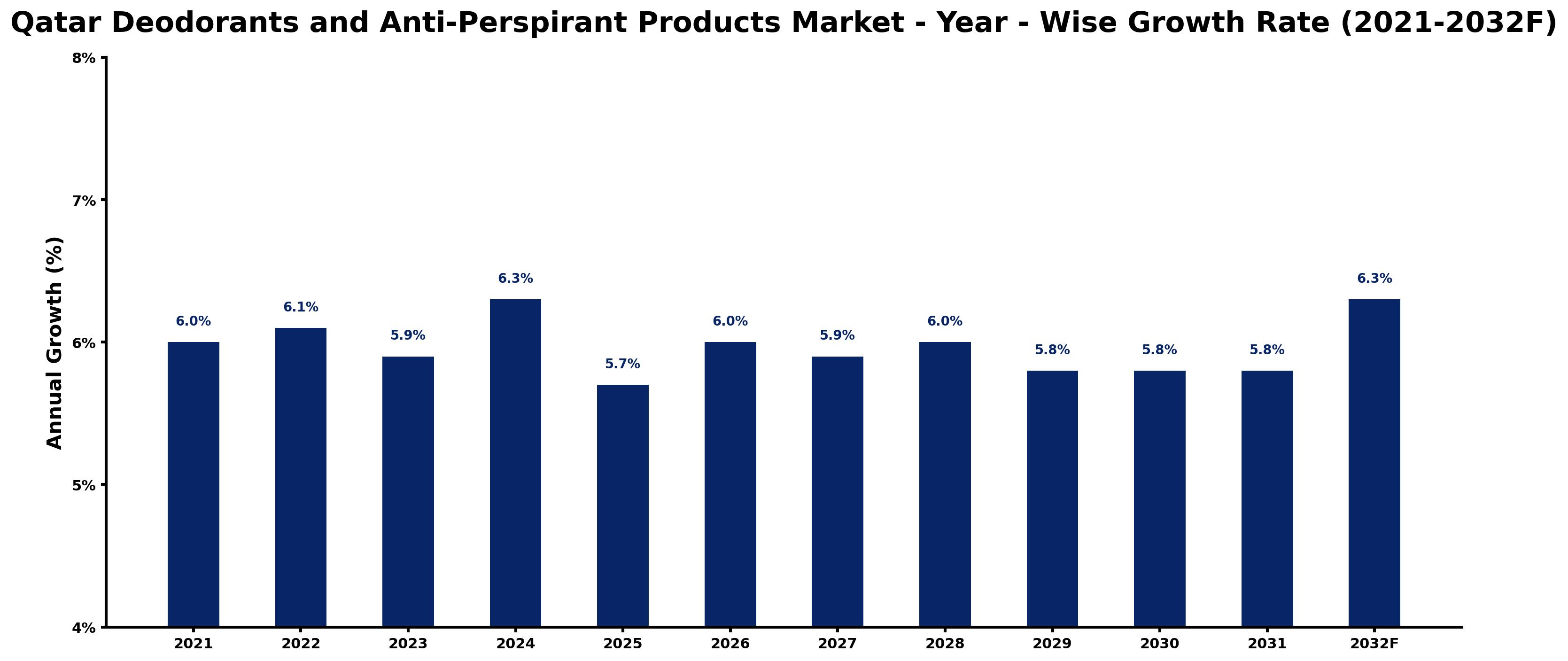
The table below presents the year wise growth rates along with the key drivers influencing the market
| Year | Growth Rate | Major Drivers |
| 2021 | 6.0% | Post-lockdown retail projects in Qatar sparked interest in personal care products. |
| 2022 | 6.1% | An influx of expatriates created diverse consumer preferences for deodorant varieties. |
| 2023 | 5.9% | Localized manufacturing initiatives began addressing the unique climatic needs of consumers. |
| 2024 | 6.3% | Sustainability trends pushed brands to innovate with eco-friendly deodorant formulations. |
| 2025 | 5.7% | E-commerce platforms expanded, offering convenient purchasing options for consumers. |
| 2026 | 6.0% | Increased awareness of health and wellness shifted focus towards natural anti-perspirants. |
| 2027 | 5.9% | Brand loyalty strengthened as companies tailored products to meet local cultural preferences. |
| 2028 | 6.0% | Partnerships with regional retailers enhanced product visibility and accessibility in stores. |
| 2029 | 5.8% | Youth demographics increasingly influenced market trends and product innovation strategies. |
| 2030 | 5.8% | Premiumization trends emerged, with consumers willing to pay more for quality products. |
| 2031 | 5.8% | Technological advancements led to more effective and longer-lasting formulations in products. |
| 2032 | 6.3% | Cultural events and festivals drove temporary spikes in deodorant and anti-perspirant sales. |
Note - Market size estimations and growth projections presented in this report are based on 6Wresearch's advanced forecasting approach, validated with industry datasets as of June 2026.
Qatar Deodorants and Anti-Perspirant Products Market Synopsis
The Qatar Deodorants and Anti-Perspirant Products Market is projected to reach 6.0% and witness significant growth during the forecast period (2026-2032). Qatar, a prosperous Arab nation in the Middle East, has cultivated a robust economy characterized by a high per capita income and substantial oil reserves. These economic advantages have fostered a booming tourism sector, drawing visitors to its stunning beaches and favorable climate. This environment has catalyzed an increasing demand for deodorants and anti-perspirant products as consumers seek effective solutions to maintain freshness and an appealing scent during their daily activities.
Qatar Deodorants and Anti-Perspirant Products Market Growth Drivers
Several key factors are propelling the growth of the Qatar deodorants and anti-perspirant products market. The primary driver is the rising demand for personal care items among consumers, which reflects a growing awareness of hygiene and grooming. Increasing disposable incomes enable consumers to spend more on quality products, further fueling market expansion. Additionally, manufacturers are leveraging diverse marketing strategies to promote their products, broadening their reach within the market. The consumer trend favoring natural ingredients has led to an increasing demand for innovative formulations that incorporate such components.
- Rising disposable income among consumers has enhanced their purchasing power, allowing for greater expenditure on personal care products.
- Increased consumer awareness regarding hygiene and grooming practices has shifted preferences towards high-quality deodorants and anti-perspirants.
- Manufacturers are actively adopting advanced marketing tactics to attract a wider customer base, including digital marketing and influencer collaborations.
- The inclination towards products formulated with natural ingredients is encouraging manufacturers to innovate and offer sustainable solutions.
- Expanding retail channels, including e-commerce platforms, are facilitating easier access to a variety of deodorant and anti-perspirant products.
Qatar Deodorants and Anti-Perspirant Products Market Challenges and Restraints
Despite the favorable market conditions, several challenges impede the growth of the Qatar deodorants and anti-perspirant products market. The high prices of these products in the region pose a significant barrier, limiting access for certain consumer demographics. Many individuals exhibit a strong preference for natural ingredients; however, the market is currently constrained by limited options due to strict import/export regulations within Qatar. Additionally, cultural norms can influence consumer behavior, particularly among male demographics, where the use of fragrances and perfumed products may be less accepted.
- High product pricing renders deodorants and anti-perspirants less accessible to segments of the population, hindering market penetration.
- The demand for natural ingredient-based products is not met with sufficient supply, stifling consumer choice and market innovation.
- Cultural perceptions regarding male fragrance use may restrict the market potential and limit targeted marketing efforts.
- Import restrictions on certain ingredients could delay the introduction of innovative product lines that meet consumer preferences.
- Economic fluctuations can impact consumer spending habits, which may lead to inconsistent sales of deodorants and anti-perspirants.
Qatar Deodorants and Anti-Perspirant Products Market Government Investment and Initiatives
The Qatari government's strategic focus on economic diversification is reflected in various initiatives that indirectly benefit the deodorants and anti-perspirants market. Government policies aimed at enhancing the local manufacturing sector encourage investments in personal care product production, fostering a more self-sufficient market. Additionally, efforts to strengthen tourism infrastructure can lead to increased consumer footfall and higher disposable incomes, further boosting demand for personal care items. Incentives aimed at promoting sustainable practices are also expected to encourage companies to develop environmentally friendly products.
Qatar Deodorants and Anti-Perspirant Products Market Latest Developments (May 2025 - June 2026)
The period from May 2025 to June 2026 has witnessed notable developments in the Qatar deodorants and anti-perspirants market, shaped significantly by evolving consumer preferences and industry responses. Manufacturers have introduced several innovative product lines that emphasize natural ingredients, addressing the rising demand for eco-friendly options. Moreover, marketing campaigns have intensified, particularly through digital channels, to engage younger demographics increasingly concerned about personal grooming. Leveraging consumer insights, brands are tailoring their products to meet specific local needs, thereby invigorating the market landscape.
Qatar Deodorants and Anti-Perspirant Products Market - Key Attractiveness of the Report
- 10 Years of Market Numbers
- Historical Data Starting from 2022 to 2025
- Base Year: 2025
- Forecast Data until 2032
- Key Performance Indicators Impacting the Market
- Major Upcoming Developments and Projects
Key Highlights of the Report:
- Qatar Deodorants and Anti-Perspirant Products Market Outlook
- Market Size of Qatar Deodorants and Anti-Perspirant Products Market, 2025
- Forecast of Qatar Deodorants and Anti-Perspirant Products Market, 2032
- Historical Data and Forecast of Qatar Deodorants and Anti-Perspirant Products Revenues & Volume for the Period 2022-2032F
- Qatar Deodorants and Anti-Perspirant Products Market Trend Evolution
- Qatar Deodorants and Anti-Perspirant Products Market Drivers and Challenges
- Qatar Deodorants and Anti-Perspirant Products Price Trends
- Qatar Deodorants and Anti-Perspirant Products Porter's Five Forces
- Qatar Deodorants and Anti-Perspirant Products Industry Life Cycle
- Historical Data and Forecast of Qatar Deodorants and Anti-Perspirant Products Market Revenues & Volume By Function for the Period 2022-2032F
- Historical Data and Forecast of Qatar Deodorants and Anti-Perspirant Products Market Revenues & Volume By Aerosol Spray for the Period 2022-2032F
- Historical Data and Forecast of Qatar Deodorants and Anti-Perspirant Products Market Revenues & Volume By Cream for the Period 2022-2032F
- Historical Data and Forecast of Qatar Deodorants and Anti-Perspirant Products Market Revenues & Volume By Roll-On for the Period 2022-2032F
- Historical Data and Forecast of Qatar Deodorants and Anti-Perspirant Products Market Revenues & Volume By Gel for the Period 2022-2032F
- Historical Data and Forecast of Qatar Deodorants and Anti-Perspirant Products Market Revenues & Volume By Ingredient for the Period 2022-2032F
- Historical Data and Forecast of Qatar Deodorants and Anti-Perspirant Products Market Revenues & Volume By Alcohol for the Period 2022-2032F
- Historical Data and Forecast of Qatar Deodorants and Anti-Perspirant Products Market Revenues & Volume By Antimicrobials for the Period 2022-2032F
- Historical Data and Forecast of Qatar Deodorants and Anti-Perspirant Products Market Revenues & Volume By Conditioner and Moisturizer for the Period 2022-2032F
- Historical Data and Forecast of Qatar Deodorants and Anti-Perspirant Products Market Revenues & Volume By Fragrances for the Period 2022-2032F
- Historical Data and Forecast of Qatar Deodorants and Anti-Perspirant Products Market Revenues & Volume By Paraben and Propellants for the Period 2022-2032F
- Historical Data and Forecast of Qatar Deodorants and Anti-Perspirant Products Market Revenues & Volume By Others for the Period 2022-2032F
- Qatar Deodorants and Anti-Perspirant Products Import Export Trade Statistics
- Market Opportunity Assessment By Function
- Market Opportunity Assessment By Ingredient
- Qatar Deodorants and Anti-Perspirant Products Top Companies Market Share
- Qatar Deodorants and Anti-Perspirant Products Competitive Benchmarking By Technical and Operational Parameters
- Qatar Deodorants and Anti-Perspirant Products Company Profiles
- Qatar Deodorants and Anti-Perspirant Products Key Strategic Recommendations






































