Qatar Edible Beans Market Size, Share & Growth Rate
The Qatar Edible Beans Market was estimated at USD 269 Million in 2025 and is projected to reach USD 352 Million by 2032, growing at a CAGR of 3.9% from 2026 to 2032. This growth trajectory is primarily fueled by shifting dietary patterns towards healthier, plant-based foods and an increasing local population that embraces a diverse culinary landscape featuring edible beans. Furthermore, the enhanced focus on food security initiatives in Qatar is anticipated to bolster both local production and consumption of these nutritious legumes.
Qatar Edible Beans Market Year-wise Growth Rate and Key Drivers
This graph highlights how the Qatar Edible Beans Market has steadily grown over the years, supported by major growth factors.
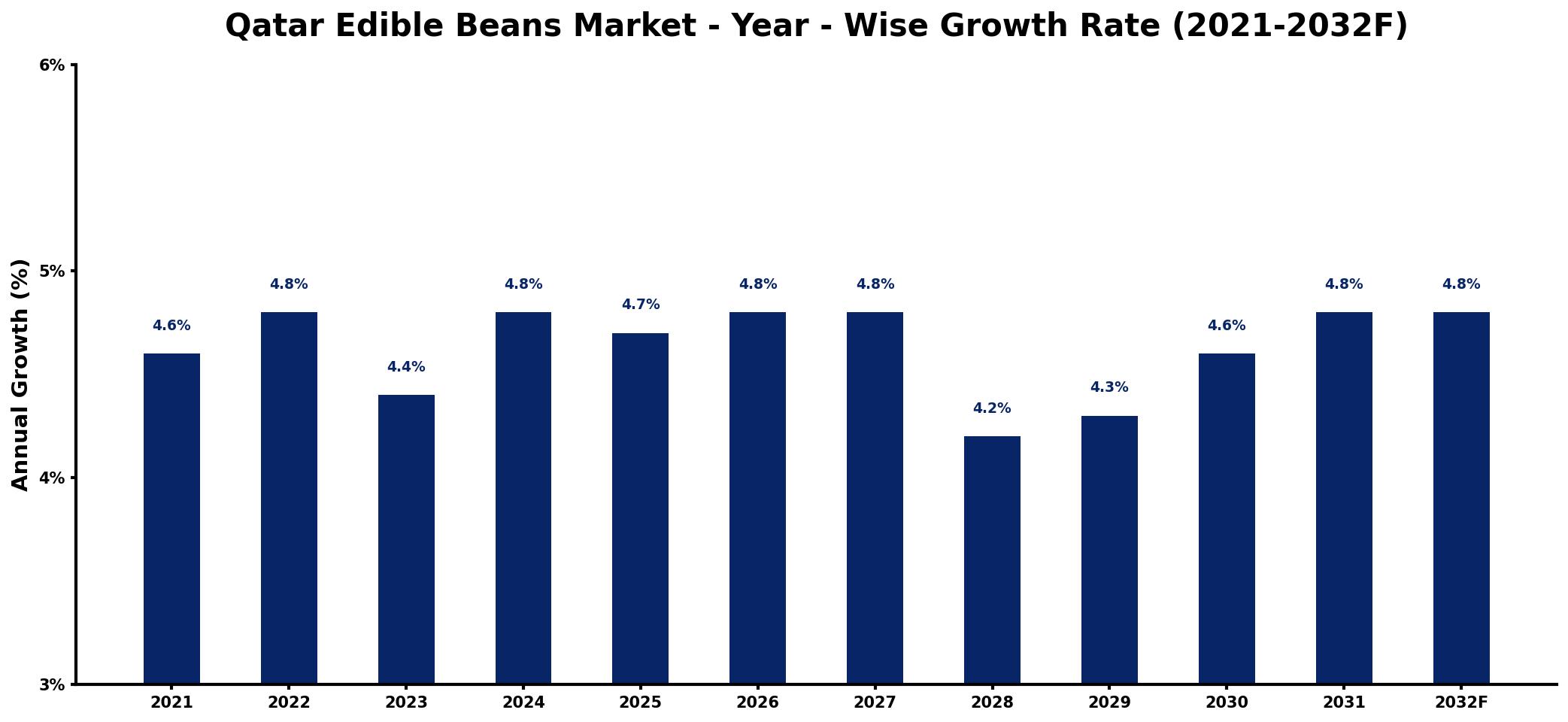
The table below presents the year‑wise growth rates along with the key drivers influencing the market
| Year | Growth Rate | Major Drivers |
| 2021 | 4.6% | Growing health consciousness among consumers |
| 2022 | 4.8% | Rising population and urbanization trends |
| 2023 | 4.4% | Increased demand for plant-based proteins |
| 2024 | 4.8% | Expansion of food processing facilities |
| 2025 | 4.7% | Surge in local farming initiatives |
| 2026 | 4.8% | Higher export opportunities in region |
| 2027 | 4.8% | Investment in sustainable agriculture practices |
| 2028 | 4.2% | Emergence of innovative food products |
| 2029 | 4.3% | Strengthening supply chain efficiencies |
| 2030 | 4.6% | Increased awareness of dietary benefits |
| 2031 | 4.8% | Boost in retail distribution channels |
| 2032 | 4.8% | Growing interest in organic products |
Note: Market size estimations and growth projections presented in this report are based on 6Wresearch's proprietary forecasting methodology, utilizing the latest available industry data, government publications, and primary research inputs.
Qatar Edible Beans Market Synopsis
Currently, the Qatar edible beans market is on an upward trend, marked by a steady rise in demand for various bean varieties such as kidney beans, chickpeas, and lentils. The increased awareness of the nutritional benefits of beans has led to a surge in consumer interest, positioning edible beans as essential components of modern diets.
In tandem with this growth is the rising influx of expatriates in Qatar, who often bring diverse culinary preferences that favor bean-based dishes. The government's commitment to food security and sustainable agricultural practices further strengthens the market's foundation, enhancing local production and reducing reliance on imports.
Qatar Edible Beans Market Key Takeaways
- The market is thriving due to increased health consciousness among consumers, leading to higher consumption of beans.
- Qatar's growing expatriate population is expanding the demand for diverse bean varieties in the culinary landscape.
- Government initiatives aimed at food security and local production are likely to stimulate market growth.
- Innovative bean-based product development is emerging as a key driver of expansion in the market.
- Despite a solid growth outlook, the market remains challenged by reliance on imported beans.
Evaluation of Restraints in Qatar Edible Beans Market
Despite its promising growth potential, the Qatar edible beans market faces significant challenges, notably its heavy dependence on imports to satisfy domestic demand. This reliance exposes the market to the volatility of global agricultural prices and potential disruptions in supply chains, which can adversely affect availability and pricing. To overcome these barriers, there is a pressing need for strategies that bolster local cultivation capabilities and enhance supply chain resilience, ensuring that the market can respond effectively to both domestic and international pressures.
Qatar Edible Beans Market Trends
Several trends are currently shaping the Qatar edible beans market. The rise in plant-based diets among health-conscious consumers has led to an increase in bean consumption as an alternative protein source. Additionally, there is a notable trend toward the introduction of innovative products such as bean-based snacks and ready-to-eat meals that cater to the busy lifestyles of consumers. Moreover, sustainability has become a significant focus, with brands prioritizing environmentally friendly sourcing and production processes to meet the demands of conscientious consumers.
Qatar Edible Beans Market Opportunities
Opportunities for growth in the Qatar edible beans market lie primarily in the expansion of local agricultural initiatives aimed at boosting self-sufficiency. Investing in modern farming techniques and technologies can enhance productivity and quality, enabling local players to compete with imported products. Furthermore, the increasing interest in value-added products presents an avenue for innovation, allowing businesses to capitalize on consumer trends while meeting the demand for healthy and convenient food options.
Government Initiatives in the Qatar Edible Beans Market
The Qatari government is actively promoting food security as part of its national strategy, encouraging local agricultural production to reduce reliance on imports. Initiatives include funding for research in sustainable agricultural practices, as well as programs aimed at training farmers and increasing crop yields. Additionally, public investments are being channeled into infrastructure that supports the distribution and processing of locally grown beans, thereby enhancing their availability and market reach.
Future Insights of the Qatar Edible Beans Market
Looking ahead to 2026-2032, the Qatar edible beans market is poised for sustained growth driven by evolving dietary trends and strategic government interventions. With an increasing focus on food security and local sourcing, the market is expected to witness a broader array of innovative products and offerings. The growing interest in health and nutrition is likely to further amplify bean consumption, making it an integral part of Qatar's evolving food landscape.
Qatar Edible Beans Market Latest Developments (2025 - 2026)
In the recent months, the Qatar edible beans market has seen a notable shift towards innovation, with new product lines emerging that cater to health-conscious consumers seeking convenience and variety. Additionally, collaborations between local farms and businesses are becoming more prevalent, enhancing the supply chain and local bean production capabilities. The focus on sustainable sourcing is also gaining momentum, with brands increasingly promoting their eco-friendly practices to align with consumer preferences.
Qatar Edible Beans Market - Key Attractiveness of the Report
- 10 Years of Market Numbers
- Historical Data Starting from 2022 to 2025
- Base Year: 2025
- Forecast Data until 2032
- Key Performance Indicators Impacting the Market
- Major Upcoming Developments and Projects
Key Highlights of the Report:
- Qatar Edible Beans Market Outlook
- Market Size of Qatar Edible Beans Market, 2025
- Forecast of Qatar Edible Beans Market, 2032
- Historical Data and Forecast of Qatar Edible Beans Revenues & Volume for the Period 2022-2032F
- Qatar Edible Beans Market Trend Evolution
- Qatar Edible Beans Market Drivers and Challenges
- Qatar Edible Beans Price Trends
- Qatar Edible Beans Porter's Five Forces
- Qatar Edible Beans Industry Life Cycle
- Historical Data and Forecast of Qatar Edible Beans Market Revenues & Volume By Product Type for the Period 2022-2032F
- Historical Data and Forecast of Qatar Edible Beans Market Revenues & Volume By Pinto Beans for the Period 2022-2032F
- Historical Data and Forecast of Qatar Edible Beans Market Revenues & Volume By Navy Beans for the Period 2022-2032F
- Historical Data and Forecast of Qatar Edible Beans Market Revenues & Volume By Great Northern Beans for the Period 2022-2032F
- Historical Data and Forecast of Qatar Edible Beans Market Revenues & Volume By Red Kidney Beans for the Period 2022-2032F
- Historical Data and Forecast of Qatar Edible Beans Market Revenues & Volume By Black Beans for the Period 2022-2032F
- Historical Data and Forecast of Qatar Edible Beans Market Revenues & Volume By Yellow Beans for the Period 2022-2032F
- Historical Data and Forecast of Qatar Edible Beans Market Revenues & Volume By Others for the Period 2022-2032F
- Historical Data and Forecast of Qatar Edible Beans Market Revenues & Volume By Distribution Channel for the Period 2022-2032F
- Historical Data and Forecast of Qatar Edible Beans Market Revenues & Volume By Supermarket/Hypermarket for the Period 2022-2032F
- Historical Data and Forecast of Qatar Edible Beans Market Revenues & Volume By Online Stores for the Period 2022-2032F
- Historical Data and Forecast of Qatar Edible Beans Market Revenues & Volume By Specialty Stores for the Period 2022-2032F
- Historical Data and Forecast of Qatar Edible Beans Market Revenues & Volume By Other for the Period 2022-2032F
- Historical Data and Forecast of Qatar Edible Beans Market Revenues & Volume By Application for the Period 2022-2032F
- Historical Data and Forecast of Qatar Edible Beans Market Revenues & Volume By Household for the Period 2022-2032F
- Historical Data and Forecast of Qatar Edible Beans Market Revenues & Volume By Restaurants for the Period 2022-2032F
- Historical Data and Forecast of Qatar Edible Beans Market Revenues & Volume By Others for the Period 2022-2032F
- Qatar Edible Beans Import Export Trade Statistics
- Market Opportunity Assessment By Product Type
- Market Opportunity Assessment By Distribution Channel
- Market Opportunity Assessment By Application
- Qatar Edible Beans Top Companies Market Share
- Qatar Edible Beans Competitive Benchmarking By Technical and Operational Parameters
- Qatar Edible Beans Company Profiles
- Qatar Edible Beans Key Strategic Recommendations






































