Brazil Edible Beans Market Top 5 Importing Countries and Market Competition (HHI) Analysis
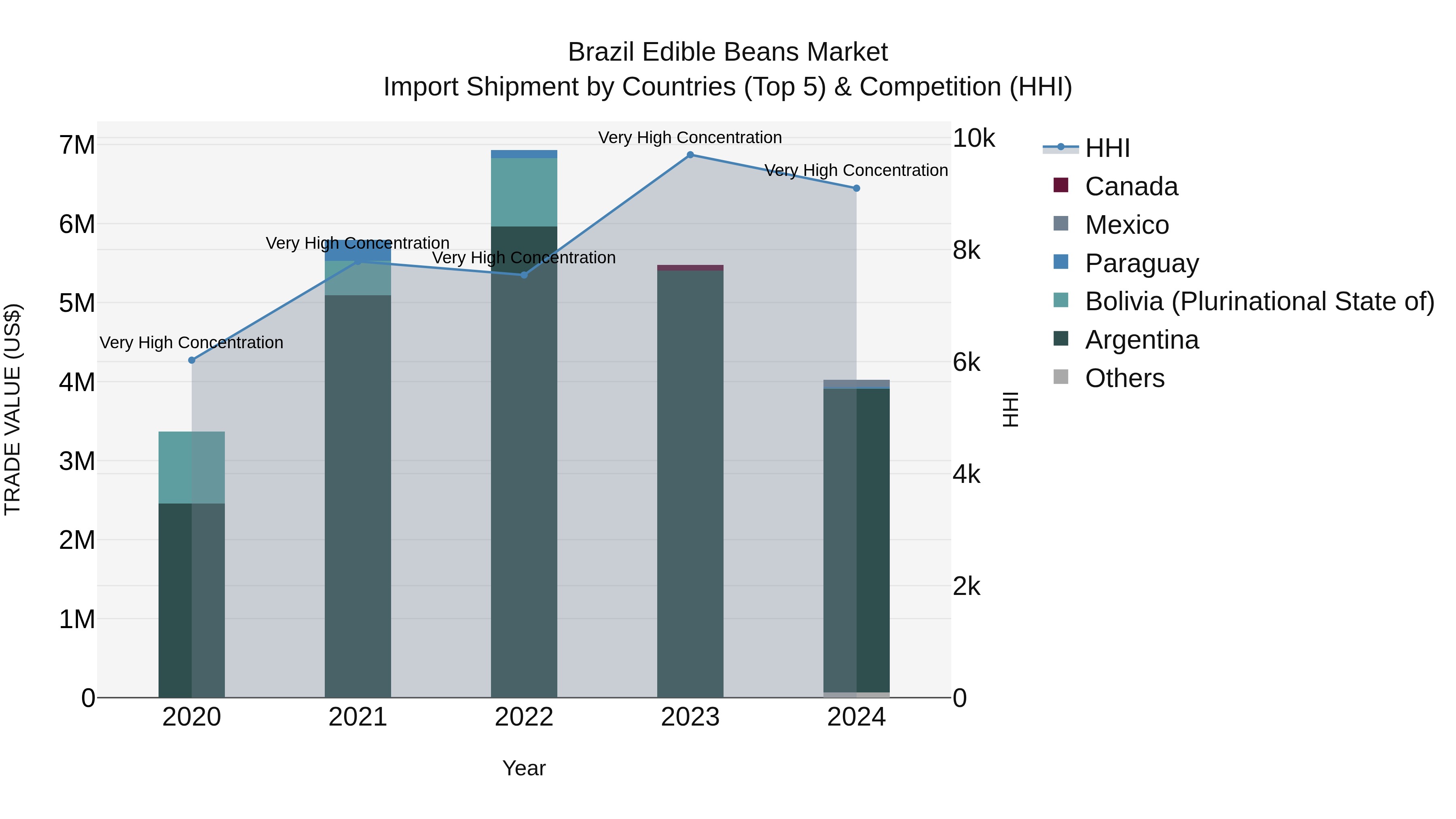
In 2024, Brazil continued to rely heavily on imports of edible beans, with Argentina, Mexico, USA, Paraguay, and Bolivia being the top exporting countries. Despite a high concentration level indicated by the HHI, the market saw a steady growth with a CAGR of 4.54% from 2020 to 2024. However, there was a significant decline in growth rate from 2023 to 2024, showing a decrease of -26.54%. This fluctuation may indicate various factors affecting import trends, and further analysis is needed to understand the dynamics of the edible beans market in Brazil.
Brazil Edible Beans Market Overview
The Brazil Edible Beans Market encompasses the production, distribution, and sales of various types of edible beans, including black beans, pinto beans, kidney beans, and navy beans, consumed as staple food ingredients in Brazil cuisine. This market is influenced by factors such as agricultural production volumes, consumer dietary preferences, export demand, weather conditions affecting crop yields, and government policies related to agriculture and food security.
Drivers of the market
The Brazil edible beans market is driven by the country`s agriculture sector`s production and consumption of beans, which are staple foods in Brazil cuisine. Edible beans such as black beans, kidney beans, and pinto beans are important sources of protein, fiber, and nutrients in the Brazil diet. Market growth is influenced by factors such as agricultural production trends, consumer dietary preferences, export demand, and government policies supporting bean cultivation.
Challenges of the market
Challenges in this market could revolve around meeting quality standards for bean production and processing, addressing supply chain inefficiencies, and managing price fluctuations. Market participants may also encounter challenges related to pest management, climate change impacts on crop yields, and competition from alternative protein sources.
Government Policy of the market
Brazil government policies influence the edible beans market through regulations on agricultural practices, food safety standards, and importation guidelines. These policies aim to ensure that edible beans meet quality requirements, adhere to food safety regulations, and promote sustainable farming practices. Regulations may cover aspects such as seed quality, pesticide usage, and labeling requirements to ensure consumer safety and product quality. Importation regulations ensure that edible beans imported into Brazil comply with these standards, fostering market integrity and public health protection.
Key Highlights of the Report:
- Brazil Edible Beans Market Outlook
- Market Size of Brazil Edible Beans Market, 2024
- Forecast of Brazil Edible Beans Market, 2031
- Historical Data and Forecast of Brazil Edible Beans Revenues & Volume for the Period 2021-2031
- Brazil Edible Beans Market Trend Evolution
- Brazil Edible Beans Market Drivers and Challenges
- Brazil Edible Beans Price Trends
- Brazil Edible Beans Porter's Five Forces
- Brazil Edible Beans Industry Life Cycle
- Historical Data and Forecast of Brazil Edible Beans Market Revenues & Volume By Product Type for the Period 2021-2031
- Historical Data and Forecast of Brazil Edible Beans Market Revenues & Volume By Pinto Beans for the Period 2021-2031
- Historical Data and Forecast of Brazil Edible Beans Market Revenues & Volume By Navy Beans for the Period 2021-2031
- Historical Data and Forecast of Brazil Edible Beans Market Revenues & Volume By Great Northern Beans for the Period 2021-2031
- Historical Data and Forecast of Brazil Edible Beans Market Revenues & Volume By Red Kidney Beans for the Period 2021-2031
- Historical Data and Forecast of Brazil Edible Beans Market Revenues & Volume By Black Beans for the Period 2021-2031
- Historical Data and Forecast of Brazil Edible Beans Market Revenues & Volume By Yellow Beans for the Period 2021-2031
- Historical Data and Forecast of Brazil Edible Beans Market Revenues & Volume By Others for the Period 2021-2031
- Historical Data and Forecast of Brazil Edible Beans Market Revenues & Volume By Distribution Channel for the Period 2021-2031
- Historical Data and Forecast of Brazil Edible Beans Market Revenues & Volume By Supermarket/Hypermarket for the Period 2021-2031
- Historical Data and Forecast of Brazil Edible Beans Market Revenues & Volume By Online Stores for the Period 2021-2031
- Historical Data and Forecast of Brazil Edible Beans Market Revenues & Volume By Specialty Stores for the Period 2021-2031
- Historical Data and Forecast of Brazil Edible Beans Market Revenues & Volume By Other for the Period 2021-2031
- Historical Data and Forecast of Brazil Edible Beans Market Revenues & Volume By Application for the Period 2021-2031
- Historical Data and Forecast of Brazil Edible Beans Market Revenues & Volume By Household for the Period 2021-2031
- Historical Data and Forecast of Brazil Edible Beans Market Revenues & Volume By Restaurants for the Period 2021-2031
- Historical Data and Forecast of Brazil Edible Beans Market Revenues & Volume By Others for the Period 2021-2031
- Brazil Edible Beans Import Export Trade Statistics
- Market Opportunity Assessment By Product Type
- Market Opportunity Assessment By Distribution Channel
- Market Opportunity Assessment By Application
- Brazil Edible Beans Top Companies Market Share
- Brazil Edible Beans Competitive Benchmarking By Technical and Operational Parameters
- Brazil Edible Beans Company Profiles
- Brazil Edible Beans Key Strategic Recommendations






































