Qatar Electric Housewares and Fans Market Summary
The qatar electric housewares and fans market was estimated at USD 196 Million in 2025 and is projected to reach USD 213 Million by 2032, growing at a CAGR of 1.0% from 2026 to 2032.
Qatar Electric Housewares and Fans Market Year-wise Growth Rate and Key Drivers
This graph highlights how the Qatar Electric Housewares and Fans Market has steadily grown over the past five years, supported by major growth factors.
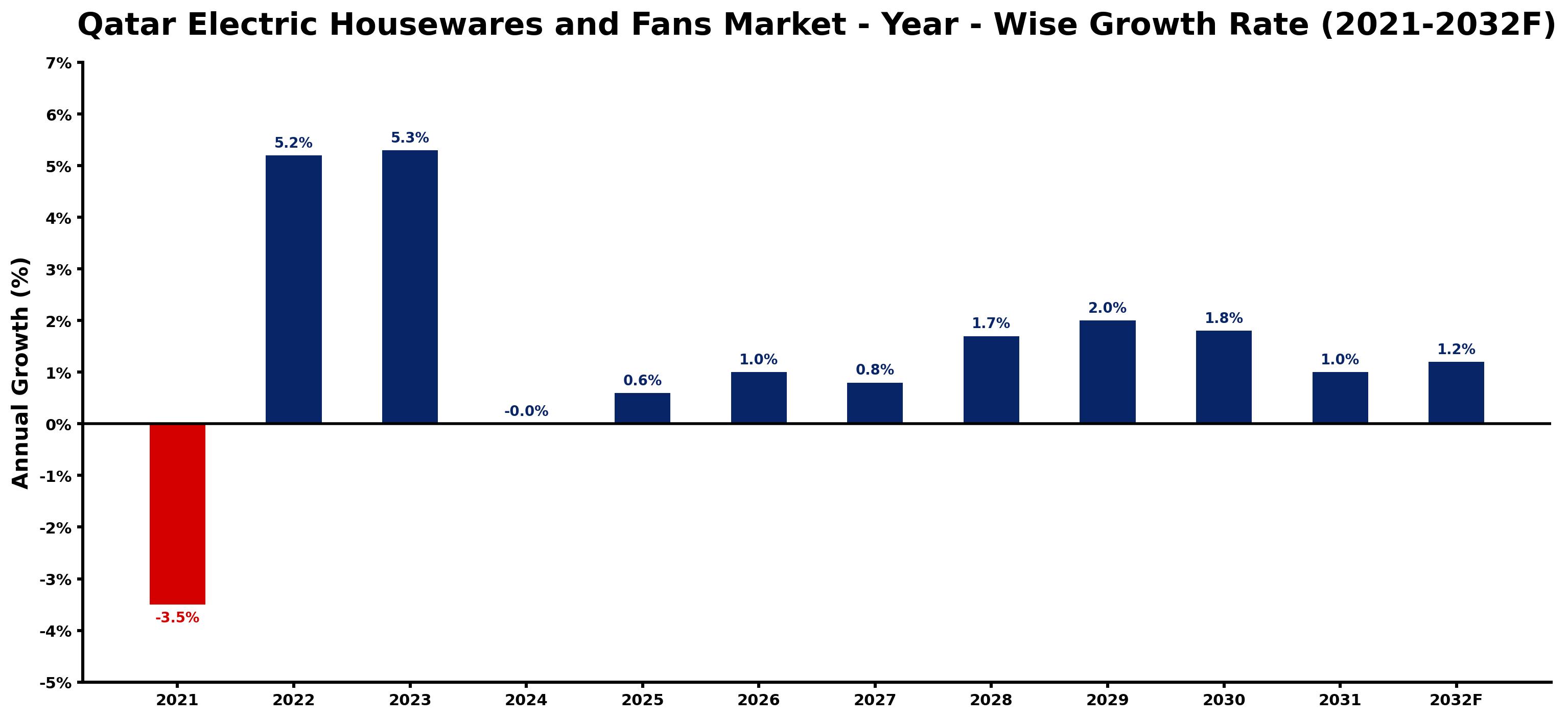
The table below presents the year wise growth rates along with the key drivers influencing the market
| Year | Growth Rate | Major Drivers |
| 2021 | -3.5% | Increased competition from imported alternatives eroded local brand loyalty and market share. |
| 2022 | 5.2% | Increased consumer awareness about energy-efficient appliances shifted purchasing preferences significantly. |
| 2023 | 5.3% | Regional construction pipelines support demand for durable electric housewares in new homes. |
| 2024 | -0.0% | Technological advancements in smart home integration attracted middle-class consumers looking for convenience. |
| 2025 | 0.6% | Hot climate requirements necessitate reliable cooling solutions, boosting fan sales across demographics. |
| 2026 | 1.0% | Emerging trends in sustainable living compel brands to offer eco-friendly electric products. |
| 2027 | 0.8% | Local manufacturing capabilities reduce import dependencies, enhancing product availability and variety. |
| 2028 | 1.7% | E-commerce growth transforms shopping behavior, making housewares more accessible to consumers. |
| 2029 | 2.0% | Increased disposable income among citizens leads to higher spending on quality electric products. |
| 2030 | 1.8% | Shifts in lifestyle, due to urbanization, encourage the use of multi-functional home appliances. |
| 2031 | 1.0% | Corporate budgets prioritize investments in energy-efficient technology for long-term savings. |
| 2032 | 1.2% | Consumer education programs elevate the understanding of product benefits, driving sustained market growth. |
Note - Market size estimations and growth projections presented in this report are based on 6Wresearch's advanced forecasting approach, validated with industry datasets as of June 2026.
Qatar Electric Housewares and Fans Market Synopsis
The Qatar Electric Housewares and Fans Market is projected to reach 1.0% and witness significant growth during the forecast period (2026-2032). This growth is largely driven by several interlinked factors including rising disposable incomes, increased awareness about energy efficiency, government initiatives promoting sustainable development, and rapid urbanization in the region. The growing demand for air conditioning solutions, especially during the scorching summer months, further enhances market opportunities. The availability of a reliable power supply across Qatar, coupled with a consumer shift towards luxury electric housewares, provides additional momentum to this market.
Qatar Electric Housewares and Fans Market Growth Drivers
The expansion of the Qatar Electric Housewares and Fans Market is primarily fueled by several key growth drivers:
- Rising disposable incomes among the Qatari population have led to increased spending on electric housewares and fans, as consumers look to enhance their lifestyle with modern conveniences.
- Consumer awareness regarding energy efficiency has prompted manufacturers to deliver more sustainable and cost-effective products, resulting in heightened market acceptance across various demographics.
- The rapid growth of urban areas, driven by extensive construction projects, has created a robust demand for household electric goods, further propelling market expansion.
- Government initiatives focused on sustainable development, such as the Vision 2031 plan, encourage local manufacturing of electronic goods, thereby reducing the nation's reliance on imported products.
- The increasing preference for luxury household products among consumers, coupled with advancements in technology, has led to innovative solutions that enhance the user experience.
Qatar Electric Housewares and Fans Market Challenges and Restraints
Despite the promising growth outlook, the Qatar Electric Housewares and Fans Market faces certain challenges:
- High import duties on electrical goods significantly impact the pricing structure of products, limiting the ability of market players to expand their offerings and reach untapped segments.
- The competitive landscape in Qatar is increasingly intense, particularly among established brands, making it difficult for smaller enterprises to maintain profitability and launch new products effectively.
- Supply chain disruptions, notably exacerbated by the global pandemic, have hindered the production and availability of electric housewares, posing further challenges to market development.
- Market fluctuations in raw material prices can adversely affect production costs, thereby influencing profitability margins.
- Regulatory compliance regarding energy efficiency standards adds another layer of complexity for manufacturers striving to balance compliance with consumer demands.
Qatar Electric Housewares and Fans Market Government Investment and Initiatives
The Qatari government has implemented a series of initiatives designed to bolster the electric housewares and fans market:
- The Vision 2031 Sustainable Development Plan aims to diversify the economy by encouraging local production and reducing dependency on imports, directly benefiting the electric houseware sector.
- Financial incentives and subsidies for manufacturers are in place to foster innovation and improve the competitiveness of local products.
- Investment in infrastructure development, particularly in urban areas, ensures a conducive environment for the growth of the electric housewares sector.
- Government campaigns promoting energy-efficient appliances contribute to increased awareness and demand among consumers.
- Partnerships between public and private sectors aim to enhance research and development efforts, driving technological advancements in the industry.
Qatar Electric Housewares and Fans Market Latest Developments (May 2025 - June 2026)
During the period from May 2025 to June 2026, the Qatar Electric Housewares and Fans Market has experienced significant developments:
- Manufacturers have increasingly focused on launching products that align with energy efficiency norms, meeting evolving consumer preferences for sustainable options.
- There has been a noticeable uptick in collaborations aimed at enhancing technological innovations within the electric housewares sector, ensuring a competitive edge in the market.
- Supply chain recovery efforts have begun to yield results, leading to improved product availability and reduced lead times.
- Consumer education initiatives launched by both the government and private sector have heightened awareness regarding the advantages of energy-efficient products.
- Continued urbanization efforts and real estate development projects have bolstered demand for electric housewares, particularly within newly constructed residential units.
Qatar Electric Housewares and Fans Market - Key Attractiveness of the Report
- 10 Years of Market Numbers
- Historical Data Starting from 2022 to 2025
- Base Year: 2025
- Forecast Data until 2032
- Key Performance Indicators Impacting the Market
- Major Upcoming Developments and Projects
Key Highlights of the Report:
- Qatar Electric Housewares and Fans Market Outlook
- Market Size of Qatar Electric Housewares and Fans Market, 2025
- Forecast of Qatar Electric Housewares and Fans Market, 2032
- Historical Data and Forecast of Qatar Electric Housewares and Fans Revenues & Volume for the Period 2022-2032F
- Qatar Electric Housewares and Fans Market Trend Evolution
- Qatar Electric Housewares and Fans Market Drivers and Challenges
- Qatar Electric Housewares and Fans Price Trends
- Qatar Electric Housewares and Fans Porter's Five Forces
- Qatar Electric Housewares and Fans Industry Life Cycle
- Historical Data and Forecast of Qatar Electric Housewares and Fans Market Revenues & Volume By Types for the Period 2022-2032F
- Historical Data and Forecast of Qatar Electric Housewares and Fans Market Revenues & Volume By Housewares for the Period 2022-2032F
- Historical Data and Forecast of Qatar Electric Housewares and Fans Market Revenues & Volume By Fans for the Period 2022-2032F
- Historical Data and Forecast of Qatar Electric Housewares and Fans Market Revenues & Volume By Electric Fans Types for the Period 2022-2032F
- Historical Data and Forecast of Qatar Electric Housewares and Fans Market Revenues & Volume By Ceiling Fans for the Period 2022-2032F
- Historical Data and Forecast of Qatar Electric Housewares and Fans Market Revenues & Volume By Floor Fans for the Period 2022-2032F
- Historical Data and Forecast of Qatar Electric Housewares and Fans Market Revenues & Volume By Wall-mounted Fans for the Period 2022-2032F
- Historical Data and Forecast of Qatar Electric Housewares and Fans Market Revenues & Volume By Electric Housewares Types for the Period 2022-2032F
- Historical Data and Forecast of Qatar Electric Housewares and Fans Market Revenues & Volume By Air purifiers for the Period 2022-2032F
- Historical Data and Forecast of Qatar Electric Housewares and Fans Market Revenues & Volume By Blenders for the Period 2022-2032F
- Historical Data and Forecast of Qatar Electric Housewares and Fans Market Revenues & Volume By Broilers for the Period 2022-2032F
- Historical Data and Forecast of Qatar Electric Housewares and Fans Market Revenues & Volume By Hair curlers for the Period 2022-2032F
- Historical Data and Forecast of Qatar Electric Housewares and Fans Market Revenues & Volume By Heaters for the Period 2022-2032F
- Historical Data and Forecast of Qatar Electric Housewares and Fans Market Revenues & Volume By Toothbrushes for the Period 2022-2032F
- Historical Data and Forecast of Qatar Electric Housewares and Fans Market Revenues & Volume By Others for the Period 2022-2032F
- Qatar Electric Housewares and Fans Import Export Trade Statistics
- Market Opportunity Assessment By Types
- Market Opportunity Assessment By Electric Fans Types
- Market Opportunity Assessment By Electric Housewares Types
- Qatar Electric Housewares and Fans Top Companies Market Share
- Qatar Electric Housewares and Fans Competitive Benchmarking By Technical and Operational Parameters
- Qatar Electric Housewares and Fans Company Profiles
- Qatar Electric Housewares and Fans Key Strategic Recommendations






































