Qatar Electric Locomotives Market Size, Share & Growth Rate
The Qatar Electric Locomotives Market was estimated at USD 235 Million in 2025 and is projected to reach USD 315 Million by 2032, growing at a CAGR of 4.3% from 2026 to 2032. This upward trajectory is primarily driven by substantial government investments in transportation infrastructure and a commitment to sustainability that aligns with global environmental standards. Furthermore, the push for more efficient rail networks is reshaping public transportation in Qatar, heralding a new era of electric locomotive adoption.
Qatar Electric Locomotives Market Year-wise Growth Rate and Key Drivers
This graph highlights how the Qatar Electric Locomotives Market has steadily grown over the years, supported by major growth factors.
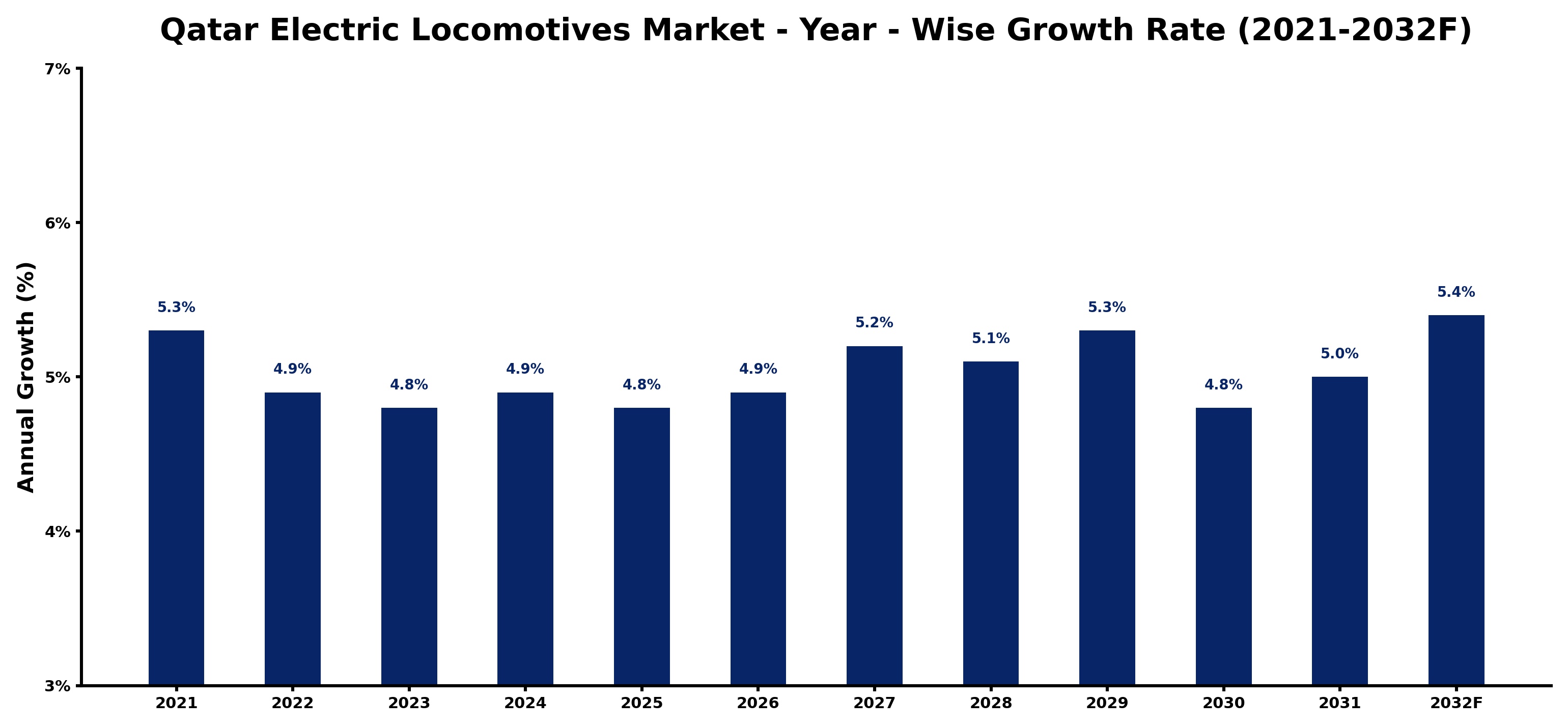
The table below presents the year‑wise growth rates along with the key drivers influencing the market
| Year | Growth Rate | Major Drivers |
| 2021 | 5.3% | Rising electricity demand across industries |
| 2022 | 4.9% | Expansion of transportation and logistics networks |
| 2023 | 4.8% | Increasing smart city development projects |
| 2024 | 4.9% | Growing renewable energy integration projects |
| 2025 | 4.8% | Rising electricity demand across industries |
| 2026 | 4.9% | Expansion of commercial construction activities |
| 2027 | 5.2% | Expansion of transportation and logistics networks |
| 2028 | 5.1% | Growing urbanization and commercial development |
| 2029 | 5.3% | Increasing smart city development projects |
| 2030 | 4.8% | Increasing industrial automation investments |
| 2031 | 5.0% | Increasing adoption of advanced technologies |
| 2032 | 5.4% | Growing urbanization and commercial development |
Note - Market size estimations and growth projections presented in this report are based on 6Wresearch's advanced forecasting approach, validated with industry datasets as of June 2026.
Qatar Electric Locomotives Market Synopsis
In recent years, Qatar has made significant strides in developing its rail infrastructure, with electric locomotives taking center stage as a key component of this transformation. The commitment to eco-friendly transportation solutions reflects the nation's broader goals of reducing carbon emissions and modernizing its transit systems.
The focus on electric locomotives is not merely a trend but a strategic initiative aimed at positioning Qatar as a leader in sustainable transport solutions. As investments pour in, the electric locomotive market is set to play a crucial role in enhancing the efficiency and capacity of the country's railway network, making travel more accessible and environmentally friendly.
Qatar Electric Locomotives Market Key Takeaways
- The Qatar Electric Locomotives Market is witnessing robust growth due to infrastructure investments.
- Government initiatives prioritize sustainability, driving the shift towards electric solutions.
- Integration of advanced technologies in electric locomotives boosts operational efficiency.
- Public transportation modernization is a critical focus for ongoing developments.
- Strategic partnerships will be essential for enhancing rail infrastructure and services.
Evaluation of Restraints in Qatar Electric Locomotives Market
Despite the promising outlook, the Qatar Electric Locomotives Market encounters significant hurdles, primarily due to the current nascent state of the rail infrastructure. Building an extensive and efficient rail system requires not just financial investment but also meticulous planning and execution, which can be slow and complicated. Furthermore, fostering a cultural shift towards rail travel within the community may take time, as traditional forms of transportation remain deeply embedded. Ensuring cooperation among various stakeholders and achieving interoperability between different rail systems also present ongoing challenges.
Qatar Electric Locomotives Market Trends
The transition toward electric locomotives is shaped by several trends, including the adoption of renewable energy sources, which further enhances the sustainability of rail transport. Automation and digital technologies are becoming integral to locomotive design, improving operational efficiency and maintenance. As Qatar seeks to modernize its transport sector, interest in hybrid systems combining electric and alternative energy solutions is also on the rise, promoting innovation in locomotive technology.
Qatar Electric Locomotives Market Opportunities
There lies substantial opportunity in the Qatar Electric Locomotives Market for investors and industry players keen to tap into the expanding infrastructure initiatives. The government's commitment to diversifying its transportation modalities opens pathways for collaboration and investment in electric locomotives. Additionally, the potential for technological advancements presents opportunities for companies specializing in innovative rail solutions, enhancing both capacity and environmental sustainability.
Government Initiatives in the Qatar Electric Locomotives Market
The Qatari government has rolled out various initiatives aimed at modernizing public transportation and encouraging sustainable practices within the rail sector. Key programs focus on funding for infrastructure development, which includes the electrification of rail lines and enhancement of existing railway facilities. Furthermore, the government actively promotes partnerships with private enterprises to foster innovation and efficiency in the electric locomotives segment.
Future Insights of the Qatar Electric Locomotives Market
Looking ahead to the period from 2026 to 2032, the Qatar Electric Locomotives Market is expected to evolve significantly. Continuous investments and technological innovations are anticipated to streamline railway operations and expand the existing network. The growing acceptance of electric locomotives among the public, coupled with increased governmental support, will solidify the market's trajectory towards achieving greater efficiency and sustainability in the long term.
Qatar Electric Locomotives Market Latest Developments (May 2025 - June 2026)
In recent months, the Qatar Electric Locomotives Market has seen increased activity regarding infrastructure projects aimed at enhancing railway connectivity. Collaborative efforts between government entities and private firms have yielded promising advancements in electric locomotive technology, aimed at improving operational efficacy and environmental performance. Furthermore, ongoing projects are set to modernize existing rail lines, showcasing a clear commitment to sustainable transport initiatives across the region.
Qatar Electric Locomotives Market - Key Attractiveness of the Report
- 10 Years of Market Numbers
- Historical Data Starting from 2022 to 2025
- Base Year: 2025
- Forecast Data until 2032
- Key Performance Indicators Impacting the Market
- Major Upcoming Developments and Projects
Key Highlights of the Report:
- Qatar Electric Locomotives Market Outlook
- Market Size of Qatar Electric Locomotives Market, 2025
- Forecast of Qatar Electric Locomotives Market, 2032
- Historical Data and Forecast of Qatar Electric Locomotives Revenues & Volume for the Period 2022-2032F
- Qatar Electric Locomotives Market Trend Evolution
- Qatar Electric Locomotives Market Drivers and Challenges
- Qatar Electric Locomotives Price Trends
- Qatar Electric Locomotives Porter's Five Forces
- Qatar Electric Locomotives Industry Life Cycle
- Historical Data and Forecast of Qatar Electric Locomotives Market Revenues & Volume By Energy Transfer for the Period 2022-2032F
- Historical Data and Forecast of Qatar Electric Locomotives Market Revenues & Volume By Overhead Lines for the Period 2022-2032F
- Historical Data and Forecast of Qatar Electric Locomotives Market Revenues & Volume By Third Rail for the Period 2022-2032F
- Historical Data and Forecast of Qatar Electric Locomotives Market Revenues & Volume By On-board Energy Storage for the Period 2022-2032F
- Historical Data and Forecast of Qatar Electric Locomotives Market Revenues & Volume By Technology for the Period 2022-2032F
- Historical Data and Forecast of Qatar Electric Locomotives Market Revenues & Volume By IGBT Module for the Period 2022-2032F
- Historical Data and Forecast of Qatar Electric Locomotives Market Revenues & Volume By GTO Thyristor for the Period 2022-2032F
- Historical Data and Forecast of Qatar Electric Locomotives Market Revenues & Volume By SiC Module for the Period 2022-2032F
- Historical Data and Forecast of Qatar Electric Locomotives Market Revenues & Volume By Traction Units for the Period 2022-2032F
- Historical Data and Forecast of Qatar Electric Locomotives Market Revenues & Volume By AC Traction Units for the Period 2022-2032F
- Historical Data and Forecast of Qatar Electric Locomotives Market Revenues & Volume By DC Traction Units for the Period 2022-2032F
- Historical Data and Forecast of Qatar Electric Locomotives Market Revenues & Volume By Multi System Units for the Period 2022-2032F
- Historical Data and Forecast of Qatar Electric Locomotives Market Revenues & Volume By Application for the Period 2022-2032F
- Historical Data and Forecast of Qatar Electric Locomotives Market Revenues & Volume By Passenger Transport for the Period 2022-2032F
- Historical Data and Forecast of Qatar Electric Locomotives Market Revenues & Volume By Freight Transport for the Period 2022-2032F
- Qatar Electric Locomotives Import Export Trade Statistics
- Market Opportunity Assessment By Energy Transfer
- Market Opportunity Assessment By Technology
- Market Opportunity Assessment By Traction Units
- Market Opportunity Assessment By Application
- Qatar Electric Locomotives Top Companies Market Share
- Qatar Electric Locomotives Competitive Benchmarking By Technical and Operational Parameters
- Qatar Electric Locomotives Company Profiles
- Qatar Electric Locomotives Key Strategic Recommendations






































