Qatar Energy Saving & Fluorescent Market Summary
The qatar energy saving & fluorescent market was estimated at USD 1330 Million in 2025 and is projected to reach USD 1909 Million by 2032, growing at a CAGR of 6.1% from 2026 to 2032.
Qatar Energy Saving & Fluorescent Market Year-wise Growth Rate and Key Drivers
This graph highlights how the Qatar Energy Saving & Fluorescent Market has steadily grown over the past five years, supported by major growth factors.
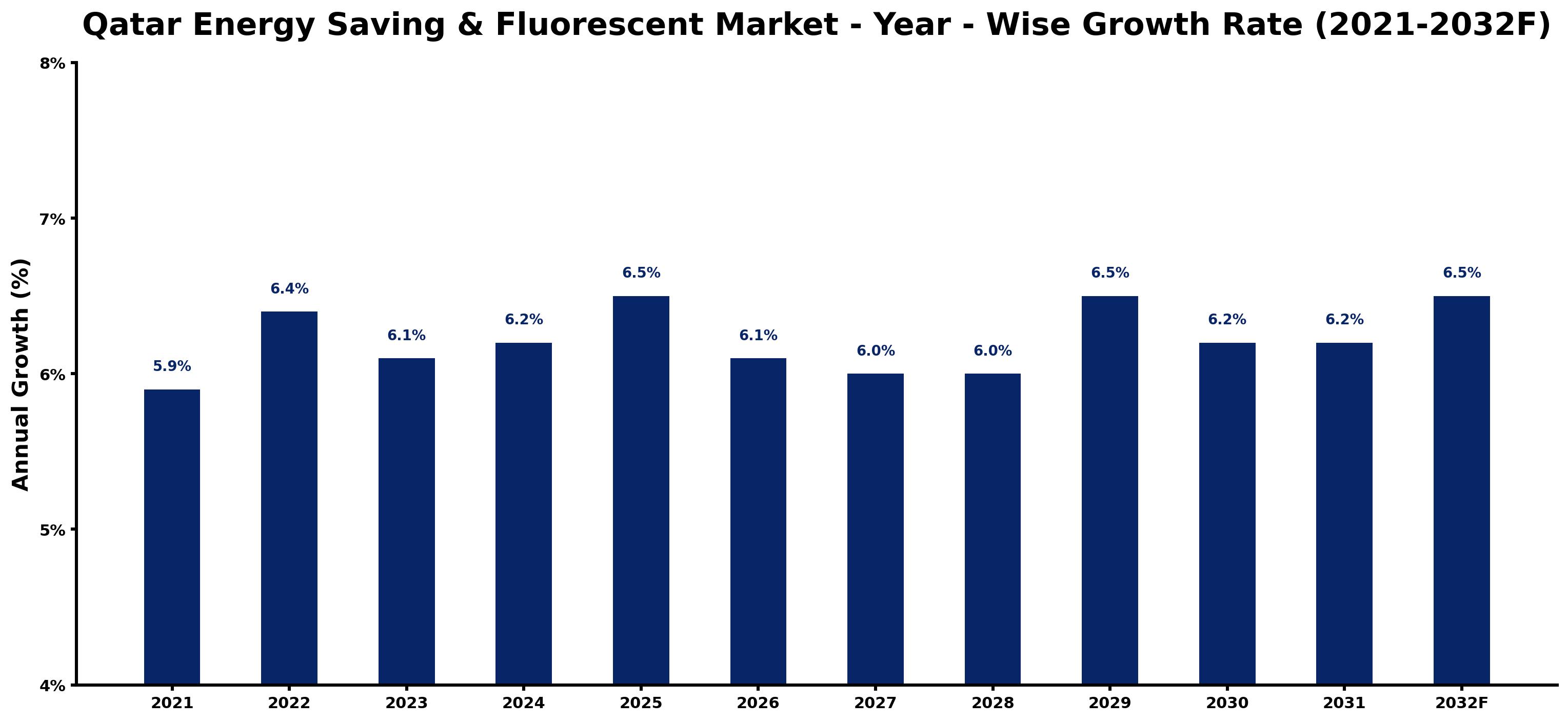
The table below presents the year wise growth rates along with the key drivers influencing the market
| Year | Growth Rate | Major Drivers |
| 2021 | 5.9% | Post-lockdown retail projects ignited interest in energy-efficient lighting solutions. |
| 2022 | 6.4% | Rising electricity costs prompted commercial sectors to invest in energy-saving technologies. |
| 2023 | 6.1% | Local manufacturers began innovating fluorescent products tailored for Qatar's extreme climate. |
| 2024 | 6.2% | The construction of NEOM attracted attention towards sustainable urban development strategies. |
| 2025 | 6.5% | Corporate budgets increasingly prioritize efficiency, influencing purchasing decisions for lighting solutions. |
| 2026 | 6.1% | International collaborations introduced advanced lighting technologies to Qatari companies. |
| 2027 | 6.0% | Consumer awareness campaigns highlighted the long-term savings from energy-efficient products. |
| 2028 | 6.0% | The hospitality sector embraced energy-saving lighting to align with global sustainability trends. |
| 2029 | 6.5% | Emerging smart home technologies offered upgraded energy management options for households. |
| 2030 | 6.2% | Investments in renewable energy infrastructure bolstered demand for complementary lighting solutions. |
| 2031 | 6.2% | The local government initiated projects encouraging widespread adoption of energy-efficient solutions. |
| 2032 | 6.5% | Market players focused on creating more affordable fluorescent options for diverse consumer segments. |
Note - Market size estimations and growth projections presented in this report are based on 6Wresearch's advanced forecasting approach, validated with industry datasets as of June 2026.
Qatar Energy Saving & Fluorescent Market Synopsis
The Qatar Energy Saving Fluorescent Market is projected to reach 6.1% and witness significant growth during the forecast period (2026-2032). This expansion is primarily driven by the increasing demand for sustainable and efficient lighting solutions, alongside the continuous advancements in energy-saving light technologies. A critical factor in this growth trajectory is the Qatari government's commitment to reducing carbon emissions through various green initiatives, including the promotion of LED lighting replacements. Furthermore, rising consumer awareness regarding cost savings associated with eco-friendly light sources, such as compact fluorescent lamps (CFLs) and LEDs, is expected to significantly boost the market's growth prospects in the coming years.
Qatar Energy Saving & Fluorescent Market Growth Drivers
Several key factors are contributing to the growth of the Qatar Energy Saving & Fluorescent Market. Firstly, the enhanced efficiency and longevity of energy-saving light sources provide substantial operational cost reduction for consumers and businesses alike. The advantages of LED lighting in terms of lower power consumption, higher efficiency compared to traditional incandescent bulbs, and significantly reduced environmental impact are driving consumer preferences.
- Technological advancements continue to improve the efficiency of energy-saving solutions, making them more appealing to consumers and businesses.
- The growing trend towards sustainability is increasingly promoting the adoption of eco-friendly lighting solutions, as both individuals and corporations seek to minimize their carbon footprints.
- Government regulations and initiatives are pushing for the replacement of outdated lighting systems with energy-efficient alternatives, thereby accelerating market growth.
- Rising competition among local suppliers has resulted in decreasing prices of energy-saving lighting products, enhancing their accessibility to a broader audience.
- The commercial sector's increasing reliance on energy-saving fluorescent lights due to their reliability and performance improvements is further fueling market demand.
Qatar Energy Saving & Fluorescent Market Trends and Opportunities
The Qatar Energy Saving & Fluorescent Market is experiencing notable trends driven by market demands and technological improvements. A significant trend is the surging preference for LED lighting solutions among consumers, attributable to their superior energy efficiency and reduced maintenance costs. Organizations are particularly drawn to these products for their long lifespan and consistent performance, which are essential for operational efficiency in commercial environments.
- Consumer preferences are shifting towards integrated lighting designs that offer both aesthetic appeal and energy efficiency.
- Increasing public awareness about the environmental benefits of energy-efficient lighting options is fueling market engagement and adoption.
- The push for smart technology integration in lighting systems is creating opportunities for energy-efficient solutions that can be controlled remotely.
- Innovations in lighting design, such as flexible and modular systems, are providing new ways to meet diverse consumer needs while optimizing energy usage.
- Complementary technological advancements in building management systems are further enhancing the demand for energy-efficient lighting solutions.
Qatar Energy Saving & Fluorescent Market Government Investment and Initiatives
The role of the Qatari government in fostering the growth of the Energy Saving & Fluorescent Market is pivotal. Through various initiatives and policies aimed at sustainability, the government has been instrumental in encouraging the transition to energy-efficient lighting solutions. Investment in public infrastructure improvements, particularly in lighting systems, is a priority, contributing to smarter and more sustainable public spaces.
- The introduction of regulations that mandate energy-efficient lighting in new public and commercial construction projects is a significant driver of market growth.
- Government incentives for residential energy efficiency upgrades encourage homeowners to shift towards CFLs and LED lighting solutions.
- Promotional campaigns aimed at raising awareness about energy conservation are being implemented to educate consumers about the benefits of using energy-efficient lighting.
- Investment in research and development of innovative lighting technologies supports the growth of the market by providing advanced products.
- The government is collaborating with local stakeholders to create standards and certifications for energy-efficient lighting, further supporting quality assurance and consumer confidence.
Qatar Energy Saving & Fluorescent Market Latest Developments (May 2025 - June 2026)
Recent developments in the Qatar Energy Saving & Fluorescent Market have focused on enhancing product offerings and expanding consumer engagement. During this period, there has been a heightened emphasis on the integration of smart technologies into energy-efficient lighting systems, allowing for improved control and energy monitoring capabilities. This trend aligns with the broader global shift towards smart home and building automation solutions.
- Increased collaboration between government entities and private sectors has led to the launch of initiatives aimed at promoting energy-efficient practices across various industries.
- New product launches in the LED segment have introduced more versatile and high-performance lighting options suited for both residential and commercial applications.
- Training programs and workshops have been established to educate electricians and construction professionals on the advantages of installing energy-efficient lighting solutions.
- Public awareness campaigns have highlighted the economic and environmental benefits associated with energy-saving technologies, driving consumer interest.
- Developments in design have allowed for the creation of innovative lighting systems that cater to both functional and aesthetic needs, reinforcing consumer adoption.
Qatar Energy Saving & Fluorescent Market - Key Attractiveness of the Report
- 10 Years of Market Numbers
- Historical Data Starting from 2022 to 2025
- Base Year: 2025
- Forecast Data until 2032
- Key Performance Indicators Impacting the Market
- Major Upcoming Developments and Projects
Key Highlights of the Report:
- Qatar Energy Saving & Fluorescent Market Outlook
- Market Size of Qatar Energy Saving & Fluorescent Market, 2025
- Forecast of Qatar Energy Saving & Fluorescent Market, 2032F
- Historical Data and Forecast of Qatar Energy Saving & Fluorescent Revenues & Volume for the Period 2022-2032F
- Qatar Energy Saving & Fluorescent Market Trend Evolution
- Qatar Energy Saving & Fluorescent Market Drivers and Challenges
- Qatar Energy Saving & Fluorescent Price Trends
- Qatar Energy Saving & Fluorescent Porter's Five Forces
- Qatar Energy Saving & Fluorescent Industry Life Cycle
- Historical Data and Forecast of Qatar Energy Saving & Fluorescent Market Revenues & Volume By Sources for the Period 2022-2032F
- Historical Data and Forecast of Qatar Energy Saving & Fluorescent Market Revenues & Volume By High-Intensity Discharge Lamps (HID) for the Period 2022-2032F
- Historical Data and Forecast of Qatar Energy Saving & Fluorescent Market Revenues & Volume By Linear Fluorescent Lamps (LFL) for the Period 2022-2032F
- Historical Data and Forecast of Qatar Energy Saving & Fluorescent Market Revenues & Volume By Light Emitting Diodes (LED) for the Period 2022-2032F
- Historical Data and Forecast of Qatar Energy Saving & Fluorescent Market Revenues & Volume By Applications for the Period 2022-2032F
- Historical Data and Forecast of Qatar Energy Saving & Fluorescent Market Revenues & Volume By Commercial for the Period 2022-2032F
- Historical Data and Forecast of Qatar Energy Saving & Fluorescent Market Revenues & Volume By Residential for the Period 2022-2032F
- Historical Data and Forecast of Qatar Energy Saving & Fluorescent Market Revenues & Volume By Government for the Period 2022-2032F
- Qatar Energy Saving & Fluorescent Import Export Trade Statistics
- Market Opportunity Assessment By Sources
- Market Opportunity Assessment By Applications
- Qatar Energy Saving & Fluorescent Top Companies Market Share
- Qatar Energy Saving & Fluorescent Competitive Benchmarking By Technical and Operational Parameters
- Qatar Energy Saving & Fluorescent Company Profiles
- Qatar Energy Saving & Fluorescent Key Strategic Recommendations






































