Qatar Fans and Ventilators Market Summary
The qatar fans and ventilators market was estimated at USD 1386 Million in 2025 and is projected to reach USD 2001 Million by 2032, growing at a CAGR of 6.6% from 2026 to 2032.
Qatar Fans and Ventilators Market Year-wise Growth Rate and Key Drivers
This graph highlights how the Qatar Fans and Ventilators Market has steadily grown over the past five years, supported by major growth factors.
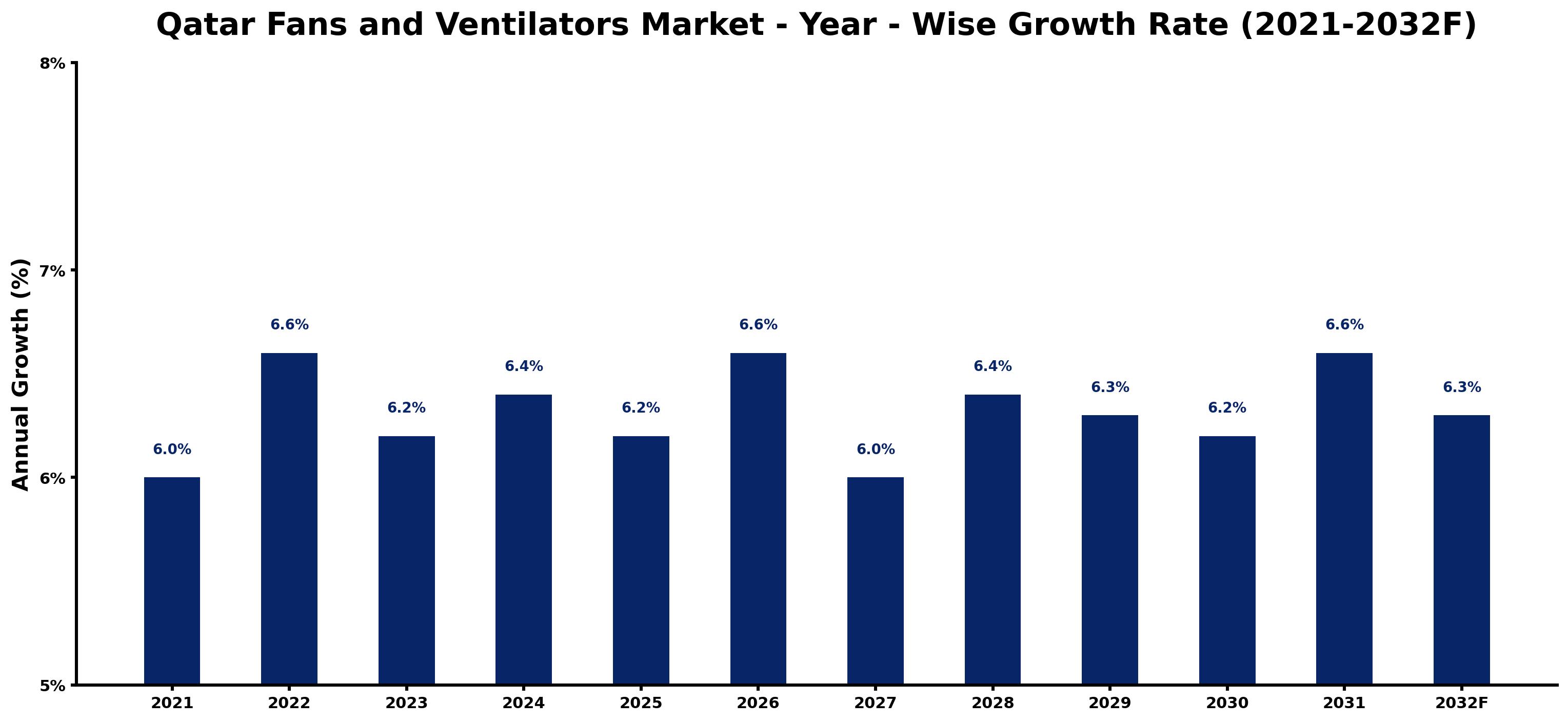
The table below presents the year wise growth rates along with the key drivers influencing the market
| Year | Growth Rate | Major Drivers |
| 2021 | 6.0% | Post-lockdown retail projects sparked initial interest in ventilation solutions for safety. |
| 2022 | 6.6% | Environmental awareness highlighted the importance of energy-efficient cooling systems in homes. |
| 2023 | 6.2% | Local construction boom increased demand for integrated HVAC systems in commercial buildings. |
| 2024 | 6.4% | Qatar's hospitality sector expansion required advanced air management for guest comfort. |
| 2025 | 6.2% | Sustainability goals encouraged manufacturers to invest in eco-friendly fan technologies. |
| 2026 | 6.6% | The FIFA World Cup showcased Qatar's need for high-performance ventilation solutions. |
| 2027 | 6.0% | Urbanization trends drove residential developers to prioritize innovative cooling solutions. |
| 2028 | 6.4% | Smart home technology adoption made ventilators with IoT features increasingly popular. |
| 2029 | 6.3% | Growing health consciousness pushed consumers toward air purification integrated products. |
| 2030 | 6.2% | Legislative changes mandated stricter air quality standards in commercial establishments. |
| 2031 | 6.6% | Corporate sustainability initiatives led businesses to upgrade outdated ventilation systems. |
| 2032 | 6.3% | Increased tourism anticipated renewed investment in advanced climate control technologies. |
Note - Market size estimations and growth projections presented in this report are based on 6Wresearch's advanced forecasting approach, validated with industry datasets as of June 2026.
Qatar Fans and Ventilators Market Synopsis
The Qatar Fans and Ventilators Market is projected to reach 6.6% and witness significant growth during the forecast period (2026-2032). This growth can be primarily attributed to an escalating demand across both residential and commercial sectors, fueled by a burgeoning population and rising awareness around indoor air quality. As Qatar continues to develop its infrastructure, the need for efficient ventilation systems becomes increasingly apparent, resulting in higher sales of fans and ventilators.
Qatar Fans and Ventilators Market Growth Drivers
The drivers behind the growth of the Qatar Fans and Ventilators Market are multifaceted. Key factors contributing to this trend include:
- Ongoing construction activities and infrastructure development projects are leading to an increased demand for effective ventilation solutions in new buildings.
- Heightened consumer awareness regarding the importance of indoor air quality, which compels residential and commercial settings to invest in advanced ventilation systems.
- Economic growth has enabled more individuals to invest in high-end fans and ventilation products, moving away from traditional methods of cooling.
- Government initiatives aimed at enhancing public infrastructure stimulate the need for integrated ventilation systems across various facilities.
- The rising building heights in urban developments necessitate efficient airflow solutions that fans and ventilators provide, thereby driving sales in the market.
Qatar Fans and Ventilators Market Challenges and Restraints
Despite its promising growth trajectory, the Qatar Fans and Ventilators Market faces several challenges. These include:
- High installation and maintenance costs associated with HVAC systems compared to traditional cooling solutions, which may discourage consumers from making investments.
- The significant energy consumption of air conditioning units can deter potential buyers, especially as consumers seek more cost-effective solutions.
- The COVID-19 pandemic had a lasting impact on supply chains, resulting in increased prices for components essential to manufacturing fans and ventilators.
- Consumer hesitance to invest in large-ticket items due to financial uncertainties stemming from economic fluctuations.
- Competition from low energy-consuming alternatives, such as evaporative coolers, may also hinder market growth.
Qatar Fans and Ventilators Market Government Investment and Initiatives
The Qatari government has actively invested in infrastructure initiatives and development programs that significantly impact the Qatar Fans and Ventilators Market. This includes:
- Major public spending projects aimed at modernizing transportation, healthcare, and residential sectors that necessitate high-quality ventilation systems.
- Incentives for sustainable building practices, encouraging the adoption of energy-efficient ventilation solutions in both commercial and residential constructions.
- The establishment of regulations mandating improved air quality standards in public buildings, driving demand for advanced ventilation technologies.
- Support for innovative solutions that enhance energy efficiency within the construction sector, aligning with Qatar's long-term sustainability goals.
- Collaboration between governmental bodies and private sector stakeholders to promote the development of a robust infrastructure capable of supporting advanced ventilation systems.
Qatar Fans and Ventilators Market Latest Developments (May 2025 - June 2026)
Recent developments in the Qatar Fans and Ventilators Market indicate a trend towards innovation and sustainability. During the period from May 2025 to June 2026, the market has seen an increased focus on incorporating smart technologies into ventilation systems. This evolution is driven by growing consumer interest in energy-efficient and user-friendly products. Additionally, industry stakeholders are prioritizing investments in research and development to enhance product performance and reduce environmental impact. The ongoing recovery from the COVID-19 pandemic has also prompted a reassessment of air quality standards, leading to heightened demand for advanced ventilation solutions in public and private spaces.
Qatar Fans and Ventilators Market - Key Attractiveness of the Report
- 10 Years of Market Numbers
- Historical Data Starting from 2022 to 2025
- Base Year: 2025
- Forecast Data until 2032
- Key Performance Indicators Impacting the Market
- Major Upcoming Developments and Projects
Key Highlights of the Report:
- Qatar Fans and Ventilators Market Outlook
- Market Size of Qatar Fans and Ventilators Market, 2025
- Forecast of Qatar Fans and Ventilators Market, 2032
- Historical Data and Forecast of Qatar Fans and Ventilators Revenues & Volume for the Period 2022-2032F
- Qatar Fans and Ventilators Market Trend Evolution
- Qatar Fans and Ventilators Market Drivers and Challenges
- Qatar Fans and Ventilators Price Trends
- Qatar Fans and Ventilators Porter's Five Forces
- Qatar Fans and Ventilators Industry Life Cycle
- Historical Data and Forecast of Qatar Fans and Ventilators Market Revenues & Volume By Material for the Period 2022-2032F
- Historical Data and Forecast of Qatar Fans and Ventilators Market Revenues & Volume By Metal for the Period 2022-2032F
- Historical Data and Forecast of Qatar Fans and Ventilators Market Revenues & Volume By Composite for the Period 2022-2032F
- Historical Data and Forecast of Qatar Fans and Ventilators Market Revenues & Volume By Rubber for the Period 2022-2032F
- Historical Data and Forecast of Qatar Fans and Ventilators Market Revenues & Volume By Plastic for the Period 2022-2032F
- Historical Data and Forecast of Qatar Fans and Ventilators Market Revenues & Volume By Application for the Period 2022-2032F
- Historical Data and Forecast of Qatar Fans and Ventilators Market Revenues & Volume By Interior for the Period 2022-2032F
- Historical Data and Forecast of Qatar Fans and Ventilators Market Revenues & Volume By Exterior for the Period 2022-2032F
- Historical Data and Forecast of Qatar Fans and Ventilators Market Revenues & Volume By Structural for the Period 2022-2032F
- Historical Data and Forecast of Qatar Fans and Ventilators Market Revenues & Volume By Powertrain for the Period 2022-2032F
- Historical Data and Forecast of Qatar Fans and Ventilators Market Revenues & Volume By Vehicle Types for the Period 2022-2032F
- Historical Data and Forecast of Qatar Fans and Ventilators Market Revenues & Volume By Passenger Vehicles for the Period 2022-2032F
- Historical Data and Forecast of Qatar Fans and Ventilators Market Revenues & Volume By Light Commercial Vehicles for the Period 2022-2032F
- Historical Data and Forecast of Qatar Fans and Ventilators Market Revenues & Volume By Heavy Commercial Vehicles for the Period 2022-2032F
- Qatar Fans and Ventilators Import Export Trade Statistics
- Market Opportunity Assessment By Material
- Market Opportunity Assessment By Application
- Market Opportunity Assessment By Vehicle Types
- Qatar Fans and Ventilators Top Companies Market Share
- Qatar Fans and Ventilators Competitive Benchmarking By Technical and Operational Parameters
- Qatar Fans and Ventilators Company Profiles
- Qatar Fans and Ventilators Key Strategic Recommendations






































