Qatar Fishing Line Market Size, Share & Growth Rate
The Qatar Fishing Line Market was estimated at USD 571 Million in 2025 and is projected to reach USD 834 Million by 2032, growing at a CAGR of 5.6% from 2026 to 2032. This growth is underpinned by the burgeoning interest in recreational fishing, driven by Qatar's rich marine biodiversity and a vibrant outdoor culture. Additionally, advancements in fishing line technology, such as the introduction of high-performance materials, are further enhancing the appeal of fishing activities across the nation.
Qatar Fishing Line Market Year-wise Growth Rate and Key Drivers
This graph highlights how the Qatar Fishing Line Market has steadily grown over the years, supported by major growth factors.
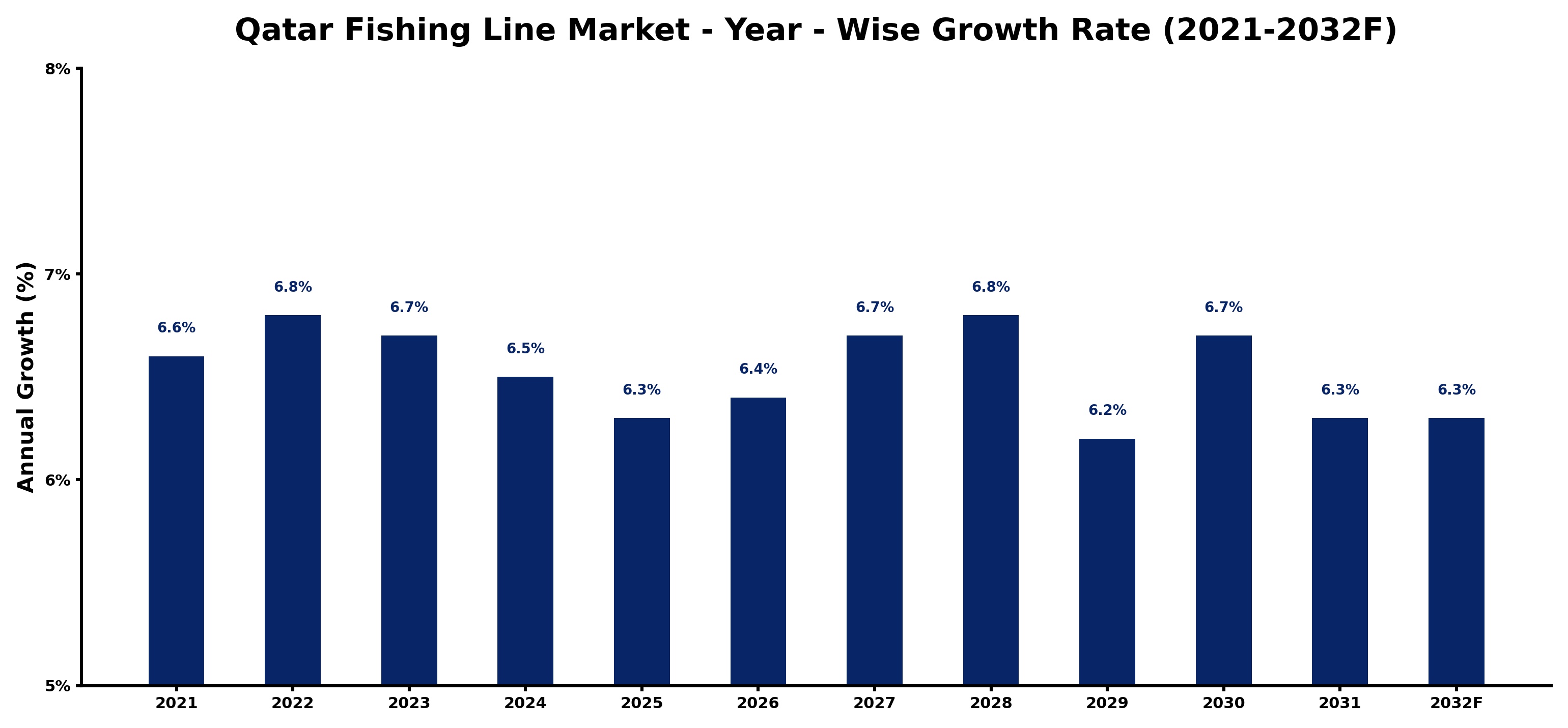
The table below presents the year‑wise growth rates along with the key drivers influencing the market
| Year | Growth Rate | Major Drivers |
| 2021 | 6.6% | Export driven fishing line manufacturers adopt advanced materials for durability |
| 2022 | 6.8% | Increased fishing vessel retrofitting bolsters demand for durable lines |
| 2023 | 6.7% | Investment in advanced fishing gear boosts local production capacity |
| 2024 | 6.5% | LNG infrastructure projects boost demand for fishing line manufacturing |
| 2025 | 6.3% | Increased manufacturing investments boost local fishing line production capabilities |
| 2026 | 6.4% | Technology integration boosts efficiency in fishing line production processes |
| 2027 | 6.7% | Investment in automated fishing line production boosts operational efficiency |
| 2028 | 6.8% | Technological upgrades in fishing line production boosted export competitiveness |
| 2029 | 6.2% | Fishing line production expansion boosts regional export capabilities |
| 2030 | 6.7% | Manufacturing investments in advanced materials boost fishing line production efficiency |
| 2031 | 6.3% | Revamped fisheries infrastructure drives demand for advanced fishing gear |
| 2032 | 6.3% | LNG infrastructure development boosts fishing line manufacturing capacity |
Note - Market size estimations and growth projections presented in this report are based on 6Wresearch's advanced forecasting approach, validated with industry datasets as of June 2026.
Qatar Fishing Line Market Synopsis
The Qatar fishing line market has shown a slight increase, with expenditures rising to around QR 64 million, up from QR 63 million the previous year. However, this figure still falls significantly short of its peak in 2015, when spending reached QR 80 million, primarily due to regulatory shifts affecting recreational fishing. As the market navigates these changes, a steady recovery is anticipated, driven by renewed interest in fishing as both a leisure activity and an essential component of local culture.
While imports dominate the market, constituting 95% of the total value, the role of domestic production remains modest, highlighting the dependency on international suppliers. The evolving landscape of fishing preferences, combined with the demand for high-quality and sustainable products, suggests that the market is poised for strategic developments that align with consumer trends.
Qatar Fishing Line Market Key Takeaways
- The market is expected to grow significantly, driven by increased recreational fishing activities and advancements in fishing line technology.
- Imported fishing lines dominate market expenditures, accounting for approximately QR 61 million of total spending.
- Environmental sustainability remains a crucial focus, influencing consumer preferences for eco-friendly products.
- Changes in regulations regarding fishing activities impact market dynamics and consumer demand.
- Qatar's coastal location and push for marine tourism bolster the fishing line market's growth prospects.
Evaluation of Restraints in Qatar Fishing Line Market
The Qatar fishing line market is currently constrained by several critical factors. Sustainability has emerged as a pivotal issue, as both consumers and regulators increasingly demand environmentally friendly products. This necessitates innovation in materials and processes to minimize environmental impact. Additionally, the presence of various fishing line alternatives in the competitive landscape complicates differentiation. Manufacturers must navigate these challenges by focusing on quality and sustainability while also educating consumers on the benefits of eco-conscious fishing practices.
Qatar Fishing Line Market Trends
Current trends in the Qatar fishing line market are heavily influenced by technological advancements and evolving consumer preferences. The introduction of braided lines and high-performance coatings has led to a noticeable improvement in product quality and durability, aligning with the demands of modern anglers. Additionally, the growing awareness of sustainability is pushing manufacturers to explore innovative materials that reduce environmental impact while still meeting high performance standards. Recreational fishing is also increasingly recognized as a key component of tourism, promoting a greater emphasis on quality fishing gear.
Qatar Fishing Line Market Opportunities
Significant growth opportunities exist within the Qatar fishing line market, especially as the nation continues to promote marine tourism. The integration of advanced technologies in manufacturing processes presents a pathway for enhanced product offerings that cater to a discerning consumer base. Furthermore, as environmental consciousness rises, there is a growing market for eco-friendly fishing lines, creating an avenue for differentiation. Engaging with local fishing communities can also provide valuable insights, driving innovation and consumer loyalty.
Government Initiatives in the Qatar Fishing Line Market
The Qatari government has implemented various initiatives aimed at promoting sustainable fishing practices, which directly influence the fishing line market. Through regulations that encourage responsible fishing, there is a concerted effort to protect marine ecosystems while fostering the fishing industry. Public spending in marine tourism and recreational activities is also on the rise, supporting the fishing gear market. These government policies are pivotal in shaping a more sustainable and competitive market environment.
Future Insights of the Qatar Fishing Line Market
Looking ahead to 2026-2032, the Qatar fishing line market is expected to witness a robust trajectory fueled by continuous innovation and consumer demand. As recreational fishing becomes increasingly integrated into the tourism sector, opportunities for growth will expand. The focus on sustainable practices is likely to push manufacturers towards greener product lines, aligning market offerings with consumer expectations and regulatory requirements. This evolution suggests a bright future for the fishing line industry in Qatar, characterized by resilience and adaptability.
Qatar Fishing Line Market Latest Developments (May 2025 - June 2026)
Recent developments in the Qatar fishing line market have showcased a growing interest in sustainability, with several manufacturers beginning to adopt eco-friendly practices in their production processes. The introduction of new high-performance lines has also attracted attention from both amateur and professional anglers, signaling an upsurge in outdoor recreational activities as public health measures ease. Collaborative initiatives between the government and local fishing communities are fostering innovation and promoting responsible fishing practices.
Qatar Fishing Line Market - Key Attractiveness of the Report
- 10 Years of Market Numbers
- Historical Data Starting from 2022 to 2025
- Base Year: 2025
- Forecast Data until 2032
- Key Performance Indicators Impacting the Market
- Major Upcoming Developments and Projects
Key Highlights of the Report:
- Qatar Fishing Line Market Outlook
- Market Size of Qatar Fishing Line Market, 2025
- Forecast of Qatar Fishing Line Market, 2032
- Historical Data and Forecast of Qatar Fishing Line Revenues & Volume for the Period 2022-2032F
- Qatar Fishing Line Market Trend Evolution
- Qatar Fishing Line Market Drivers and Challenges
- Qatar Fishing Line Price Trends
- Qatar Fishing Line Porter's Five Forces
- Qatar Fishing Line Industry Life Cycle
- Historical Data and Forecast of Qatar Fishing Line Market Revenues & Volume By Product Type for the Period 2022-2032F
- Historical Data and Forecast of Qatar Fishing Line Market Revenues & Volume By Nylon Fishing Line for the Period 2022-2032F
- Historical Data and Forecast of Qatar Fishing Line Market Revenues & Volume By Carbon Fishing Line for the Period 2022-2032F
- Historical Data and Forecast of Qatar Fishing Line Market Revenues & Volume By PE Fishing Line for the Period 2022-2032F
- Historical Data and Forecast of Qatar Fishing Line Market Revenues & Volume By Others for the Period 2022-2032F
- Historical Data and Forecast of Qatar Fishing Line Market Revenues & Volume By Application for the Period 2022-2032F
- Historical Data and Forecast of Qatar Fishing Line Market Revenues & Volume By River Fishing for the Period 2022-2032F
- Historical Data and Forecast of Qatar Fishing Line Market Revenues & Volume By Ocean Fishing for the Period 2022-2032F
- Historical Data and Forecast of Qatar Fishing Line Market Revenues & Volume By Others for the Period 2022-2032F
- Qatar Fishing Line Import Export Trade Statistics
- Market Opportunity Assessment By Product Type
- Market Opportunity Assessment By Application
- Qatar Fishing Line Top Companies Market Share
- Qatar Fishing Line Competitive Benchmarking By Technical and Operational Parameters
- Qatar Fishing Line Company Profiles
- Qatar Fishing Line Key Strategic Recommendations






































