Qatar Food And Beverages Market Size, Share & Growth Rate
The Qatar Food And Beverages Market was estimated at USD 1147 Million in 2025 and is projected to reach USD 1988 Million by 2032, growing at a CAGR of 8.2% from 2026 to 2032. This promising growth trajectory is primarily driven by the nations booming population and escalating disposable incomes, leading to heightened demand for both local and international culinary offerings. Additionally, a surge in tourism and evolving consumer preferences towards healthier and diverse dining experiences are further propelling the market forward.
Qatar Food And Beverages Market Year-wise Growth Rate and Key Drivers
This graph highlights how the Qatar Food And Beverages Market has steadily grown over the years, supported by major growth factors.
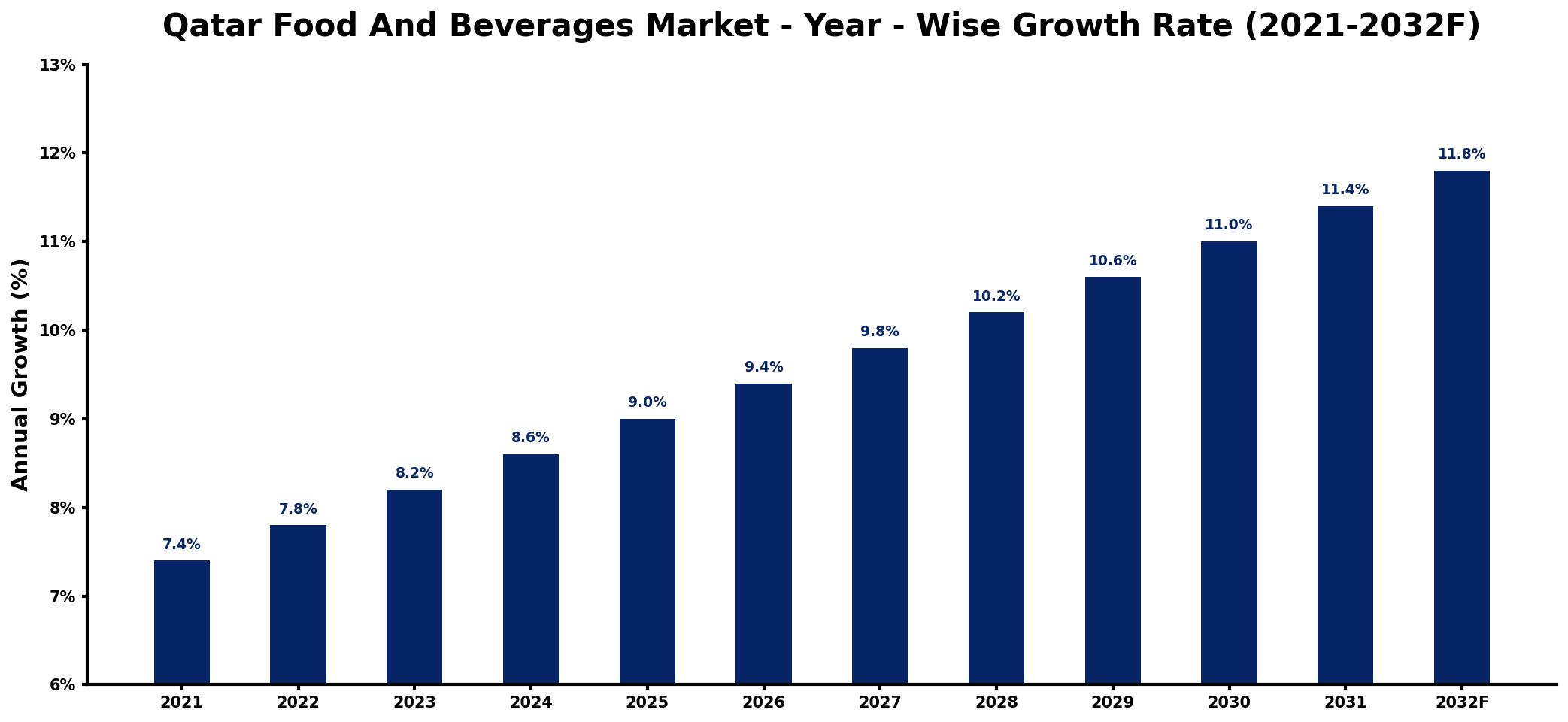
The table below presents the year‑wise growth rates along with the key drivers influencing the market
| Year | Growth Rate | Major Drivers |
| 2021 | 7.4% | Increase in consumer spending habits |
| 2022 | 7.8% | Growth in e-commerce platforms |
| 2023 | 8.2% | Expansion of local production facilities |
| 2024 | 8.6% | Rise in health-conscious consumers |
| 2025 | 9.0% | Investment in sustainable practices |
| 2026 | 9.4% | Development of new distribution channels |
| 2027 | 9.8% | Emergence of innovative product lines |
| 2028 | 10.2% | stronger distribution network expansion |
| 2029 | 10.6% | Strengthening of supply chain networks |
| 2030 | 11.0% | Increased focus on premium offerings |
| 2031 | 11.4% | Adoption of digital marketing strategies |
| 2032 | 11.8% | Enhancement of local sourcing initiatives |
Note: Market size estimations and growth projections presented in this report are based on 6Wresearch's proprietary forecasting methodology, utilizing the latest available industry data, government publications, and primary research inputs.
Qatar Food And Beverages Market Synopsis
In Qatar, a unique blend of traditional and contemporary dining experiences caters to a multicultural population, fueling demand for an extensive variety of food and beverage products. The market's dynamism is significantly influenced by the region's rapid economic growth, where high-income levels allow consumers to indulge in premium food and drink options.
Consumers are increasingly seeking out convenience and health-conscious alternatives, driving brands to innovate in product offerings. This competitive landscape creates ample opportunities for both domestic and international players to establish a foothold and enhance their market presence in Qatar.
Qatar Food And Beverages Market Key Takeaways
- The market is projected to grow significantly, indicating robust consumer spending in the sector.
- There is a notable shift towards healthier food options, reflecting changing dietary preferences.
- The tourism industry's expansion serves as a vital growth driver for food and beverage consumption.
- Innovative dining experiences are gaining popularity, altering traditional consumption patterns.
- Government initiatives play a crucial role in promoting a vibrant culinary culture and industry growth.
Evaluation of Restraints in Qatar Food And Beverages Market
Despite its growth potential, the Qatar Food and Beverages Market faces certain restraints that could impede its trajectory. One significant factor is the shifting consumer demand for healthier options, which requires companies to adapt their product lines quickly. Additionally, the COVID-19 pandemic has left lasting effects on consumer behavior, leading to a focus on home-cooked meals and delivery services that some established brands may struggle to adapt to. These dynamic consumer preferences necessitate continuous innovation and flexibility within the industry.
Qatar Food And Beverages Market Trends
Several current trends are shaping the Qatar Food and Beverages Market. There is a growing interest in organic and locally sourced ingredients, driven by health-conscious consumers. The rise of online food delivery services, accelerated by the pandemic, has transformed how consumers access their favorite meals. Additionally, the trend towards experiential dining—where consumers seek unique culinary experiences—continues to grow, enticing both locals and tourists alike.
Qatar Food And Beverages Market Opportunities
The landscape presents a multitude of growth and investment opportunities. As international brands penetrate the market, local players can innovate to meet diverse consumer preferences. Additionally, there is significant potential in the health and wellness segment, as consumers increasingly seek nutritious options. The integration of technology in food service and delivery offers avenues for operational efficiency and customer engagement, further enhancing market prospects.
Government Initiatives in the Qatar Food And Beverages Market
The Qatari government has implemented various initiatives to foster the growth of its food and beverages sector. Programs promoting local food production, alongside investments in culinary tourism, aim to enhance the countrys food landscape. Moreover, government-led events and festivals celebrating culinary diversity serve to not only boost local businesses but also attract international attention, reinforcing Qatars position as a vibrant hub for gastronomy.
Future Insights of the Qatar Food And Beverages Market
Looking ahead to 2026-2032, the Qatar Food And Beverages Market is poised for transformative growth. With an increasing focus on sustainable practices, companies that adopt eco-friendly initiatives may gain a competitive edge. The ongoing evolution of consumer preferences, particularly towards healthier and diverse options, will further shape product offerings. Continuous government support and the influx of tourism will also drive market expansion, setting the stage for a dynamic food and beverages landscape.
Qatar Food And Beverages Market Latest Developments (2025 - 2026)
Recent developments in the market indicate a stronger shift towards digitalization, with many businesses enhancing their online presence to cater to the growing demand for food delivery. Innovative culinary events have been organized to engage consumers and celebrate the diverse food culture within Qatar. The focus on sustainability has also gained momentum, with several brands committing to environmentally friendly practices, thus responding to the evolving consumer sentiment.
Qatar Food And Beverages Market - Key Attractiveness of the Report
- 10 Years of Market Numbers
- Historical Data Starting from 2022 to 2025
- Base Year: 2025
- Forecast Data until 2032
- Key Performance Indicators Impacting the Market
- Major Upcoming Developments and Projects
Key Highlights of the Report:
- Qatar Food And Beverages Market Outlook
- Market Size of Qatar Food And Beverages Market, 2025
- Forecast of Qatar Food And Beverages Market, 2032
- Historical Data and Forecast of Qatar Food And Beverages Revenues & Volume for the Period 2022-2032F
- Qatar Food And Beverages Market Trend Evolution
- Qatar Food And Beverages Market Drivers and Challenges
- Qatar Food And Beverages Price Trends
- Qatar Food And Beverages Porter's Five Forces
- Qatar Food And Beverages Industry Life Cycle
- Historical Data and Forecast of Qatar Food And Beverages Market Revenues & Volume By Type for the Period 2022-2032F
- Historical Data and Forecast of Qatar Food And Beverages Market Revenues & Volume By Alcoholic Beverages for the Period 2022-2032F
- Historical Data and Forecast of Qatar Food And Beverages Market Revenues & Volume By Non-Alcoholic Beverages for the Period 2022-2032F
- Historical Data and Forecast of Qatar Food And Beverages Market Revenues & Volume By Grain Products for the Period 2022-2032F
- Historical Data and Forecast of Qatar Food And Beverages Market Revenues & Volume By Bakery and Confectionary for the Period 2022-2032F
- Historical Data and Forecast of Qatar Food And Beverages Market Revenues & Volume By Frozen for the Period 2022-2032F
- Historical Data and Forecast of Qatar Food And Beverages Market Revenues & Volume By Canned and Dried Food for the Period 2022-2032F
- Historical Data and Forecast of Qatar Food And Beverages Market Revenues & Volume By Dairy Food for the Period 2022-2032F
- Historical Data and Forecast of Qatar Alcoholic Beverages Food And Beverages Market Revenues & Volume By Meat for the Period 2022-2032F
- Historical Data and Forecast of Qatar Food And Beverages Market Revenues & Volume By Distribution Channel for the Period 2022-2032F
- Historical Data and Forecast of Qatar Food And Beverages Market Revenues & Volume By Supermarkets/Hypermarkets for the Period 2022-2032F
- Historical Data and Forecast of Qatar Food And Beverages Market Revenues & Volume By Convenience Stores for the Period 2022-2032F
- Historical Data and Forecast of Qatar Food And Beverages Market Revenues & Volume By E-Commerce for the Period 2022-2032F
- Historical Data and Forecast of Qatar Food And Beverages Market Revenues & Volume By Others for the Period 2022-2032F
- Historical Data and Forecast of Qatar Food And Beverages Market Revenues & Volume By Nature for the Period 2022-2032F
- Historical Data and Forecast of Qatar Food And Beverages Market Revenues & Volume By Organic for the Period 2022-2032F
- Historical Data and Forecast of Qatar Food And Beverages Market Revenues & Volume By Conventional for the Period 2022-2032F
- Qatar Food And Beverages Import Export Trade Statistics
- Market Opportunity Assessment By Type
- Market Opportunity Assessment By Distribution Channel
- Market Opportunity Assessment By Nature
- Qatar Food And Beverages Top Companies Market Share
- Qatar Food And Beverages Competitive Benchmarking By Technical and Operational Parameters
- Qatar Food And Beverages Company Profiles
- Qatar Food And Beverages Key Strategic Recommendations






































