Qatar Fuel Station Market Size, Share & Growth Rate
The Qatar Fuel Station Market was estimated at USD 397 Million in 2025 and is projected to reach USD 554 Million by 2032, growing at a CAGR of 4.9% from 2026 to 2032. This trajectory is fueled by a dynamic economic landscape and increasing vehicle ownership, alongside a commitment to enhancing transport infrastructure. As urban areas expand and consumer preferences shift towards convenience, fuel stations are evolving to meet diverse demands, ensuring robust growth ahead.
Qatar Fuel Station Market Year-wise Growth Rate and Key Drivers
This graph highlights how the Qatar Fuel Station Market has steadily grown over the years, supported by major growth factors.
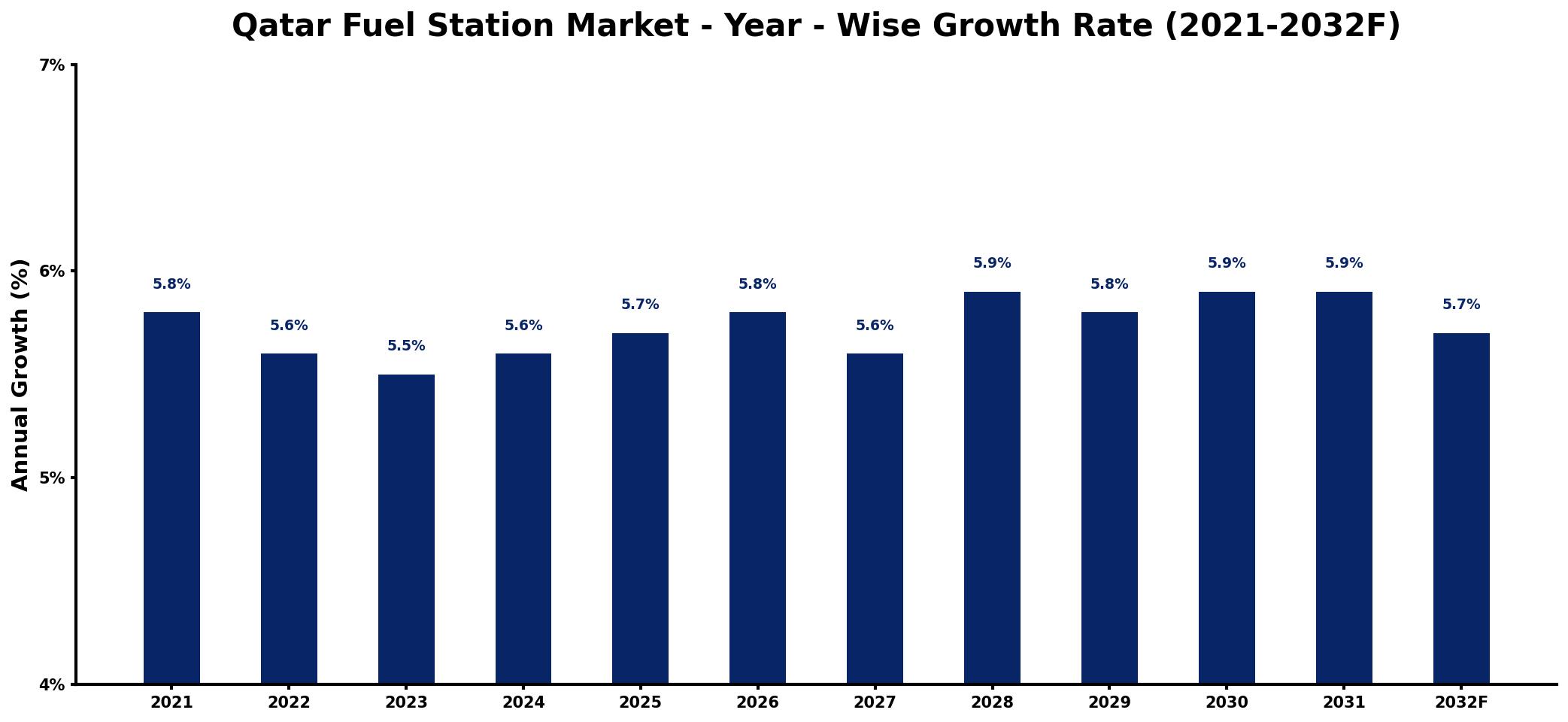
The table below presents the year‑wise growth rates along with the key drivers influencing the market
| Year | Growth Rate | Major Drivers |
| 2021 | 5.8% | Rising energy demand from industries |
| 2022 | 5.6% | Increased investments in infrastructure |
| 2023 | 5.5% | Growing population driving consumption |
| 2024 | 5.6% | Expansion of transportation networks |
| 2025 | 5.7% | Boost in tourism and travel |
| 2026 | 5.8% | Advancements in logistics technologies |
| 2027 | 5.6% | Strengthening regional trade agreements |
| 2028 | 5.9% | Heightened urbanization trends observed |
| 2029 | 5.8% | Emergence of alternative energy sources |
| 2030 | 5.9% | Increased government sustainability initiatives |
| 2031 | 5.9% | Growth of electric vehicle market |
| 2032 | 5.7% | Rising consumer preferences for convenience |
Note: Market size estimations and growth projections presented in this report are based on 6Wresearch's proprietary forecasting methodology, utilizing the latest available industry data, government publications, and primary research inputs.
Qatar Fuel Station Market Synopsis
The increasing vehicle ownership in Qatar is the strongest force shaping the fuel station market today. With a rising population and an expanding economy, the demand for fuel continues to soar, requiring a responsive and adaptable refueling infrastructure. Fuel stations are not merely dispensaries of fuel but vital service hubs that offer a range of amenities, from convenience stores to car wash services.
As the government invests in transportation enhancements and sustainable mobility initiatives, the fuel station market finds itself at a pivotal crossroads. This combination of investment and evolving consumer needs is propelling the market towards innovative solutions, paving the way for growth and transformation in the coming years.
Qatar Fuel Station Market Key Takeaways
- The Qatar fuel station market is experiencing steady growth driven by increasing vehicle registrations.
- Urbanization and rising demand for transportation fuel are significant contributors to market expansion.
- Technological advancements, including electric vehicle charging stations, are reshaping traditional fuel stations.
- Government initiatives focus on improving infrastructure and promoting sustainable energy alternatives.
- The market remains sensitive to external factors, highlighting the need for operational adaptability.
Evaluation of Restraints in Qatar Fuel Station Market
Despite the encouraging growth trajectory, the Qatar fuel station market grapples with notable restraints. The shift towards electric vehicles (EVs) represents a significant challenge to traditional fuel retailers. The need for extensive investment in EV charging infrastructure creates a complex landscape requiring collaboration among multiple stakeholders. Additionally, ensuring the compatibility and safety of charging systems across various EV models introduces technical challenges that fuel station operators must navigate carefully to remain competitive and profitable.
Qatar Fuel Station Market Trends
The Qatar fuel station market is witnessing several emerging trends that are shaping its landscape. One prominent trend is the increasing integration of renewable energy sources and alternative fuels, reflecting a growing consumer preference for sustainable options. Additionally, the incorporation of digital technologies and mobile applications is enhancing customer engagement and operational efficiency. This trend towards digitalization enables fuel stations to better meet consumer expectations for convenience and service quality.
Qatar Fuel Station Market Opportunities
Within the evolving dynamics of the Qatar fuel station market lie numerous growth and investment opportunities. The expansion of urban areas and the accompanying rise in vehicle numbers present a fertile ground for new fuel stations, especially in underserved regions. Furthermore, the transition towards cleaner energy sources opens avenues for fuel stations to diversify their services, including offering electric vehicle charging solutions and alternative fuel options. By strategically positioning themselves in these emerging markets, operators can enhance their competitive edge.
Government Initiatives in the Qatar Fuel Station Market
The Qatari government is proactively investing in initiatives aimed at advancing the fuel station market. Key policies are focused on enhancing transportation infrastructure and encouraging sustainable practices within the sector. Incentives for adopting cleaner energy technologies and the development of extensive EV charging networks are part of the governments strategy. Public spending aimed at upgrading existing stations and expanding the network enhances market accessibility and service quality.
Future Insights of the Qatar Fuel Station Market
Looking forward to the period between 2026 and 2032, the Qatar fuel station market is set to undergo significant transformation. The shift towards electric vehicles and sustainable energy sources is expected to reshape the operational landscape of fuel stations. As consumer behavior evolves, operators will need to adapt, focusing on diversification of services and enhancing customer experience. The market's resilience, coupled with strategic government initiatives, positions it for steady growth in the coming years.
Qatar Fuel Station Market Latest Developments (2025 - 2026)
Recent developments in the Qatar fuel station market indicate a growing trend towards modernization and sustainability. Operators are increasingly integrating advanced technologies, such as digital payment systems and smart fuel management solutions, to enhance operational efficiency. In addition, several fuel stations are beginning to install electric vehicle charging stations to cater to the rising demand for sustainable transportation. Such initiatives reflect the market's commitment to adapting to changing consumer preferences and industry standards.
Qatar Fuel Station Market - Key Attractiveness of the Report
- 10 Years of Market Numbers
- Historical Data Starting from 2022 to 2025
- Base Year: 2025
- Forecast Data until 2032
- Key Performance Indicators Impacting the Market
- Major Upcoming Developments and Projects
Key Highlights of the Report:
- Qatar Fuel Station Market Outlook
- Market Size of Qatar Fuel Station Market, 2025
- Forecast of Qatar Fuel Station Market, 2032
- Historical Data and Forecast of Qatar Fuel Station Revenues & Volume for the Period 2022-2032F
- Qatar Fuel Station Market Trend Evolution
- Qatar Fuel Station Market Drivers and Challenges
- Qatar Fuel Station Price Trends
- Qatar Fuel Station Porter's Five Forces
- Qatar Fuel Station Industry Life Cycle
- Historical Data and Forecast of Qatar Fuel Station Market Revenues & Volume By Fuel for the Period 2022-2032F
- Historical Data and Forecast of Qatar Fuel Station Market Revenues & Volume By Gasoline for the Period 2022-2032F
- Historical Data and Forecast of Qatar Fuel Station Market Revenues & Volume By Diesel for the Period 2022-2032F
- Historical Data and Forecast of Qatar Fuel Station Market Revenues & Volume By Gas for the Period 2022-2032F
- Historical Data and Forecast of Qatar Fuel Station Market Revenues & Volume By others for the Period 2022-2032F
- Historical Data and Forecast of Qatar Fuel Station Market Revenues & Volume By End-User for the Period 2022-2032F
- Historical Data and Forecast of Qatar Fuel Station Market Revenues & Volume By Road Transport Vehicles for the Period 2022-2032F
- Historical Data and Forecast of Qatar Fuel Station Market Revenues & Volume By Air Transport Vehicles for the Period 2022-2032F
- Historical Data and Forecast of Qatar Fuel Station Market Revenues & Volume By Water Transport Vehicles for the Period 2022-2032F
- Qatar Fuel Station Import Export Trade Statistics
- Market Opportunity Assessment By Fuel
- Market Opportunity Assessment By End-User
- Qatar Fuel Station Top Companies Market Share
- Qatar Fuel Station Competitive Benchmarking By Technical and Operational Parameters
- Qatar Fuel Station Company Profiles
- Qatar Fuel Station Key Strategic Recommendations






































