Qatar Gaming Market Size, Share & Growth Rate
The Qatar Gaming Market was estimated at USD 323 Million in 2025 and is projected to reach USD 464 Million by 2032, growing at a CAGR of 5.3% from 2026 to 2032. This growth trajectory is propelled by the increasing youth demographic that is not only tech-savvy but also actively participates in both console and PC gaming. Additionally, the rise of esports in the region is contributing significantly to the overall market dynamism, as Qatari players engage in competitive gaming at both regional and international levels.
Qatar Gaming Market Year-wise Growth Rate and Key Drivers
This graph highlights how the Qatar Gaming Market has steadily grown over the years, supported by major growth factors.
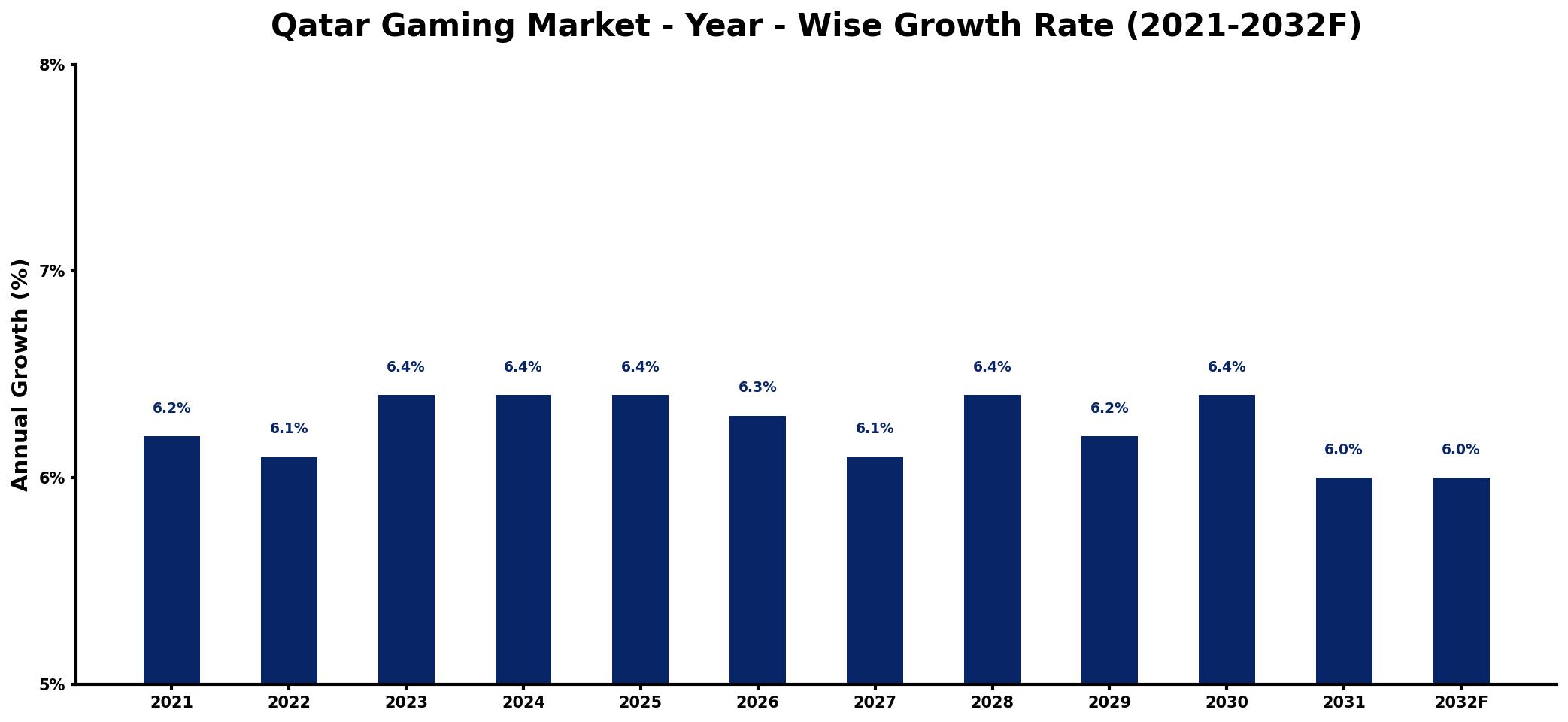
The table below presents the year‑wise growth rates along with the key drivers influencing the market
| Year | Growth Rate | Major Drivers |
| 2021 | 6.2% | Rise in digital entertainment demand |
| 2022 | 6.1% | Increased disposable income levels |
| 2023 | 6.4% | Expansion of online platforms |
| 2024 | 6.4% | Growth in mobile technology usage |
| 2025 | 6.4% | Surge in social interaction events |
| 2026 | 6.3% | Emergence of new technologies |
| 2027 | 6.1% | Higher participation in community events |
| 2028 | 6.4% | Development of immersive experiences |
| 2029 | 6.2% | Increase in international tourism interest |
| 2030 | 6.4% | Continued investment in infrastructure |
| 2031 | 6.0% | Strengthening of regulatory frameworks |
| 2032 | 6.0% | Diversification of entertainment offerings |
Note: Market size estimations and growth projections presented in this report are based on 6Wresearch's proprietary forecasting methodology, utilizing the latest available industry data, government publications, and primary research inputs.
Qatar Gaming Market Synopsis
The appetite for video games in Qatar has intensified, particularly among the younger populace, fostering a vibrant gaming culture. With advancements in technology, accessibility to various gaming platforms has expanded, creating a robust environment for diverse gaming experiences. The flourishing esports scene is not just a pastime; it is becoming a celebrated aspect of local entertainment and community engagement.
Government support is also notable, with initiatives aimed at developing infrastructure for gaming and esports. This backing has catalyzed partnerships with international entities, further establishing Qatar as a regional gaming hub. The strategic investment in gaming-related events and talent development positions the country as a pivotal player in the broader MENA gaming landscape.
Qatar Gaming Market Key Takeaways
- The youth demographic is a primary driver of gaming interest, leading to a robust local community.
- Technological advancements, especially in high-speed internet and mobile accessibility, are boosting market growth.
- Esports has become a prominent cultural element, with increased participation in international competitions.
- Government policies favor the development of gaming infrastructure, attracting international collaborations.
- There is a growing trend toward digital distribution, reflecting changes in consumer behavior post-COVID-19.
Evaluation of Restraints in Qatar Gaming Market
Despite its growth, the Qatar gaming market faces notable restraints. Cultural sensitivities influence regulatory frameworks, particularly regarding content deemed inappropriate, leading to stricter controls on game availability. This often results in a limited selection for gamers, hindering market potential. Furthermore, ongoing challenges related to internet infrastructure and connectivity can disrupt the online gaming experience, creating barriers to seamless engagement.
Additionally, while there is a concerted effort to attract international gaming events to Qatar, competition from established global gaming hubs necessitates significant investment in infrastructure and incentives. Striking a balance between cultural norms and the demand for diverse gaming content remains an ongoing challenge for stakeholders in the industry.
Qatar Gaming Market Trends
A shift towards mobile gaming is gaining traction, driven by the prevalence of smartphones among the youth. Furthermore, the integration of virtual reality (VR) and augmented reality (AR) technologies is becoming increasingly popular, enhancing the immersive gaming experience. Gamification in educational contexts is also emerging, reflecting a broader acceptance of gaming's role beyond mere entertainment. The advent of cross-platform gaming is another trend, enabling gamers on different devices to connect, further enriching the local gaming community.
Qatar Gaming Market Opportunities
Investors and entrepreneurs will find ample opportunities within the Qatar gaming market, particularly in the esports sector. Establishing dedicated gaming arenas and event spaces can capitalize on the growing enthusiasm for competitive gaming. Additionally, there is a strong need for local game development, offering a niche for creative industries to flourish. Collaborations with educational institutions to develop gaming-related curricula can also harness the potential of young talent, creating a pipeline of skilled professionals for the industry.
Government Initiatives in the Qatar Gaming Market
The Qatari government is actively promoting the gaming sector as a critical component of its economic diversification strategy. Investments are being funneled into building esports infrastructure and hosting regional tournaments. Programs aimed at nurturing local talent are being prioritized, reflecting a commitment to developing a sustainable gaming ecosystem. Public-private partnerships are also being explored to foster collaboration between the government and private sector stakeholders, enhancing the industrys growth potential.
Future Insights of the Qatar Gaming Market
Looking ahead to 2026-2032, the Qatar gaming market is poised for robust growth as technological advancements continue to reshape consumer experiences. The burgeoning interest in esports will likely drive increased investment in competitions and infrastructure, positioning Qatar as a major player in the regional landscape. Additionally, as cultural acceptance of gaming broadens, a more diverse range of game offerings may emerge, further engaging the local community and attracting international gamers. Overall, the market's evolution will be characterized by innovation, investment, and increased connectivity.
Qatar Gaming Market Latest Developments (2025 - 2026)
In recent months, the Qatar gaming industry has seen an uptick in collaborative initiatives with global gaming studios, aimed at enriching the local content library. The government has ramped up efforts to host major esports tournaments, enhancing visibility for Qatar in the international gaming community. Additionally, various tech companies have launched campaigns to promote mobile gaming, reflecting the increasing demand for accessible gaming solutions. Overall, the market is trending towards a more interconnected and dynamic ecosystem.
Qatar Gaming Market - Key Attractiveness of the Report
- 10 Years of Market Numbers
- Historical Data Starting from 2022 to 2025
- Base Year: 2025
- Forecast Data until 2032
- Key Performance Indicators Impacting the Market
- Major Upcoming Developments and Projects
Key Highlights of the Report:
- Qatar Gaming Market Outlook
- Market Size of Qatar Gaming Market, 2025
- Forecast of Qatar Gaming Market, 2032
- Historical Data and Forecast of Qatar Gaming Revenues & Volume for the Period 2022-2032F
- Qatar Gaming Market Trend Evolution
- Qatar Gaming Market Drivers and Challenges
- Qatar Gaming Price Trends
- Qatar Gaming Porter's Five Forces
- Qatar Gaming Industry Life Cycle
- Historical Data and Forecast of Qatar Gaming Market Revenues & Volume By Game Type for the Period 2022-2032F
- Historical Data and Forecast of Qatar Gaming Market Revenues & Volume By Shooter for the Period 2022-2032F
- Historical Data and Forecast of Qatar Gaming Market Revenues & Volume By Action for the Period 2022-2032F
- Historical Data and Forecast of Qatar Gaming Market Revenues & Volume By Sports for the Period 2022-2032F
- Historical Data and Forecast of Qatar Gaming Market Revenues & Volume By Role-Playing for the Period 2022-2032F
- Historical Data and Forecast of Qatar Gaming Market Revenues & Volume By Others for the Period 2022-2032F
- Historical Data and Forecast of Qatar Gaming Market Revenues & Volume By Device Type for the Period 2022-2032F
- Historical Data and Forecast of Qatar Gaming Market Revenues & Volume By PC/MMO for the Period 2022-2032F
- Historical Data and Forecast of Qatar Gaming Market Revenues & Volume By Tablet for the Period 2022-2032F
- Historical Data and Forecast of Qatar Gaming Market Revenues & Volume By Mobile Phone for the Period 2022-2032F
- Historical Data and Forecast of Qatar Gaming Market Revenues & Volume By TV/Console for the Period 2022-2032F
- Historical Data and Forecast of Qatar Gaming Market Revenues & Volume By End-User for the Period 2022-2032F
- Historical Data and Forecast of Qatar Gaming Market Revenues & Volume By Male for the Period 2022-2032F
- Historical Data and Forecast of Qatar Gaming Market Revenues & Volume By Female for the Period 2022-2032F
- Qatar Gaming Import Export Trade Statistics
- Market Opportunity Assessment By Game Type
- Market Opportunity Assessment By Device Type
- Market Opportunity Assessment By End-User
- Qatar Gaming Top Companies Market Share
- Qatar Gaming Competitive Benchmarking By Technical and Operational Parameters
- Qatar Gaming Company Profiles
- Qatar Gaming Key Strategic Recommendations






































