Qatar Gas Equipment Market Size, Share & Growth Rate
The Qatar Gas Equipment Market was estimated at USD 446 Million in 2025 and is projected to reach USD 581 Million by 2032, growing at a CAGR of 3.8% from 2026 to 2032. This projected growth trajectory is underscored by Qatar's strategic initiatives to leverage its rich natural gas resources, emphasizing cleaner energy solutions across diverse sectors. A governmental push towards infrastructure investment and the development of liquefied natural gas (LNG) capabilities further fuels the demand for advanced gas equipment, positioning Qatar as a key player in the global energy landscape.
Qatar Gas Equipment Market Year-wise Growth Rate and Key Drivers
This graph highlights how the Qatar Gas Equipment Market has steadily grown over the years, supported by major growth factors.
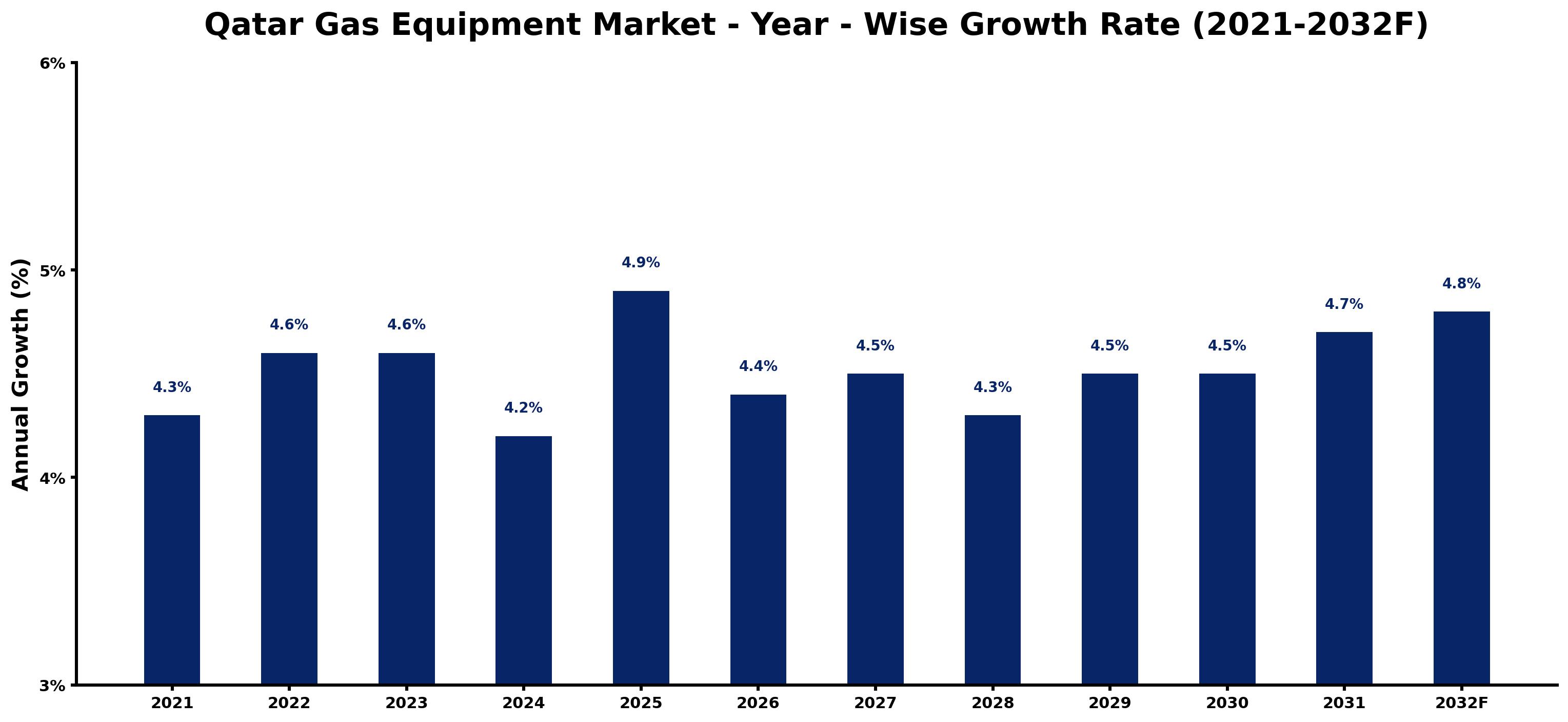
The table below presents the year‑wise growth rates along with the key drivers influencing the market
| Year | Growth Rate | Major Drivers |
| 2021 | 4.3% | Expansion of manufacturing activities |
| 2022 | 4.6% | Increasing adoption of advanced technologies |
| 2023 | 4.6% | Rising electricity demand across industries |
| 2024 | 4.2% | Rapid growth in telecom and data center sectors |
| 2025 | 4.9% | Increasing smart city development projects |
| 2026 | 4.4% | Increasing adoption of advanced technologies |
| 2027 | 4.5% | Rapid growth in telecom and data center sectors |
| 2028 | 4.3% | Government infrastructure modernization initiatives |
| 2029 | 4.5% | Expansion of commercial construction activities |
| 2030 | 4.5% | Expansion of transportation and logistics networks |
| 2031 | 4.7% | Increasing industrial automation investments |
| 2032 | 4.8% | Expansion of manufacturing activities |
Note - Market size estimations and growth projections presented in this report are based on 6Wresearch's advanced forecasting approach, validated with industry datasets as of June 2026.
Qatar Gas Equipment Market Synopsis
The Qatar Gas Equipment Market is undergoing transformative growth as the country capitalizes on its extensive natural gas reserves. The government's policies actively promote the integration of natural gas into power generation, industrial applications, and transportation systems. This alignment not only ensures energy sustainability but also enhances economic diversification.
The increasing focus on natural gas as a cleaner alternative to traditional fossil fuels drives the demand for specialized gas equipment. Qatar's commitment to expanding its gas processing facilities and LNG infrastructure positions it as a crucial exporter on the global stage, creating a robust market environment for gas equipment suppliers.
Qatar Gas Equipment Market Key Takeaways
- The market is projected to grow steadily with a CAGR of 3.8% from 2026 to 2032.
- Infrastructure investments are significantly influencing the growth of gas equipment demand.
- There is a critical shift towards cleaner energy alternatives in various sectors.
- Qatar's strategic role as a leading LNG exporter enhances its market attractiveness.
- Resilience and recovery from pandemic impacts are reshaping the market dynamics.
Evaluation of Restraints in Qatar Gas Equipment Market
Despite notable growth, the Qatar Gas Equipment Market is not without its challenges. Price volatility in global energy markets poses a significant risk, affecting project viability and investment decisions. Moreover, increasing competition from international suppliers necessitates local companies to innovate and ensure high-quality standards to maintain market share. These factors compel stakeholders to strategically navigate uncertainties while leveraging Qatar's unique advantages in the gas sector.
Qatar Gas Equipment Market Trends
A shift towards digitization and automation within the gas equipment sector is emerging, enhancing operational efficiency and reducing costs. Additionally, a growing emphasis on sustainability is driving the adoption of technologies that minimize environmental impact. The integration of renewable energy sources alongside natural gas usage is becoming increasingly prominent, reflecting a broader trend towards hybrid energy solutions in Qatar.
Qatar Gas Equipment Market Opportunities
The ongoing developments in Qatar's LNG projects present considerable growth opportunities for gas equipment suppliers. Expansion initiatives in gas processing and transportation infrastructure pave the way for innovative technologies and solutions. Furthermore, as the global demand for clean energy rises, Qatar's established reputation as a reliable LNG provider positions it favorably for international collaborations and export opportunities.
Government Initiatives in the Qatar Gas Equipment Market
The Qatari government is heavily investing in the expansion of its gas infrastructure as part of its National Vision 2030 strategy. This includes funding for gas processing facilities, new LNG terminals, and incentives to attract foreign investment into the gas sector. Such initiatives demonstrate a commitment to enhancing domestic capabilities while also promoting sustainability within the energy landscape.
Future Insights of the Qatar Gas Equipment Market
Looking ahead to the period of 2026-2032, the Qatar Gas Equipment Market is expected to experience robust growth driven by technological advancements and increased investment in infrastructure. The continuous push for cleaner energy alternatives will likely shape the market landscape, encouraging innovations in gas extraction and processing technologies. As Qatar strengthens its position as a key LNG player, the prospects for gas equipment will remain bright, appealing to both domestic and international stakeholders.
Qatar Gas Equipment Market Latest Developments (May 2025 - June 2026)
Recent developments within the Qatar Gas Equipment Market have showcased a renewed focus on enhancing operational efficiencies through technology adoption. Industry players are increasingly investing in automation and digital solutions to streamline processes. The government has also signaled ongoing support for infrastructure expansions and renewable energy integration, indicating a robust trajectory for market growth and sustainability initiatives.
Qatar Gas Equipment Market - Key Attractiveness of the Report
- 10 Years of Market Numbers
- Historical Data Starting from 2022 to 2025
- Base Year: 2025
- Forecast Data until 2032
- Key Performance Indicators Impacting the Market
- Major Upcoming Developments and Projects
Key Highlights of the Report:
- Qatar Gas Equipment Market Outlook
- Market Size of Qatar Gas Equipment Market, 2025
- Forecast of Qatar Gas Equipment Market, 2032
- Historical Data and Forecast of Qatar Gas Equipment Revenues & Volume for the Period 2022-2032F
- Qatar Gas Equipment Market Trend Evolution
- Qatar Gas Equipment Market Drivers and Challenges
- Qatar Gas Equipment Price Trends
- Qatar Gas Equipment Porter's Five Forces
- Qatar Gas Equipment Industry Life Cycle
- Historical Data and Forecast of Qatar Gas Equipment Market Revenues & Volume By Equipment Type for the Period 2022-2032F
- Historical Data and Forecast of Qatar Gas Equipment Market Revenues & Volume By Gas Delivery Systems for the Period 2022-2032F
- Historical Data and Forecast of Qatar Gas Equipment Market Revenues & Volume By Gas Regulators for the Period 2022-2032F
- Historical Data and Forecast of Qatar Gas Equipment Market Revenues & Volume By Flow Devices for the Period 2022-2032F
- Historical Data and Forecast of Qatar Gas Equipment Market Revenues & Volume By Purifiers & Filters for the Period 2022-2032F
- Historical Data and Forecast of Qatar Gas Equipment Market Revenues & Volume By Gas Generating Systems for the Period 2022-2032F
- Historical Data and Forecast of Qatar Gas Equipment Market Revenues & Volume By Gas Detection Systems for the Period 2022-2032F
- Historical Data and Forecast of Qatar Gas Equipment Market Revenues & Volume By Cryogenic Products for the Period 2022-2032F
- Historical Data and Forecast of Qatar Gas Delivery Systems Gas Equipment Market Revenues & Volume By Accessories for the Period 2022-2032F
- Historical Data and Forecast of Qatar Gas Equipment Market Revenues & Volume By Process for the Period 2022-2032F
- Historical Data and Forecast of Qatar Gas Equipment Market Revenues & Volume By Gas Generation for the Period 2022-2032F
- Historical Data and Forecast of Qatar Gas Equipment Market Revenues & Volume By Gas Storage for the Period 2022-2032F
- Historical Data and Forecast of Qatar Gas Equipment Market Revenues & Volume By Gas Detection for the Period 2022-2032F
- Historical Data and Forecast of Qatar Gas Equipment Market Revenues & Volume By Gas Transportation for the Period 2022-2032F
- Historical Data and Forecast of Qatar Gas Equipment Market Revenues & Volume By End-Gas for the Period 2022-2032F
- Historical Data and Forecast of Qatar Gas Equipment Market Revenues & Volume By Nitrogen for the Period 2022-2032F
- Historical Data and Forecast of Qatar Gas Equipment Market Revenues & Volume By Hydrogen for the Period 2022-2032F
- Historical Data and Forecast of Qatar Gas Equipment Market Revenues & Volume By Helium for the Period 2022-2032F
- Historical Data and Forecast of Qatar Gas Equipment Market Revenues & Volume By Oxygen for the Period 2022-2032F
- Historical Data and Forecast of Qatar Gas Equipment Market Revenues & Volume By Carbon Dioxide for the Period 2022-2032F
- Historical Data and Forecast of Qatar Gas Equipment Market Revenues & Volume By Others for the Period 2022-2032F
- Historical Data and Forecast of Qatar Gas Equipment Market Revenues & Volume By End-Users for the Period 2022-2032F
- Historical Data and Forecast of Qatar Gas Equipment Market Revenues & Volume By Metal Fabrication for the Period 2022-2032F
- Historical Data and Forecast of Qatar Gas Equipment Market Revenues & Volume By Chemicals for the Period 2022-2032F
- Historical Data and Forecast of Qatar Gas Equipment Market Revenues & Volume By Healthcare for the Period 2022-2032F
- Historical Data and Forecast of Qatar Gas Equipment Market Revenues & Volume By Oil and Gas for the Period 2022-2032F
- Historical Data and Forecast of Qatar Gas Equipment Market Revenues & Volume By Food and Beverage for the Period 2022-2032F
- Historical Data and Forecast of Qatar Gas Equipment Market Revenues & Volume By Others for the Period 2022-2032F
- Qatar Gas Equipment Import Export Trade Statistics
- Market Opportunity Assessment By Equipment Type
- Market Opportunity Assessment By Process
- Market Opportunity Assessment By End-Gas
- Market Opportunity Assessment By End-Users
- Qatar Gas Equipment Top Companies Market Share
- Qatar Gas Equipment Competitive Benchmarking By Technical and Operational Parameters
- Qatar Gas Equipment Company Profiles
- Qatar Gas Equipment Key Strategic Recommendations






































