Qatar Gift Retailing Market Summary
The qatar gift retailing market was estimated at USD 1227 Million in 2025 and is projected to reach USD 2270 Million by 2032, growing at a CAGR of 10.6% from 2026 to 2032.
Qatar Gift Retailing Market Year-wise Growth Rate and Key Drivers
This graph highlights how the Qatar Gift Retailing Market has steadily grown over the past five years, supported by major growth factors.
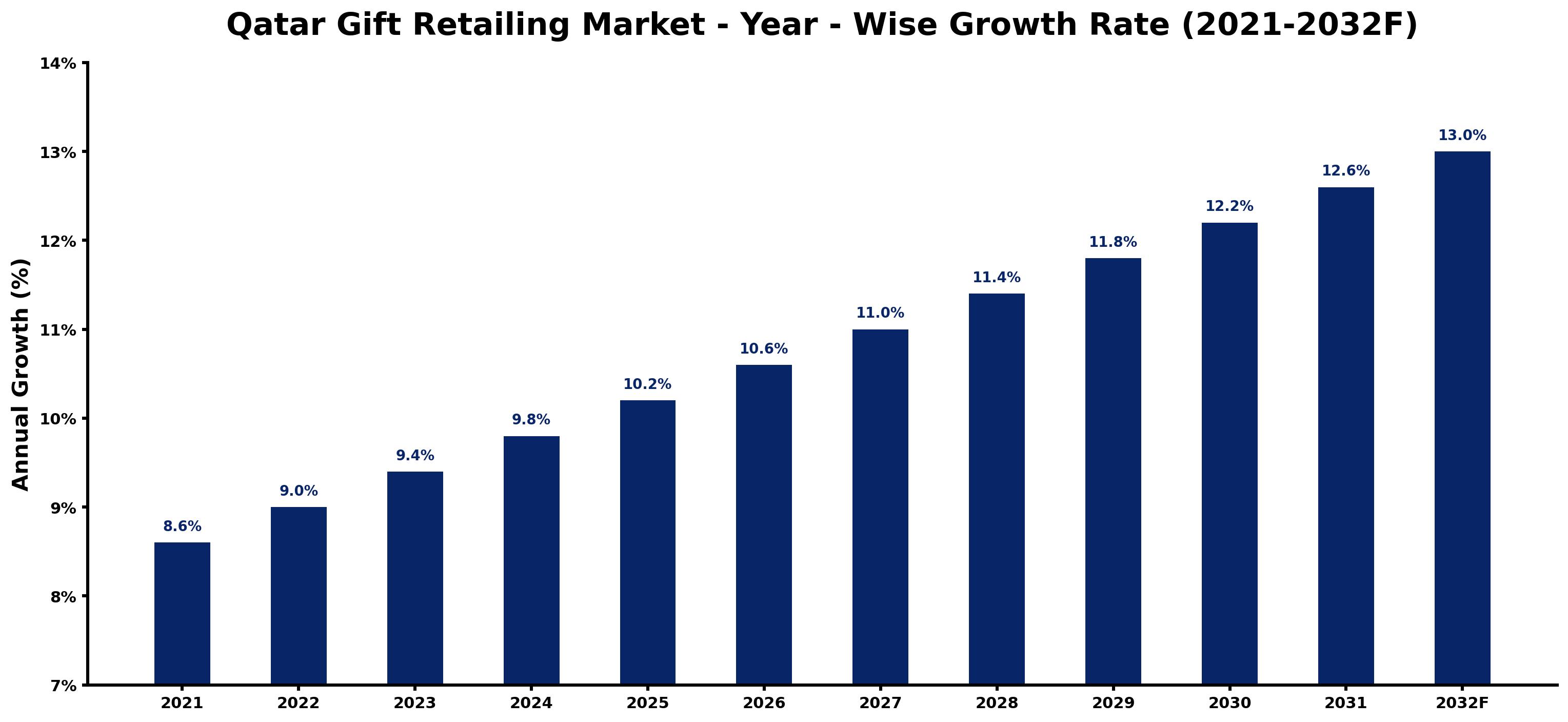
The table below presents the year wise growth rates along with the key drivers influencing the market
| Year | Growth Rate | Major Drivers |
| 2021 | 8.6% | Post-lockdown retail projects ignited consumer interest in unique gift offerings. |
| 2022 | 9.0% | Cultural festivals and holidays showcased local artisans' talents, boosting market visibility. |
| 2023 | 9.4% | E-commerce platforms expanded, offering convenience for gift shopping in Qatar. |
| 2024 | 9.8% | Collaborations with local artists created distinctive products appealing to tourists. |
| 2025 | 10.2% | Corporate gifting trends highlighted customization, enhancing brand loyalty and engagement. |
| 2026 | 10.6% | Millennials and Gen Z increasingly influenced gift preferences towards sustainability and uniqueness. |
| 2027 | 11.0% | Urbanization accelerated, with new shopping malls fostering a vibrant retail environment. |
| 2028 | 11.4% | Digital marketing campaigns targeted younger demographics, elevating online sales significantly. |
| 2029 | 11.8% | Experiential gifting options emerged, reflecting a shift towards memorable purchasing experiences. |
| 2030 | 12.2% | Investment in luxury retail segments attracted affluent shoppers seeking exclusive items. |
| 2031 | 12.6% | Local brands gained recognition, promoting Qatari culture through their gift offerings. |
| 2032 | 13.0% | Technological innovations transformed personalization, tailoring gifts to individual consumer preferences. |
Note - Market size estimations and growth projections presented in this report are based on 6Wresearch's advanced forecasting approach, validated with industry datasets as of June 2026.
Qatar Gift Retailing Market Synopsis
The Qatar Gift Retailing Market is projected to reach 10.6% and witness significant growth during the forecast period (2026-2032). The gift retail sector in Qatar is deeply rooted in cultural practices, with gifting being an integral part of social interactions during numerous occasions, including religious celebrations, weddings, and birthdays. The increase in population, enhanced disposable incomes, and a growing expatriate community are all crucial drivers contributing to the evolving landscape of the Qatar gift retailing market.
Qatar Gift Retailing Market Growth Drivers
Several factors are propelling the growth of the Qatar gift retailing market. Firstly, the cultural significance of gifting permeates various aspects of Qatari life, enabling consistent demand throughout the year. Secondly, a burgeoning tourism sector has resulted in an influx of visitors keen on purchasing gifts and souvenirs, which bolsters sales for retailers across the country. Thirdly, the increasing income levels among residents encourage higher spending on gifts, further stimulating market expansion. Additionally, the influx of expatriates has diversified consumer preferences, prompting retailers to adapt their offerings accordingly. Lastly, effective marketing strategies, including promotions during peak seasons, have positively influenced consumer engagement and sales outcomes.
Qatar Gift Retailing Market Challenges and Restraints
Despite its growth potential, the Qatar gift retailing market faces significant challenges. The Covid-19 pandemic had a considerable impact on consumer behavior, leading to altered spending patterns and a decline in store foot traffic. Restrictions on movement and social distancing measures further exacerbated these challenges, prompting retailers to pivot towards e-commerce. This shift required an abrupt adaptation to digital sales channels and innovative customer engagement strategies. Additionally, fluctuating economic conditions could potentially influence consumer purchasing power, thereby impacting overall market demand.
Qatar Gift Retailing Market Government Investment and Initiatives
The Qatari government has implemented several initiatives to foster growth in the gift retailing sector. Efforts to enhance tourism—such as hosting international events—have created a favorable environment for gift retailing by attracting visitors eager to purchase local products. Investments in infrastructure improvements and public spaces have also made shopping districts more accessible and appealing to tourists and residents alike. Additionally, government policies promoting local entrepreneurship encourage new entrants in the retail space, further enriching the market. Initiatives to support e-commerce development are also increasingly relevant, particularly as consumer preferences shift towards online shopping.
Qatar Gift Retailing Market Trends and Opportunities
The Qatar gift retailing market is witnessing notable trends that present opportunities for growth. The rise of e-commerce has transformed traditional retail dynamics, offering retailers the chance to expand their reach and customer base. Moreover, there is a growing trend towards personalized and unique gifts that resonate with consumers' desires for meaningful gestures. Retailers are also increasingly focusing on sustainable and local products, catering to environmentally conscious consumers who seek to support local artisans. Additionally, innovative marketing campaigns that leverage social media are gaining traction, enabling brands to effectively engage with younger demographics.
Qatar Gift Retailing Market Latest Developments (May 2025 - June 2026)
From May 2025 to June 2026, the Qatar gift retailing market has experienced a series of developments aimed at revitalizing the sector post-Covid-19. Retailers have increasingly focused on enhancing their online presence, optimizing websites for better user experience, and integrating digital payment solutions. Additionally, brick-and-mortar stores have begun implementing safety measures to reassure customers and encourage in-store visits. Promotions and targeted advertising campaigns have been employed to re-engage consumers, focusing on emotional connections during significant gifting occasions. Furthermore, collaborations with local artists and designers have emerged, offering distinctive product lines that celebrate Qatari culture. These initiatives illustrate a proactive approach towards rebuilding consumer trust and stimulating market activity.
Qatar Gift Retailing Market - Key Attractiveness of the Report
- 10 Years of Market Numbers
- Historical Data Starting from 2022 to 2025
- Base Year: 2025
- Forecast Data until 2032
- Key Performance Indicators Impacting the Market
- Major Upcoming Developments and Projects
Key Highlights of the Report:
- Qatar Gift Retailing Market Outlook
- Market Size of Qatar Gift Retailing Market, 2025
- Forecast of Qatar Gift Retailing Market, 2032
- Historical Data and Forecast of Qatar Gift Retailing Revenues & Volume for the Period 2022-2032F
- Qatar Gift Retailing Market Trend Evolution
- Qatar Gift Retailing Market Drivers and Challenges
- Qatar Gift Retailing Price Trends
- Qatar Gift Retailing Porter's Five Forces
- Qatar Gift Retailing Industry Life Cycle
- Historical Data and Forecast of Qatar Gift Retailing Market Revenues & Volume By Product Type for the Period 2022-2032F
- Historical Data and Forecast of Qatar Gift Retailing Market Revenues & Volume By Souvenirs and Novelty Items for the Period 2022-2032F
- Historical Data and Forecast of Qatar Gift Retailing Market Revenues & Volume By Seasonal Decorations for the Period 2022-2032F
- Historical Data and Forecast of Qatar Gift Retailing Market Revenues & Volume By Greeting Cards for the Period 2022-2032F
- Historical Data and Forecast of Qatar Gift Retailing Market Revenues & Volume By Giftware? for the Period 2022-2032F
- Historical Data and Forecast of Qatar Gift Retailing Market Revenues & Volume By Other? for the Period 2022-2032F
- Historical Data and Forecast of Qatar Gift Retailing Market Revenues & Volume By Distribution Channel for the Period 2022-2032F
- Historical Data and Forecast of Qatar Gift Retailing Market Revenues & Volume By Online for the Period 2022-2032F
- Historical Data and Forecast of Qatar Gift Retailing Market Revenues & Volume By Offline for the Period 2022-2032F
- Qatar Gift Retailing Import Export Trade Statistics
- Market Opportunity Assessment By Product Type
- Market Opportunity Assessment By Distribution Channel
- Qatar Gift Retailing Top Companies Market Share
- Qatar Gift Retailing Competitive Benchmarking By Technical and Operational Parameters
- Qatar Gift Retailing Company Profiles
- Qatar Gift Retailing Key Strategic Recommendations






































