Qatar Hollow Section Steel Market Size, Share & Growth Rate
The Qatar Hollow Section Steel Market was estimated at USD 479 Million in 2025 and is projected to reach USD 639 Million by 2032, growing at a CAGR of 4.2% from 2026 to 2032. This growth trajectory is largely fueled by the ongoing construction boom within the country, particularly initiatives linked to the FIFA World Cup 2022 and the ambitious National Vision 2031. The material's structural versatility and robustness continue to position it as a vital component for modern architectural needs and infrastructure development.
Qatar Hollow Section Steel Market Year-wise Growth Rate and Key Drivers
This graph highlights how the Qatar Hollow Section Steel Market has steadily grown over the years, supported by major growth factors.
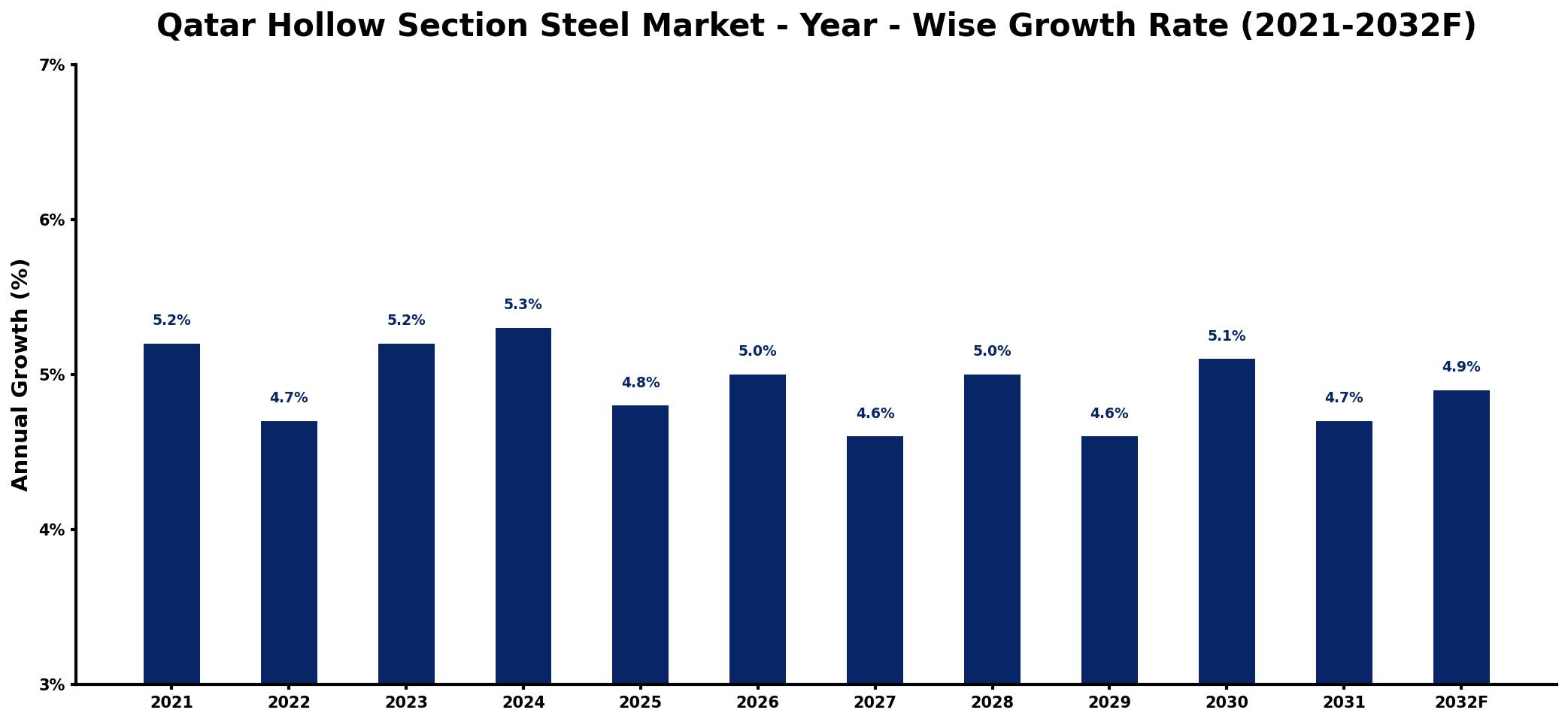
The table below presents the year‑wise growth rates along with the key drivers influencing the market
| Year | Growth Rate | Major Drivers |
| 2021 | 5.2% | Infrastructure projects drive demand growth |
| 2022 | 4.7% | Increased construction activities nationwide |
| 2023 | 5.2% | Rising investments in commercial buildings |
| 2024 | 5.3% | Expansion of energy sector projects |
| 2025 | 4.8% | Growing residential development initiatives |
| 2026 | 5.0% | Boost in industrial manufacturing investments |
| 2027 | 4.6% | Emergence of new construction technologies |
| 2028 | 5.0% | Increase in government infrastructure spending |
| 2029 | 4.6% | Strengthening of regional trade agreements |
| 2030 | 5.1% | growing regional consumption patterns |
| 2031 | 4.7% | Enhanced focus on sustainable construction |
| 2032 | 4.9% | Rising demand from transportation sector |
Note: Market size estimations and growth projections presented in this report are based on 6Wresearch's proprietary forecasting methodology, utilizing the latest available industry data, government publications, and primary research inputs.
Qatar Hollow Section Steel Market Synopsis
In recent years, the hollow section steel market in Qatar has shown remarkable momentum, responding dynamically to surging demand from various sectors. However, the market is on the brink of a significant evolution, driven by large-scale infrastructure projects and a rapidly growing urban landscape that necessitate advanced construction materials.
As the nation pivots towards sustainable and innovative building practices, the hollow section steel market is set to undergo transformation, cementing its role in the evolution of Qatar's skyline. Enhanced material properties and increased production capacities will play pivotal roles in aligning supply with the projected demand.
Qatar Hollow Section Steel Market Key Takeaways
- The hollow section steel market in Qatar is expected to see a consistent uptick driven by the construction sector's expansion.
- Investment in infrastructure and urban development projects will support sustained demand for hollow section steel products.
- The market will face pricing challenges due to global steel price volatility, necessitating adaptive strategies.
- COVID-19 disruptions have influenced market fluctuations, yet recovery is underway with a resurgence of construction activity.
- Regulatory compliance and material quality assurance remain paramount in shaping industry dynamics.
Evaluation of Restraints in Qatar Hollow Section Steel Market
Despite the positive outlook, the Qatar hollow section steel market encounters notable constraints that could temper growth. Fluctuating global steel prices pose a significant threat to profitability, placing pressure on manufacturers and distributors alike. Furthermore, navigating the complex landscape of regulatory frameworks can be burdensome, especially for smaller entities aiming to comply with stringent quality and safety standards. Additionally, demand dynamics tied to cyclical construction activities can introduce volatility, requiring stakeholders to adopt agile strategies to manage market uncertainties effectively.
Qatar Hollow Section Steel Market Trends
The trends shaping the hollow section steel market in Qatar point toward increased demand for lightweight yet durable materials that can facilitate modern architectural designs. Additionally, the shift towards environmentally friendly construction practices is gaining momentum, prompting manufacturers to explore sustainable production methodologies. Innovations in steel processing and enhancements in corrosion resistance are becoming key focal points, ensuring that hollow section steel remains relevant in a competitive market landscape.
Qatar Hollow Section Steel Market Opportunities
There exists a wealth of opportunities within the Qatar hollow section steel market, particularly in the realm of infrastructural advancement. Investment in public works, transportation networks, and urban housing projects will create an ongoing demand for hollow section steel. Additionally, the advent of smart city initiatives and infrastructure modernization are likely to open new avenues for suppliers willing to align with these transformative projects. Such developments promise not only growth but also the potential for innovative partnerships across the sector.
Government Initiatives in the Qatar Hollow Section Steel Market
The Qatari government is proactively investing in infrastructure to support economic diversification and sustainable development goals. Initiatives such as the National Vision 2031 and various public-private partnerships are fostering an environment that encourages extensive construction projects. These governmental efforts are not only increasing demand for hollow section steel but are also streamlining approvals and compliance processes, which ultimately benefit the industry as a whole. The emphasis on safety, quality, and efficiency is likely to enhance the operational landscape for market participants.
Future Insights of the Qatar Hollow Section Steel Market
Looking ahead to 2026-2032, the Qatar hollow section steel market is poised for significant evolution. As large-scale construction projects continue to rise, the demand for high-quality, versatile materials will only intensify. Moreover, increased focus on sustainability and the adoption of advanced construction technologies will further propel market growth. Stakeholders are encouraged to remain adaptive, leveraging innovations and regulatory support to maximize their position within this expanding market.
Qatar Hollow Section Steel Market Latest Developments (2025 - 2026)
Recent developments in the Qatar hollow section steel market reflect a proactive approach towards addressing the rising demand for construction materials. Key industry players are investing in production capacity enhancements and exploring new supply chain strategies to mitigate potential disruptions. Furthermore, there has been a noticeable uptick in collaboration between manufacturers and construction firms, aimed at integrating innovative building practices and materials into upcoming projects. These shifts indicate a resilient market adapting to post-pandemic realities and leveraging new growth opportunities.
Qatar Hollow Section Steel Market - Key Attractiveness of the Report
- 10 Years of Market Numbers
- Historical Data Starting from 2022 to 2025
- Base Year: 2025
- Forecast Data until 2032
- Key Performance Indicators Impacting the Market
- Major Upcoming Developments and Projects
Key Highlights of the Report:
- Qatar Hollow Section Steel Market Outlook
- Market Size of Qatar Hollow Section Steel Market, 2025
- Forecast of Qatar Hollow Section Steel Market, 2032
- Historical Data and Forecast of Qatar Hollow Section Steel Revenues & Volume for the Period 2022-2032F
- Qatar Hollow Section Steel Market Trend Evolution
- Qatar Hollow Section Steel Market Drivers and Challenges
- Qatar Hollow Section Steel Price Trends
- Qatar Hollow Section Steel Porter's Five Forces
- Qatar Hollow Section Steel Industry Life Cycle
- Historical Data and Forecast of Qatar Hollow Section Steel Market Revenues & Volume By Type for the Period 2022-2032F
- Historical Data and Forecast of Qatar Hollow Section Steel Market Revenues & Volume By Rectangular Hollow Section for the Period 2022-2032F
- Historical Data and Forecast of Qatar Hollow Section Steel Market Revenues & Volume By Square Hollow Section for the Period 2022-2032F
- Historical Data and Forecast of Qatar Hollow Section Steel Market Revenues & Volume By Circular Hollow Section for the Period 2022-2032F
- Historical Data and Forecast of Qatar Hollow Section Steel Market Revenues & Volume By Other for the Period 2022-2032F
- Historical Data and Forecast of Qatar Hollow Section Steel Market Revenues & Volume By Application for the Period 2022-2032F
- Historical Data and Forecast of Qatar Hollow Section Steel Market Revenues & Volume By Agricultural for the Period 2022-2032F
- Historical Data and Forecast of Qatar Hollow Section Steel Market Revenues & Volume By Construction for the Period 2022-2032F
- Historical Data and Forecast of Qatar Hollow Section Steel Market Revenues & Volume By General Engineering for the Period 2022-2032F
- Historical Data and Forecast of Qatar Hollow Section Steel Market Revenues & Volume By Mechanical Application for the Period 2022-2032F
- Historical Data and Forecast of Qatar Hollow Section Steel Market Revenues & Volume By Others for the Period 2022-2032F
- Historical Data and Forecast of Qatar Hollow Section Steel Market Revenues & Volume By Global Hollow Section Steel Market dynamics for the Period 2022-2032F
- Historical Data and Forecast of Qatar Hollow Section Steel Market Revenues & Volume By Global Hollow Section Steel Market size for the Period 2022-2032F
- Historical Data and Forecast of Qatar Hollow Section Steel Market Revenues & Volume By Supply & Demand for the Period 2022-2032F
- Qatar Hollow Section Steel Import Export Trade Statistics
- Market Opportunity Assessment By Type
- Market Opportunity Assessment By Application
- Qatar Hollow Section Steel Top Companies Market Share
- Qatar Hollow Section Steel Competitive Benchmarking By Technical and Operational Parameters
- Qatar Hollow Section Steel Company Profiles
- Qatar Hollow Section Steel Key Strategic Recommendations






































