Qatar Industrial Drums Market Size, Share & Growth Rate
The Qatar Industrial Drums Market was estimated at USD 141 Million in 2025 and is projected to reach USD 153 Million by 2032, growing at a CAGR of 1.2% from 2026 to 2032. This growth trajectory is primarily driven by the robust development of Qatar's manufacturing and logistics sectors, which are increasingly relying on industrial drums for efficient storage and transportation solutions. Additionally, the rising need for secure packaging of chemicals and bulk materials enhances the demand for high-quality industrial drums.
Qatar Industrial Drums Market Year-wise Growth Rate and Key Drivers
This graph highlights how the Qatar Industrial Drums Market has steadily grown over the years, supported by major growth factors.
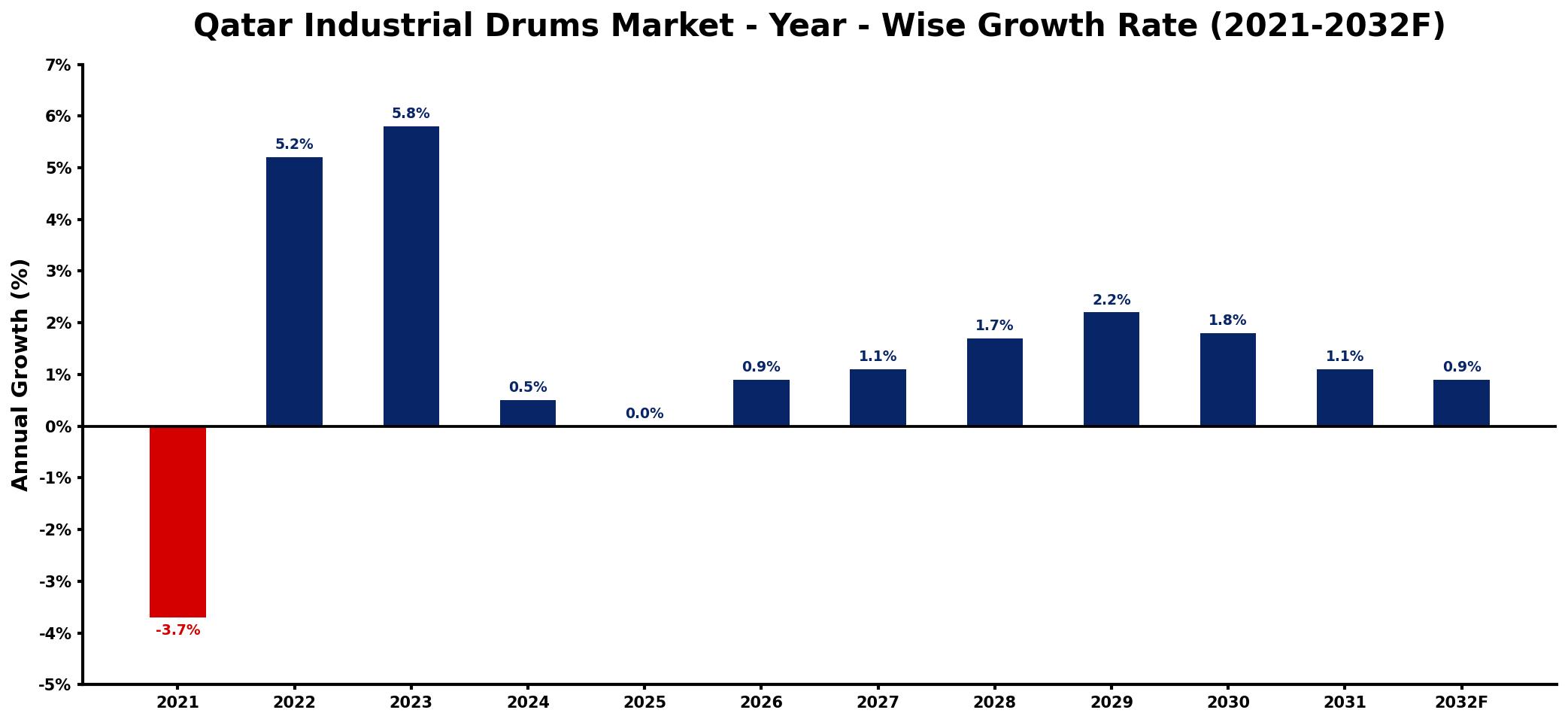
The table below presents the year‑wise growth rates along with the key drivers influencing the market
| Year | Growth Rate | Major Drivers |
| 2021 | -3.7% | decrease in manufacturing activities |
| 2022 | 5.2% | rising demand from construction sector |
| 2023 | 5.8% | increased exports to neighboring markets |
| 2024 | 0.5% | growing investments in infrastructure projects |
| 2025 | 0.0% | expansion of local production facilities |
| 2026 | 0.9% | higher consumer spending on goods |
| 2027 | 1.1% | increased focus on sustainability initiatives |
| 2028 | 1.7% | growing commercial sector adoption |
| 2029 | 2.2% | emergence of new market players |
| 2030 | 1.8% | expanding healthcare application demand |
| 2031 | 1.1% | increased regulatory support for industries |
| 2032 | 0.9% | development of strategic partnerships |
Note: Market size estimations and growth projections presented in this report are based on 6Wresearch's proprietary forecasting methodology, utilizing the latest available industry data, government publications, and primary research inputs.
Qatar Industrial Drums Market Synopsis
Currently, the industrial drums market in Qatar is witnessing significant momentum, reflecting the nation's ongoing economic diversification efforts. With investments aimed at bolstering infrastructure and industry, the demand for reliable storage and transportation solutions is more pronounced than ever.
This market serves a pivotal role in catering to various sectors, including chemicals, pharmaceuticals, and food processing. As the industrial base expands, the requirement for efficient packaging options continues to rise, positioning manufacturers and suppliers to capitalize on the favorable conditions.
Qatar Industrial Drums Market Key Takeaways
- Steady growth in the Qatar Industrial Drums Market is anticipated, driven by manufacturing and logistics expansion.
- High-quality standards and regulatory compliance remain critical for market players navigating this sector.
- COVID-19 impacts are expected to normalize, leading to a rebound in industrial drum demand.
- Key sectors such as chemicals and pharmaceuticals significantly drive the demand for industrial drums.
- Investment in quality control processes will be vital to maintain competitiveness.
Evaluation of Restraints in Qatar Industrial Drums Market
Despite the promising outlook, the Qatar Industrial Drums Market faces several restraints that could hinder growth. Compliance with stringent international safety and quality standards requires substantial investment in manufacturing processes. Additionally, fluctuations in global steel prices could destabilize production costs, creating uncertainty for market participants. The necessity for businesses to remain agile in response to economic cycles and shifting demands from key industries adds another layer of complexity to operating in this market.
Qatar Industrial Drums Market Trends
A notable trend in the Qatar Industrial Drums Market is the growing preference for eco-friendly and recyclable materials in manufacturing processes. As sustainability becomes a focal point across industries, the demand for drums made from environmentally friendly materials is increasing. Additionally, innovations in drum design and manufacturing processes are leading to enhanced durability and functionality, making them more appealing to end-users. Digitalization in logistics and inventory management also plays a critical role, enabling real-time tracking and efficient supply chain management.
Qatar Industrial Drums Market Opportunities
Opportunities for growth within the Qatar Industrial Drums Market are abundant, particularly as the government pushes forward with initiatives aimed at economic diversification. The expansion of sectors such as food processing and pharmaceuticals presents fresh avenues for manufacturers. Additionally, the increasing need for compliant and safe storage solutions, especially in light of stricter regulations concerning hazardous materials, creates room for businesses to innovate and offer specialized products. This landscape offers not only short-term gains but also long-term strategic advantages for well-positioned entities.
Government Initiatives in the Qatar Industrial Drums Market
The Qatari government has been active in promoting industrial growth through various initiatives aimed at enhancing infrastructure and encouraging private investment. Programs aimed at improving logistics and transportation networks facilitate smoother operations for companies dealing in industrial drums. Additionally, public spending on infrastructure projects bolsters demand for industrial packaging solutions, ensuring that manufacturers align with national development objectives.
Future Insights of the Qatar Industrial Drums Market
Looking ahead to 2026-2032, the Qatar Industrial Drums Market is set to continue its growth trajectory. Increasing industrial activity, driven by the nations economic diversification strategy, will sustain demand for reliable packaging solutions. Additionally, as compliance with safety standards remains paramount, manufacturers that invest in quality and innovation will likely emerge as market leaders. The ongoing evolution of logistics and supply chain management will also shape demand dynamics, further solidifying the market's role in Qatar's industrial ecosystem.
Qatar Industrial Drums Market Latest Developments (2025 - 2026)
In the recent period, the Qatar Industrial Drums Market has experienced notable shifts as companies adapt to changing regulations and customer preferences. There has been an increase in product offerings aimed at sustainability, with several manufacturers exploring eco-friendly materials for drum production. Furthermore, advancements in manufacturing technology are streamlining production processes, enhancing product quality and consistency. As economic activity stabilizes post-pandemic, firms are poised to capitalize on emerging opportunities in various sectors.
Qatar Industrial Drums Market - Key Attractiveness of the Report
- 10 Years of Market Numbers
- Historical Data Starting from 2022 to 2025
- Base Year: 2025
- Forecast Data until 2032
- Key Performance Indicators Impacting the Market
- Major Upcoming Developments and Projects
Key Highlights of the Report:
- Qatar Industrial Drums Market Outlook
- Market Size of Qatar Industrial Drums Market, 2025
- Forecast of Qatar Industrial Drums Market, 2032
- Historical Data and Forecast of Qatar Industrial Drums Revenues & Volume for the Period 2022-2032F
- Qatar Industrial Drums Market Trend Evolution
- Qatar Industrial Drums Market Drivers and Challenges
- Qatar Industrial Drums Price Trends
- Qatar Industrial Drums Porter's Five Forces
- Qatar Industrial Drums Industry Life Cycle
- Historical Data and Forecast of Qatar Industrial Drums Market Revenues & Volume By Product Type for the Period 2022-2032F
- Historical Data and Forecast of Qatar Industrial Drums Market Revenues & Volume By Steel Drum for the Period 2022-2032F
- Historical Data and Forecast of Qatar Industrial Drums Market Revenues & Volume By Plastic Drum for the Period 2022-2032F
- Historical Data and Forecast of Qatar Industrial Drums Market Revenues & Volume By Fiber Drum for the Period 2022-2032F
- Historical Data and Forecast of Qatar Industrial Drums Market Revenues & Volume By Capacity for the Period 2022-2032F
- Historical Data and Forecast of Qatar Industrial Drums Market Revenues & Volume By Up to 100 Liter for the Period 2022-2032F
- Historical Data and Forecast of Qatar Industrial Drums Market Revenues & Volume By 100 to 250 Liter for the Period 2022-2032F
- Historical Data and Forecast of Qatar Industrial Drums Market Revenues & Volume By 250 to 500 Liter for the Period 2022-2032F
- Historical Data and Forecast of Qatar Industrial Drums Market Revenues & Volume By Above 500 Liter for the Period 2022-2032F
- Historical Data and Forecast of Qatar Industrial Drums Market Revenues & Volume By End Use for the Period 2022-2032F
- Historical Data and Forecast of Qatar Industrial Drums Market Revenues & Volume By Food & Beverages for the Period 2022-2032F
- Historical Data and Forecast of Qatar Industrial Drums Market Revenues & Volume By Chemical & Fertilizers for the Period 2022-2032F
- Historical Data and Forecast of Qatar Industrial Drums Market Revenues & Volume By Pharmaceuticals for the Period 2022-2032F
- Historical Data and Forecast of Qatar Industrial Drums Market Revenues & Volume By Petroleum & Lubricants for the Period 2022-2032F
- Historical Data and Forecast of Qatar Industrial Drums Market Revenues & Volume By Building & Construction for the Period 2022-2032F
- Historical Data and Forecast of Qatar Industrial Drums Market Revenues & Volume By Paints, Inks, & Dyes for the Period 2022-2032F
- Historical Data and Forecast of Qatar Industrial Drums Market Revenues & Volume By Other End Uses for the Period 2022-2032F
- Qatar Industrial Drums Import Export Trade Statistics
- Market Opportunity Assessment By Product Type
- Market Opportunity Assessment By Capacity
- Market Opportunity Assessment By End Use
- Qatar Industrial Drums Top Companies Market Share
- Qatar Industrial Drums Competitive Benchmarking By Technical and Operational Parameters
- Qatar Industrial Drums Company Profiles
- Qatar Industrial Drums Key Strategic Recommendations






































