Qatar Industrial Flooring Market Size, Share & Growth Rate
The Qatar Industrial Flooring Market was estimated at USD 121 Million in 2025 and is projected to reach USD 132 Million by 2032, growing at a CAGR of 1.3% from 2026 to 2032. This growth trajectory is primarily fueled by the dynamic expansion of the construction and industrial sectors within Qatar. As the country continues to invest heavily in infrastructure projects such as stadiums and logistics hubs, the demand for durable, high-performance flooring solutions is expected to rise significantly.
Qatar Industrial Flooring Market Year-wise Growth Rate and Key Drivers
This graph highlights how the Qatar Industrial Flooring Market has steadily grown over the years, supported by major growth factors.
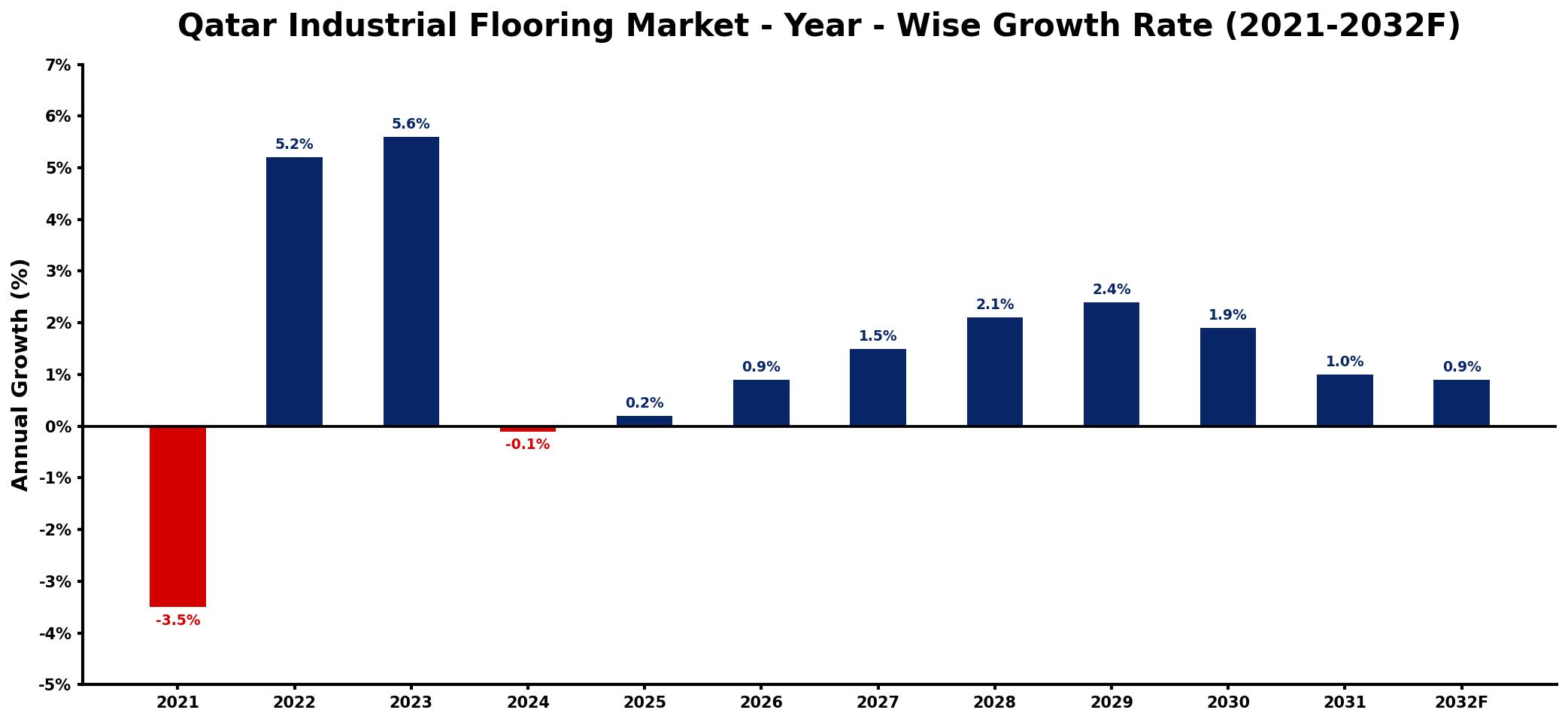
The table below presents the year‑wise growth rates along with the key drivers influencing the market
| Year | Growth Rate | Major Drivers |
| 2021 | -3.5% | decrease in construction investments |
| 2022 | 5.2% | rise in manufacturing sector demand |
| 2023 | 5.6% | expansion of logistics facilities |
| 2024 | -0.1% | slowdown in real estate projects |
| 2025 | 0.2% | growth in retail sector activities |
| 2026 | 0.9% | increased infrastructure development projects |
| 2027 | 1.5% | surge in commercial space requirements |
| 2028 | 2.1% | enhanced focus on sustainability initiatives |
| 2029 | 2.4% | growing need for warehouse spaces |
| 2030 | 1.9% | influx of foreign investments |
| 2031 | 1.0% | increased capital investment inflows |
| 2032 | 0.9% | development of smart cities initiatives |
Note: Market size estimations and growth projections presented in this report are based on 6Wresearch's proprietary forecasting methodology, utilizing the latest available industry data, government publications, and primary research inputs.
Qatar Industrial Flooring Market Synopsis
The strongest force shaping the Qatar Industrial Flooring Market is the unprecedented growth in its construction sector. Ongoing infrastructure projects create a compelling need for innovative flooring solutions that can withstand rigorous industrial demands while prioritizing sustainability and safety.
This market is witnessing a shift toward advanced materials that not only offer durability but also meet the increasing sustainability expectations of industries like healthcare and food processing. Consequently, companies are presented with numerous opportunities to innovate and tailor flooring solutions that cater to specific operational requirements.
Qatar Industrial Flooring Market Key Takeaways
- The Qatar Industrial Flooring Market is driven by robust growth in construction and industrial sectors.
- Diverse applications across healthcare, food processing, and automotive industries are creating demand for specialized flooring solutions.
- Key factors influencing market growth include sustainability, durability, and ease of maintenance.
- As the market recovers from COVID-19 disruptions, focus on hygienic flooring options is intensifying.
- Customization remains a challenge, necessitating a balance between tailored solutions and cost-effectiveness.
Evaluation of Restraints in Qatar Industrial Flooring Market
Despite the promising growth outlook, the Qatar Industrial Flooring Market faces notable restraints. The primary challenge lies in the customization of flooring solutions to meet the specific needs of various industries. Each sector, whether manufacturing, logistics, or healthcare, presents unique requirements that demand tailored flooring products capable of enduring heavy usage and environmental challenges. This necessity for customization must be balanced with the goal of maintaining cost-effectiveness, complicating market dynamics and potentially limiting accessibility for smaller companies.
Qatar Industrial Flooring Market Trends
Current trends highlight a pronounced shift toward sustainability in flooring materials. Eco-friendly options are gaining traction as industries increasingly prioritize environmental responsibility. Furthermore, the integration of advanced technologies, such as antimicrobial coatings and slip-resistant surfaces, is enhancing functionality and safety in industrial flooring applications. Such innovations not only cater to regulatory requirements but also elevate the performance standards expected by end-users.
Qatar Industrial Flooring Market Opportunities
There are significant growth and investment opportunities within the Qatar Industrial Flooring Market, particularly in sectors aligned with the nations Vision 2030 agenda. The emphasis on infrastructure development creates a fertile ground for companies to introduce cutting-edge flooring solutions tailored to specific applications. Additionally, the increasing focus on hygienic and sustainable flooring presents avenues for innovative product development, which can cater to both domestic and export markets.
Government Initiatives in the Qatar Industrial Flooring Market
The Qatari government has been proactive in promoting industrial growth through various initiatives. Infrastructure spending remains a central tenet of public policy, encouraging investments in transportation, logistics, and healthcare facilities. Government-led projects aimed at sustainability and environmental responsibility further bolster the demand for innovative flooring solutions. By fostering collaboration between public and private sectors, the government is paving the way for growth in the industrial flooring landscape.
Future Insights of the Qatar Industrial Flooring Market
Looking ahead to 2026-2032, the Qatar Industrial Flooring Market is poised for steady growth. The ongoing momentum in construction and industrial expansion will likely persist, supported by the countrys ambitious infrastructure projects. The increasing demand for customized, durable, and sustainable flooring solutions will shape product development strategies. As companies adapt to meet the evolving needs of various sectors, the market is expected to thrive, driven by innovation and a commitment to quality.
Qatar Industrial Flooring Market Latest Developments (2025 - 2026)
In recent months, the Qatar Industrial Flooring Market has seen a surge in interest towards sustainable flooring technologies. Companies are actively investing in research and development to enhance product offerings that align with environmentally friendly practices. Additionally, collaborations between industry stakeholders and research institutions are becoming increasingly common, aimed at accelerating innovation in flooring materials. This collaborative effort promises to push the boundaries of what is possible in industrial flooring, addressing both functional and environmental considerations.
Qatar Industrial Flooring Market - Key Attractiveness of the Report
- 10 Years of Market Numbers
- Historical Data Starting from 2022 to 2025
- Base Year: 2025
- Forecast Data until 2032
- Key Performance Indicators Impacting the Market
- Major Upcoming Developments and Projects
Key Highlights of the Report:
- Qatar Industrial Flooring Market Outlook
- Market Size of Qatar Industrial Flooring Market, 2025
- Forecast of Qatar Industrial Flooring Market, 2032
- Historical Data and Forecast of Qatar Industrial Flooring Revenues & Volume for the Period 2022-2032F
- Qatar Industrial Flooring Market Trend Evolution
- Qatar Industrial Flooring Market Drivers and Challenges
- Qatar Industrial Flooring Price Trends
- Qatar Industrial Flooring Porter's Five Forces
- Qatar Industrial Flooring Industry Life Cycle
- Historical Data and Forecast of Qatar Industrial Flooring Market Revenues & Volume By End User Industry for the Period 2022-2032F
- Historical Data and Forecast of Qatar Industrial Flooring Market Revenues & Volume By Chemical for the Period 2022-2032F
- Historical Data and Forecast of Qatar Industrial Flooring Market Revenues & Volume By Food and Beverages for the Period 2022-2032F
- Historical Data and Forecast of Qatar Industrial Flooring Market Revenues & Volume By Healthcare for the Period 2022-2032F
- Historical Data and Forecast of Qatar Industrial Flooring Market Revenues & Volume By Transportation and Aviation for the Period 2022-2032F
- Historical Data and Forecast of Qatar Industrial Flooring Market Revenues & Volume By Others for the Period 2022-2032F
- Historical Data and Forecast of Qatar Industrial Flooring Market Revenues & Volume By Thickness for the Period 2022-2032F
- Historical Data and Forecast of Qatar Industrial Flooring Market Revenues & Volume By Light duty for the Period 2022-2032F
- Historical Data and Forecast of Qatar Industrial Flooring Market Revenues & Volume By Medium Duty for the Period 2022-2032F
- Historical Data and Forecast of Qatar Industrial Flooring Market Revenues & Volume By Heavy Duty for the Period 2022-2032F
- Historical Data and Forecast of Qatar Industrial Flooring Market Revenues & Volume By Material Type for the Period 2022-2032F
- Historical Data and Forecast of Qatar Industrial Flooring Market Revenues & Volume By Epoxy for the Period 2022-2032F
- Historical Data and Forecast of Qatar Industrial Flooring Market Revenues & Volume By Polyaspartic for the Period 2022-2032F
- Historical Data and Forecast of Qatar Industrial Flooring Market Revenues & Volume By Polyurethane for the Period 2022-2032F
- Historical Data and Forecast of Qatar Industrial Flooring Market Revenues & Volume By Anhydrite for the Period 2022-2032F
- Historical Data and Forecast of Qatar Industrial Flooring Market Revenues & Volume By Others for the Period 2022-2032F
- Qatar Industrial Flooring Import Export Trade Statistics
- Market Opportunity Assessment By End User Industry
- Market Opportunity Assessment By Thickness
- Market Opportunity Assessment By Material Type
- Qatar Industrial Flooring Top Companies Market Share
- Qatar Industrial Flooring Competitive Benchmarking By Technical and Operational Parameters
- Qatar Industrial Flooring Company Profiles
- Qatar Industrial Flooring Key Strategic Recommendations






































