Qatar Inorganic Acids Market Size, Share & Growth Rate
The Qatar Inorganic Acids Market was estimated at USD 190 Million in 2025 and is projected to reach USD 259 Million by 2032, growing at a CAGR of 4.5% from 2026 to 2032. This growth trajectory is primarily driven by the expanding industrial sector in Qatar, which has seen significant investments in chemical manufacturing and petroleum refining. As industries seek reliable inputs for their processes, the demand for essential inorganic acids is expected to rise, further propelled by Qatar's initiatives toward economic diversification.
Qatar Inorganic Acids Market Year-wise Growth Rate and Key Drivers
This graph highlights how the Qatar Inorganic Acids Market has steadily grown over the years, supported by major growth factors.
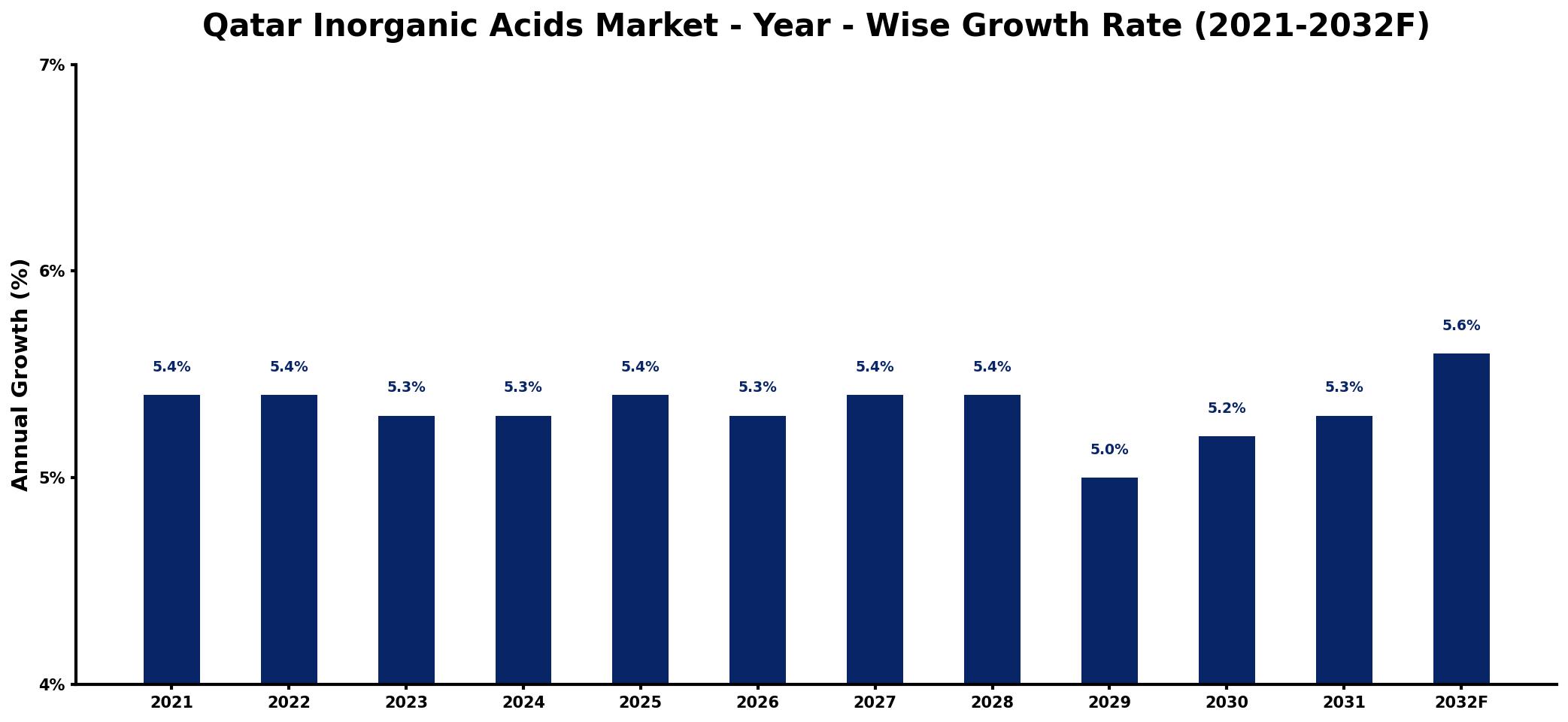
The table below presents the year‑wise growth rates along with the key drivers influencing the market
| Year | Growth Rate | Major Drivers |
| 2021 | 5.4% | Rising industrial manufacturing activities |
| 2022 | 5.4% | Increased construction project investments |
| 2023 | 5.3% | Growing chemical processing sector |
| 2024 | 5.3% | Surge in agricultural applications |
| 2025 | 5.4% | Expansion of water treatment facilities |
| 2026 | 5.3% | Boost in energy sector demand |
| 2027 | 5.4% | Development of new production methods |
| 2028 | 5.4% | Strengthened export market opportunities |
| 2029 | 5.0% | Emerging alternative energy initiatives |
| 2030 | 5.2% | Advancements in environmental regulations |
| 2031 | 5.3% | Heightened focus on sustainability practices |
| 2032 | 5.6% | Innovations in manufacturing technologies |
Note: Market size estimations and growth projections presented in this report are based on 6Wresearch's proprietary forecasting methodology, utilizing the latest available industry data, government publications, and primary research inputs.
Qatar Inorganic Acids Market Synopsis
In Qatar, inorganic acids play a critical role in various applications ranging from chemical production to agricultural processes. The increasing need for efficient industrial processes in sectors such as petrochemicals and construction is fueling demand for acids like sulfuric and hydrochloric acid.
With Qatar's commitment to advancing its industrial capabilities, the inorganic acids market stands poised for substantial growth. Companies are adopting more sustainable practices to produce these acids, aligning with global environmental trends and regulations, ensuring minimal impact on the surroundings.
Qatar Inorganic Acids Market Key Takeaways
- The market is witnessing a significant uptick due to industrial expansion and diversification.
- Inorganic acids are integral to numerous industrial applications, enhancing productivity and efficiency.
- Sustainable production methods are being increasingly prioritized among manufacturers.
- Government initiatives are supporting the growth of the industrial sector, further driving demand.
- The ongoing recovery from COVID-19 is expected to stabilize and strengthen market dynamics.
Evaluation of Restraints in Qatar Inorganic Acids Market
Despite the growth prospects, the Qatar inorganic acids market faces notable restraints. A primary concern is the consistent supply of raw materials essential for acid production, which can be vulnerable to fluctuations in global markets and geopolitical tensions. Additionally, environmental regulations pose challenges, requiring market players to invest in advanced technologies for waste management and emissions control. Stringent regulatory compliance and safety standards further complicate operations, necessitating careful navigation to maintain market presence.
Qatar Inorganic Acids Market Trends
Current trends in the Qatar inorganic acids market highlight a robust push towards sustainability and green chemistry. Manufacturers are actively exploring environmentally friendly alternatives and methods to reduce their carbon footprints. Technological advancements in production processes are also transforming how these acids are synthesized, with innovations aimed at enhancing efficiency while minimizing ecological impact. Furthermore, the integration of automation in manufacturing processes is emerging as a trend, improving overall productivity.
Qatar Inorganic Acids Market Opportunities
Opportunities in the Qatar inorganic acids market are vast, particularly as the country continues to diversify its economy. The expanding industrial landscape presents avenues for investment in production facilities that prioritize eco-friendly methods. Additionally, potential partnerships with technology firms focusing on sustainability can enhance market competitiveness. The increasing emphasis on agricultural chemicals also opens doors for growth, as inorganic acids become crucial for improving soil health and crop yield.
Government Initiatives in the Qatar Inorganic Acids Market
The Qatari government is actively promoting industrial growth through various initiatives aimed at enhancing the chemical sector. Policies encouraging foreign investment and technology transfer are expected to bolster local production capacities. Additionally, public spending on infrastructure development, aligned with the National Vision 2030, supports the overall growth of the industrial landscape, indirectly benefiting the inorganic acids market through increased demand and enhanced manufacturing capabilities.
Future Insights of the Qatar Inorganic Acids Market
Looking ahead to 2026-2032, the Qatar inorganic acids market is set to evolve significantly. Continued industrialization, coupled with advancements in production technologies, will likely enhance both the efficiency and sustainability of acid manufacturing. As the global landscape shifts towards greener practices, Qatari companies that align with these trends will not only meet local demands but potentially export to broader markets, capitalizing on new opportunities presented by international environmental standards.
Qatar Inorganic Acids Market Latest Developments (2025 - 2026)
In recent months, the Qatar inorganic acids market has seen a focus on enhancing production capabilities through technological upgrades. Companies are investing in modern production facilities designed to minimize environmental impact. There is also a trend of collaboration between industrial players and academic institutions to develop innovative approaches to acid production, further driving efficiency and sustainability. The recovery from the pandemic continues to shape market dynamics, with increased demand expected across various sectors.
Qatar Inorganic Acids Market - Key Attractiveness of the Report
- 10 Years of Market Numbers
- Historical Data Starting from 2022 to 2025
- Base Year: 2025
- Forecast Data until 2032
- Key Performance Indicators Impacting the Market
- Major Upcoming Developments and Projects
Key Highlights of the Report:
- Qatar Inorganic Acids Market Outlook
- Market Size of Qatar Inorganic Acids Market, 2025
- Forecast of Qatar Inorganic Acids Market, 2032
- Historical Data and Forecast of Qatar Inorganic Acids Revenues & Volume for the Period 2022-2032F
- Qatar Inorganic Acids Market Trend Evolution
- Qatar Inorganic Acids Market Drivers and Challenges
- Qatar Inorganic Acids Price Trends
- Qatar Inorganic Acids Porter's Five Forces
- Qatar Inorganic Acids Industry Life Cycle
- Historical Data and Forecast of Qatar Inorganic Acids Market Revenues & Volume By Type for the Period 2022-2032F
- Historical Data and Forecast of Qatar Inorganic Acids Market Revenues & Volume By Hydrochloric Acid for the Period 2022-2032F
- Historical Data and Forecast of Qatar Inorganic Acids Market Revenues & Volume By Sulfuric Acid for the Period 2022-2032F
- Historical Data and Forecast of Qatar Inorganic Acids Market Revenues & Volume By Nitric Acid for the Period 2022-2032F
- Historical Data and Forecast of Qatar Inorganic Acids Market Revenues & Volume By Phosphoric Acid for the Period 2022-2032F
- Historical Data and Forecast of Qatar Inorganic Acids Market Revenues & Volume By Boric Acid for the Period 2022-2032F
- Historical Data and Forecast of Qatar Inorganic Acids Market Revenues & Volume By Hydrofluoric Acid for the Period 2022-2032F
- Historical Data and Forecast of Qatar Inorganic Acids Market Revenues & Volume By Others for the Period 2022-2032F
- Historical Data and Forecast of Qatar Inorganic Acids Market Revenues & Volume By Application for the Period 2022-2032F
- Historical Data and Forecast of Qatar Inorganic Acids Market Revenues & Volume By Agrochemicals & Fertilizers for the Period 2022-2032F
- Historical Data and Forecast of Qatar Inorganic Acids Market Revenues & Volume By Pigments & Dyes for the Period 2022-2032F
- Historical Data and Forecast of Qatar Inorganic Acids Market Revenues & Volume By Pharmaceutical for the Period 2022-2032F
- Historical Data and Forecast of Qatar Inorganic Acids Market Revenues & Volume By Explosives for the Period 2022-2032F
- Historical Data and Forecast of Qatar Inorganic Acids Market Revenues & Volume By Others for the Period 2022-2032F
- Qatar Inorganic Acids Import Export Trade Statistics
- Market Opportunity Assessment By Type
- Market Opportunity Assessment By Application
- Qatar Inorganic Acids Top Companies Market Share
- Qatar Inorganic Acids Competitive Benchmarking By Technical and Operational Parameters
- Qatar Inorganic Acids Company Profiles
- Qatar Inorganic Acids Key Strategic Recommendations






































