Qatar Inorganic Chemicals Market Size, Share & Growth Rate
The Qatar Inorganic Chemicals Market was estimated at USD 351 Million in 2025 and is projected to reach USD 477 Million by 2032, growing at a CAGR of 4.5% from 2026 to 2032. This growth is primarily fueled by the booming construction sector, which relies heavily on inorganic chemicals for materials such as cement and lime. The ongoing investment in infrastructure projects further underscores the rising demand for high-quality inorganic chemicals across various industrial applications.
Qatar Inorganic Chemicals Market Year-wise Growth Rate and Key Drivers
This graph highlights how the Qatar Inorganic Chemicals Market has steadily grown over the years, supported by major growth factors.
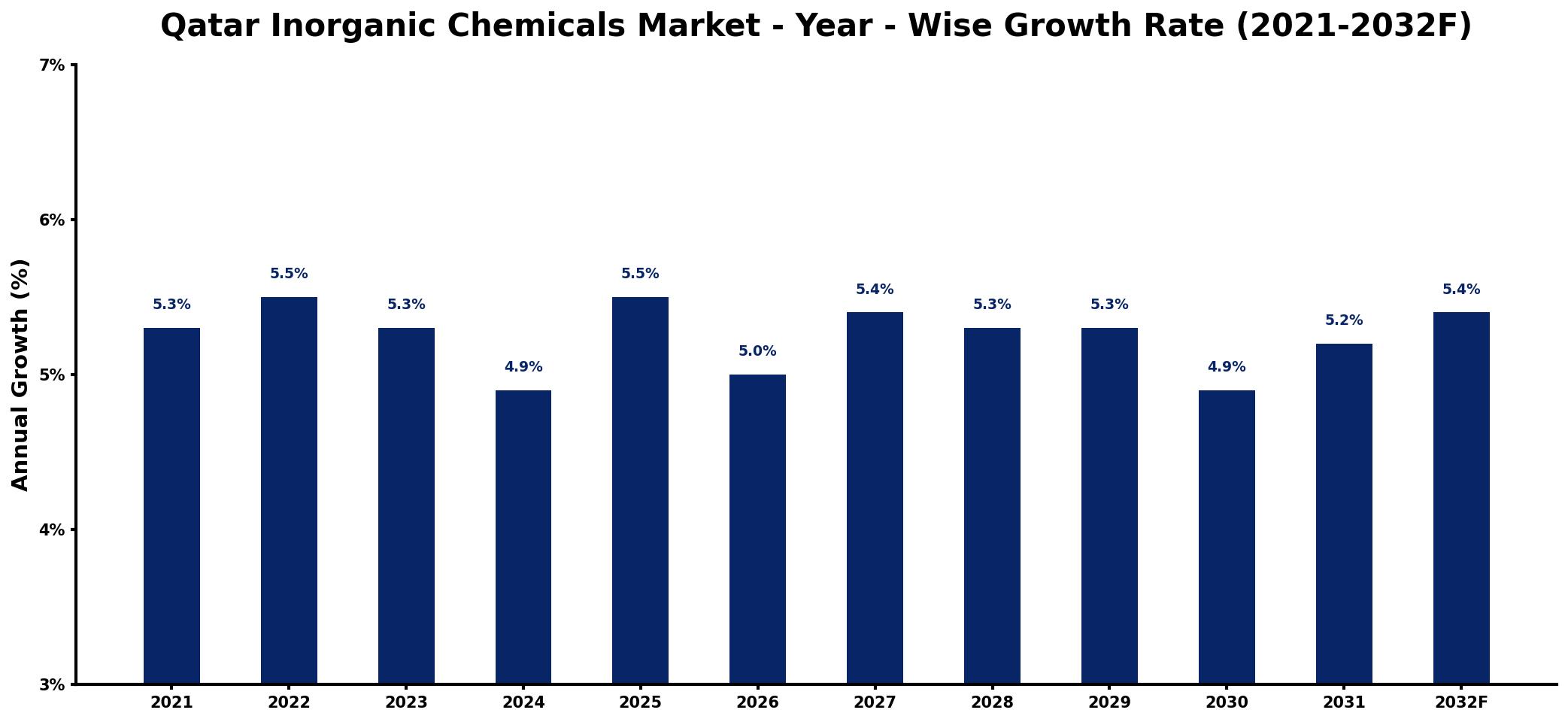
The table below presents the year‑wise growth rates along with the key drivers influencing the market
| Year | Growth Rate | Major Drivers |
| 2021 | 5.3% | Rising construction sector investments |
| 2022 | 5.5% | Increased agricultural productivity initiatives |
| 2023 | 5.3% | Growing demand for water treatment |
| 2024 | 4.9% | Declining reliance on imports |
| 2025 | 5.5% | Expansion of manufacturing capabilities |
| 2026 | 5.0% | Boost in renewable energy projects |
| 2027 | 5.4% | Increased focus on sustainability practices |
| 2028 | 5.3% | improved processing technologies adoption |
| 2029 | 5.3% | Surge in urban development projects |
| 2030 | 4.9% | Reduction in raw material costs |
| 2031 | 5.2% | Increased exports to neighboring regions |
| 2032 | 5.4% | Rising investments in infrastructure projects |
Note: Market size estimations and growth projections presented in this report are based on 6Wresearch's proprietary forecasting methodology, utilizing the latest available industry data, government publications, and primary research inputs.
Qatar Inorganic Chemicals Market Synopsis
Recent momentum in the Qatar inorganic chemicals market has been marked by significant industrial activities and an expanding construction sector. As the country prepares for future growth, the market is set to diversify, creating opportunities for specialized applications of inorganic chemicals.
In the coming years, demand for inorganic chemicals will increasingly reflect innovations in production processes and a commitment to environmental sustainability. The push towards more sustainable practices will shape the industry's landscape, influencing both product offerings and consumer expectations.
Qatar Inorganic Chemicals Market Key Takeaways
- Robust growth driven by a thriving construction industry and infrastructure development.
- Increased emphasis on quality and sustainability in inorganic chemical production.
- Emerging opportunities in specialty chemicals for diverse industrial applications.
- Competitive landscape shaped by local and global suppliers.
- Post-COVID recovery facilitating renewed investments in manufacturing capabilities.
Evaluation of Restraints in Qatar Inorganic Chemicals Market
The Qatar inorganic chemicals market faces notable constraints that could hinder its overall potential. One major challenge is the need for product diversification; as industries evolve, the demand for specialized inorganic chemicals intensifies. Meeting these requirements while ensuring high standards of quality and purity demands significant investment in technology and processes. Additionally, compliance with evolving environmental regulations necessitates ongoing adaptation, which could strain operational capacities. These factors, combined with competition from established global players, create a complex landscape for local manufacturers aiming to remain competitive.
Qatar Inorganic Chemicals Market Trends
The market is currently influenced by several trends, including an increased focus on sustainable production methods and the integration of advanced technologies to enhance efficiency. Companies are innovating to reduce waste and energy consumption, reflecting a broader commitment to environmental stewardship. Moreover, as the construction and manufacturing sectors seek specialized chemical solutions, there is a growing trend toward the development of advanced materials that improve performance and sustainability in applications.
Qatar Inorganic Chemicals Market Opportunities
Genuine growth opportunities lie in expanding product lines to meet emerging industrial needs, particularly in sectors such as water treatment and renewable energy. As Qatar's industrial base diversifies, the demand for high-quality inorganic chemicals is expected to rise, creating a favorable environment for investment. Partnerships between local firms and international suppliers can also enhance technological capabilities and open new markets, further driving growth.
Government Initiatives in the Qatar Inorganic Chemicals Market
The Qatari government plays a vital role in fostering growth within the inorganic chemicals market through various initiatives and investments. Public spending on infrastructure projects promotes demand for construction materials, while regulatory frameworks encourage sustainable practices in chemical production. Additionally, support for research and development projects enhances innovation, enabling local firms to develop specialized products that meet international standards and expectations.
Future Insights of the Qatar Inorganic Chemicals Market
Looking ahead to 2026-2032, the Qatar inorganic chemicals market is expected to experience continued growth driven by the ongoing expansion of the construction and manufacturing sectors. The industry's evolution will likely be characterized by advancements in technology, especially concerning environmental sustainability. As businesses adapt to regulatory changes and consumer preferences for greener products, we can anticipate a shift towards more innovative solutions that not only meet market demands but also align with broader sustainability goals.
Qatar Inorganic Chemicals Market Latest Developments (2025 - 2026)
In recent months, the Qatar inorganic chemicals sector has seen a focus on enhancing production capabilities through investments in state-of-the-art technologies. There have also been discussions surrounding partnerships aimed at improving supply chain resilience, especially in response to previous disruptions caused by the pandemic. Additionally, companies are actively engaging in initiatives to develop specialty chemicals tailored for evolving market needs, particularly within healthcare and environmental applications.
Qatar Inorganic Chemicals Market - Key Attractiveness of the Report
- 10 Years of Market Numbers
- Historical Data Starting from 2022 to 2025
- Base Year: 2025
- Forecast Data until 2032
- Key Performance Indicators Impacting the Market
- Major Upcoming Developments and Projects
Key Highlights of the Report:
- Qatar Inorganic Chemicals Market Outlook
- Market Size of Qatar Inorganic Chemicals Market, 2025
- Forecast of Qatar Inorganic Chemicals Market, 2032
- Historical Data and Forecast of Qatar Inorganic Chemicals Revenues & Volume for the Period 2022-2032F
- Qatar Inorganic Chemicals Market Trend Evolution
- Qatar Inorganic Chemicals Market Drivers and Challenges
- Qatar Inorganic Chemicals Price Trends
- Qatar Inorganic Chemicals Porter's Five Forces
- Qatar Inorganic Chemicals Industry Life Cycle
- Historical Data and Forecast of Qatar Inorganic Chemicals Market Revenues & Volume By Type for the Period 2022-2032F
- Historical Data and Forecast of Qatar Inorganic Chemicals Market Revenues & Volume By Ammonia for the Period 2022-2032F
- Historical Data and Forecast of Qatar Inorganic Chemicals Market Revenues & Volume By Chlor alkali for the Period 2022-2032F
- Historical Data and Forecast of Qatar Inorganic Chemicals Market Revenues & Volume By Ammonium nitrate for the Period 2022-2032F
- Historical Data and Forecast of Qatar Inorganic Chemicals Market Revenues & Volume By Ammonium sulfate for the Period 2022-2032F
- Historical Data and Forecast of Qatar Inorganic Chemicals Market Revenues & Volume By Inorganic acid for the Period 2022-2032F
- Historical Data and Forecast of Qatar Inorganic Chemicals Market Revenues & Volume By Sodium hydroxide for the Period 2022-2032F
- Historical Data and Forecast of Qatar Inorganic Chemicals Market Revenues & Volume By Hydrogen peroxide for the Period 2022-2032F
- Historical Data and Forecast of Qatar Ammonia Inorganic Chemicals Market Revenues & Volume By Oxygen for the Period 2022-2032F
- Qatar Inorganic Chemicals Import Export Trade Statistics
- Market Opportunity Assessment By Type
- Qatar Inorganic Chemicals Top Companies Market Share
- Qatar Inorganic Chemicals Competitive Benchmarking By Technical and Operational Parameters
- Qatar Inorganic Chemicals Company Profiles
- Qatar Inorganic Chemicals Key Strategic Recommendations






































