Qatar Internet Protocol Television (IPTV) CDN Market Size & Growth Rate (2026-2032)
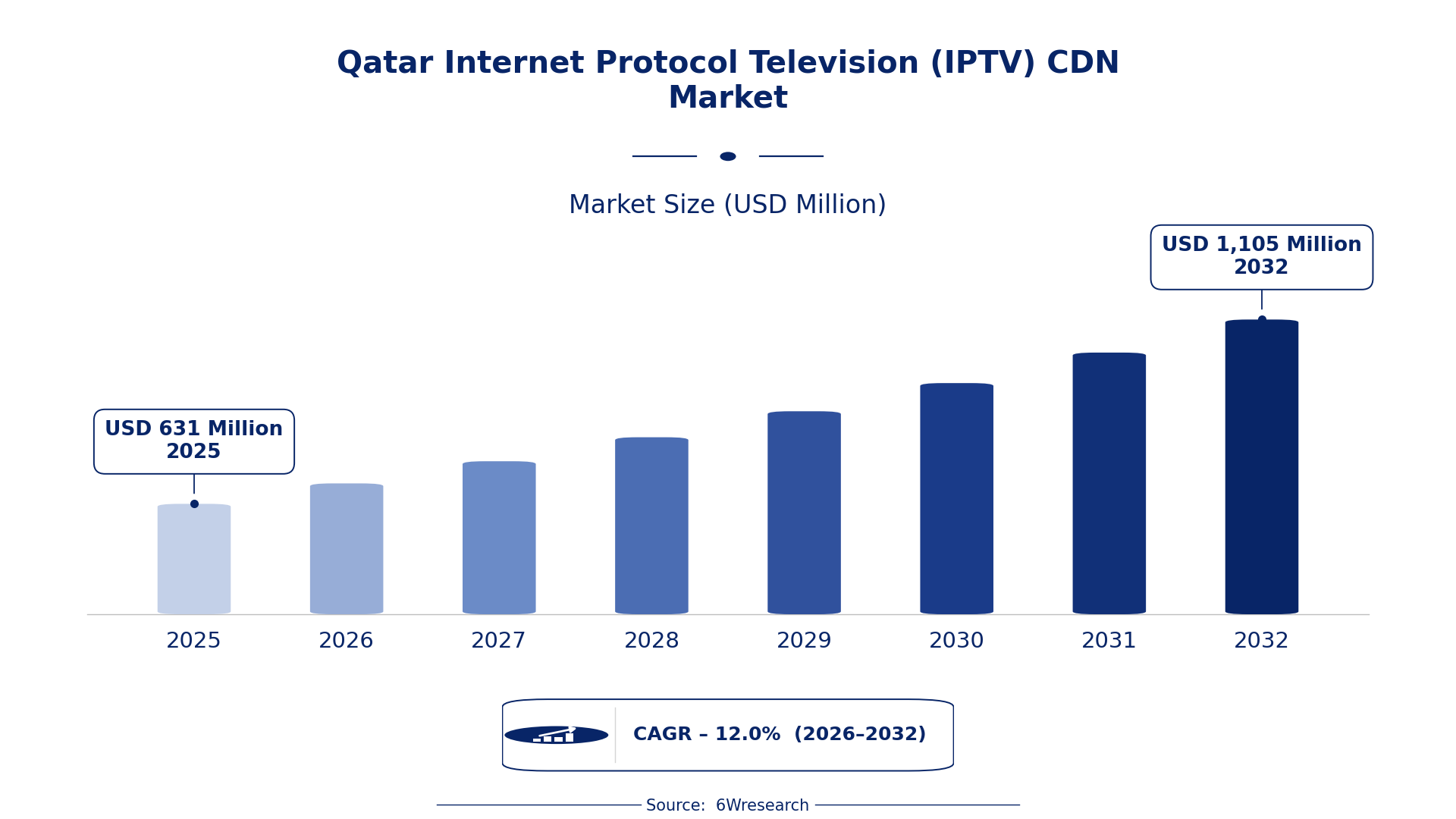
The Qatar Internet Protocol Television (IPTV) CDN Market was estimated at USD 631 Million in 2025 and is projected to reach USD 1105 Million by 2032, growing at a CAGR of 12.0% from 2026 to 2032.
Qatar Internet Protocol Television (IPTV) CDN Market Synopsis
Consumer appetite for high-quality video content is surging in Qatar, pushing IPTV services to the forefront of entertainment. The integration of advanced technologies in content delivery is essential for providers aiming to meet growing expectations.
As telecom operators enhance their infrastructure, innovations in CDN technology become critical to addressing latency and ensuring optimal streaming experiences. This demand signals a vigorous investment climate within the IPTV CDN market.
Qatar Internet Protocol Television (IPTV) CDN Market Year-wise Growth Rate and Key Drivers
This graph illustrates the annual growth rates of the Qatar Internet Protocol Television (IPTV) CDN Market from 2021 to 2032, highlighting a steady upward trajectory and projected expansion over the forecast period.
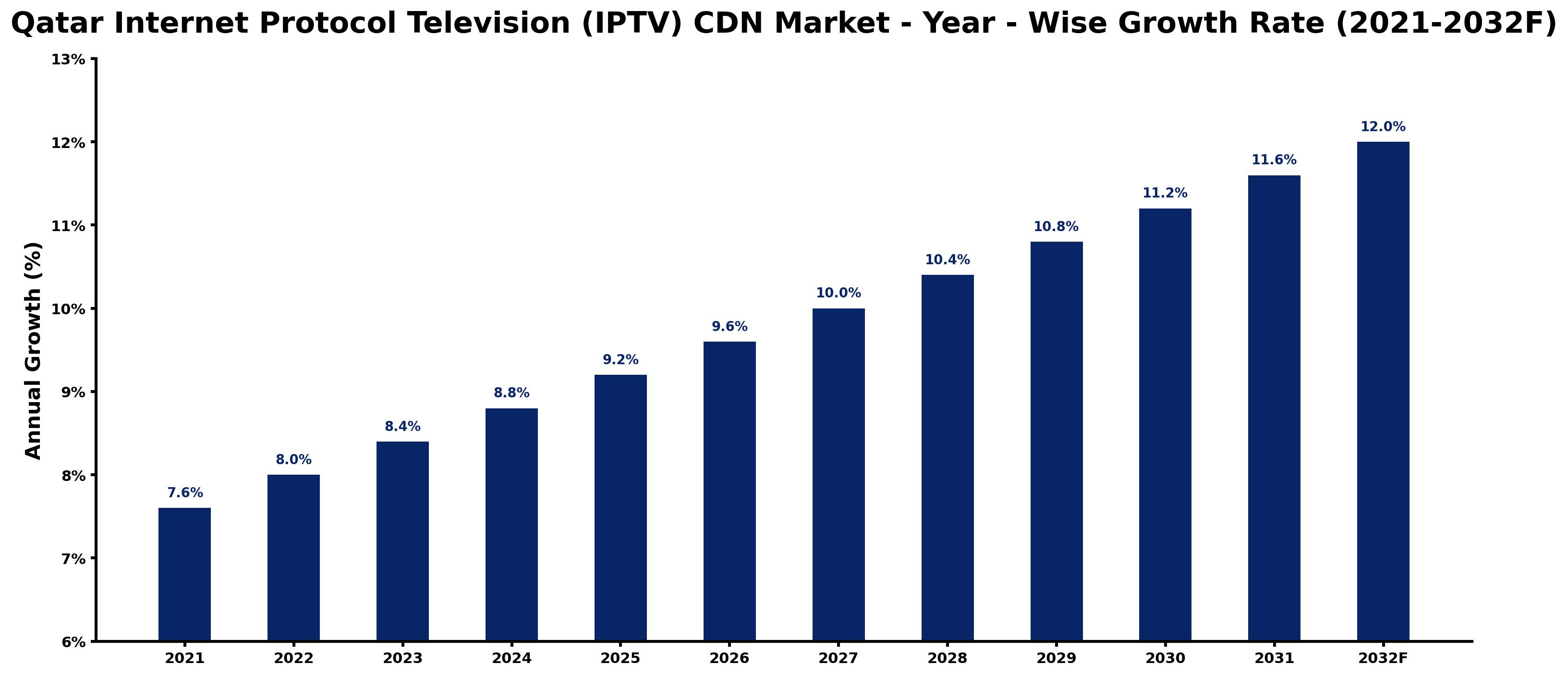
The table below presents the year‑wise growth rates along with the key drivers influencing the market
| Year | Growth Rate | Major Drivers |
| 2021 | 7.6% | Qatar National Vision 2030 emphasizing digital broadcasting growth. |
| 2022 | 8.0% | Increased smartphone penetration boosting IPTV accessibility. |
| 2023 | 8.4% | Rise in expatriate population enhancing diverse content demand. |
| 2024 | 8.8% | Government support for next-gen broadband infrastructure investments. |
| 2025 | 9.2% | Emerging OTT platforms driving subscription service innovations. |
| 2026 | 9.6% | Enhanced viewer experience through 5G network rollouts. |
| 2027 | 10.0% | Demand for high-quality streaming during major events. |
| 2028 | 10.4% | Qatar's ongoing events fostering demand for premium content. |
| 2029 | 10.8% | Regulatory support for international partnerships in content delivery. |
| 2030 | 11.2% | Growing preference for on-demand entertainment among youth. |
| 2031 | 11.6% | Increased digital literacy from educational initiatives in media. |
| 2032 | 12.0% | Advancements in compression technology improving broadcast quality. |
Note: Market size estimations and growth projections presented in this report are based on 6Wresearch's proprietary forecasting methodology, utilizing the latest available industry data, government publications, and primary research inputs.
Qatar Internet Protocol Television (IPTV) CDN Market Key Takeaways
Below are some of the specific key takeaways from the market, including:
- The market is set for significant growth, driven by increasing demand for on-demand and live streaming services.
- Key drivers include expanding fiber-optic networks and the rise in smart device adoption.
- Advanced video codecs are enhancing content delivery efficiency and quality.
- Qatar’s telecommunications infrastructure is adapting to meet the requirements of diverse viewers.
- Challenges such as network congestion and content protection will require ongoing technological solutions.
Evaluation of Restraints in Qatar Internet Protocol Television (IPTV) CDN Market
The Qatar IPTV CDN market encounters various restraints that impede its full potential. Chief among these is the risk of network congestion, which can lead to significant drops in streaming quality. Latency issues can negatively impact the user experience, especially during peak viewing times. Furthermore, the diverse preferences of audiences across Qatar necessitate adaptable content delivery solutions, which complicates operational strategies for providers. Additionally, stringent digital rights management and copyright concerns put further pressure on content delivery networks to maintain compliance while optimizing performance.
Qatar Internet Protocol Television (IPTV) CDN Market Trends
A notable trend is the rising integration of artificial intelligence in CDN management, which enhances content delivery by predicting demand and optimizing routing. There's also a marked increase in partnerships between content providers and telecom companies, fostering collaborative strategies that enhance service quality. The shift toward interactive and immersive viewing experiences, such as augmented reality and virtual reality content, is gaining traction, pushing CDN technology to evolve rapidly to accommodate new formats.
Qatar Internet Protocol Television (IPTV) CDN Market Opportunities
Investment opportunities abound in the expansion of broadband infrastructure across Qatar, particularly in underserved areas. The transition to 5G technology offers a path for improved bandwidth and reduced latency, presenting new avenues for content providers. Additionally, the growing trend of mobile IPTV opens opportunities for tailored content delivery solutions, as consumers increasingly seek on-the-go viewing options. Lastly, as more providers look to diversify their offerings, niche content tailored to local preferences can carve out profitable segments in an otherwise competitive market.
Government Initiatives in the Qatar Internet Protocol Television (IPTV) CDN Market
Government policies in Qatar are strategically steering the IPTV CDN market toward enhanced digital connectivity and infrastructure growth. The regulatory framework encourages innovation in telecommunications, which is critical for supporting the demand for high-quality content delivery. Current initiatives focus on upgrading broadband infrastructure and expanding access to high-speed internet services, ensuring that residents can fully benefit from advanced IPTV offerings.
- A national digital infrastructure upgrade programme now in its rollout phase aims to improve connectivity and reduce latency across urban and rural areas.
- Current regulatory initiatives focus on ensuring fair competition among service providers to foster innovation and improve service quality.
- A recently launched public-private partnership is focused on expanding fiber-optic networks throughout the country, enhancing content delivery capabilities.
- Future plans include initiatives aimed at integrating smart technologies within existing infrastructures to facilitate greater service efficiency and responsiveness.
- Upcoming policies are expected to focus on enhancing digital rights management frameworks to protect content providers while ensuring consumer access to diverse content.
Future Insights of the Qatar Internet Protocol Television (IPTV) CDN Market
From 2026 to 2032, the Qatar IPTV CDN market is positioned for dynamic growth driven by technological advancements and increasing consumer demand for high-quality streaming experiences. The expansion of 5G networks will provide the necessary bandwidth for sophisticated applications, including 4K streaming and interactive content. As competition increases among service providers, the focus will shift toward personalized content offerings and premium viewing experiences, solidifying IPTV's place as a mainstay in Qatar's entertainment industry.
Qatar Internet Protocol Television (IPTV) CDN Market Latest Developments
Recent months have seen significant activity in the Qatar IPTV CDN market, with various players launching initiatives aimed at enhancing service delivery and user experience. With a growing focus on user engagement, developments in content personalization and technology integration are shaping the future of IPTV services.
- A major telecommunications company launched a new CDN service aimed at improving live streaming quality, with rollout completed by early 2025.
- In mid-2025, a new partnership was formed between a leading technology vendor and local content providers to improve content delivery efficiencies.
- Ongoing initiatives aim to integrate AI-driven analytics into existing CDN infrastructure to enhance performance and user satisfaction, expected to launch in late 2025.
- Several providers are currently upgrading their networks to support 4K content delivery, with significant upgrades planned through 2026.
- Upcoming enhancements to regulatory frameworks are anticipated, expected to be announced in late 2025 to support innovation in the IPTV sector.
Qatar Internet Protocol Television (IPTV) CDN Market - Key Attractiveness of the Report
- 10 Years of Market Numbers
- Historical Data Starting from 2022 to 2025
- Base Year: 2025
- Forecast Data until 2032
- Key Performance Indicators Impacting the Market
- Major Upcoming Developments and Projects
Key Highlights of the Report:
- Qatar Internet Protocol Television (IPTV) CDN Market Outlook
- Market Size of Qatar Internet Protocol Television (IPTV) CDN Market, 2025
- Forecast of Qatar Internet Protocol Television (IPTV) CDN Market, 2032
- Historical Data and Forecast of Qatar Internet Protocol Television (IPTV) CDN Revenues & Volume for the Period 2022-2032F
- Qatar Internet Protocol Television (IPTV) CDN Market Trend Evolution
- Qatar Internet Protocol Television (IPTV) CDN Market Drivers and Challenges
- Qatar Internet Protocol Television (IPTV) CDN Price Trends
- Qatar Internet Protocol Television (IPTV) CDN Porter's Five Forces
- Qatar Internet Protocol Television (IPTV) CDN Industry Life Cycle
- Historical Data and Forecast of Qatar Internet Protocol Television (IPTV) CDN Market Revenues & Volume By Type for the Period 2022-2032F
- Historical Data and Forecast of Qatar Internet Protocol Television (IPTV) CDN Market Revenues & Volume By Video for the Period 2022-2032F
- Historical Data and Forecast of Qatar Internet Protocol Television (IPTV) CDN Market Revenues & Volume By Non-Video Content for the Period 2022-2032F
- Historical Data and Forecast of Qatar Internet Protocol Television (IPTV) CDN Market Revenues & Volume By Service for the Period 2022-2032F
- Historical Data and Forecast of Qatar Internet Protocol Television (IPTV) CDN Market Revenues & Volume By In-House for the Period 2022-2032F
- Historical Data and Forecast of Qatar Internet Protocol Television (IPTV) CDN Market Revenues & Volume By Manage Service for the Period 2022-2032F
- Historical Data and Forecast of Qatar Internet Protocol Television (IPTV) CDN Market Revenues & Volume By End-User for the Period 2022-2032F
- Historical Data and Forecast of Qatar Internet Protocol Television (IPTV) CDN Market Revenues & Volume By SME for the Period 2022-2032F
- Historical Data and Forecast of Qatar Internet Protocol Television (IPTV) CDN Market Revenues & Volume By Large Enterprise for the Period 2022-2032F
- Historical Data and Forecast of Qatar Internet Protocol Television (IPTV) CDN Market Revenues & Volume By Residential Customers for the Period 2022-2032F
- Qatar Internet Protocol Television (IPTV) CDN Import Export Trade Statistics
- Market Opportunity Assessment By Type
- Market Opportunity Assessment By Service
- Market Opportunity Assessment By End-User
- Qatar Internet Protocol Television (IPTV) CDN Top Companies Market Share
- Qatar Internet Protocol Television (IPTV) CDN Competitive Benchmarking By Technical and Operational Parameters
- Qatar Internet Protocol Television (IPTV) CDN Company Profiles
- Qatar Internet Protocol Television (IPTV) CDN Key Strategic Recommendations






































