Qatar Kids Footwear Market Summary
The qatar kids footwear market was estimated at USD 161 Million in 2025 and is projected to reach USD 224 Million by 2032, growing at a CAGR of 5.4% from 2026 to 2032.
Qatar Kids Footwear Market Year-wise Growth Rate and Key Drivers
This graph highlights how the Qatar Kids Footwear Market has steadily grown over the past five years, supported by major growth factors.
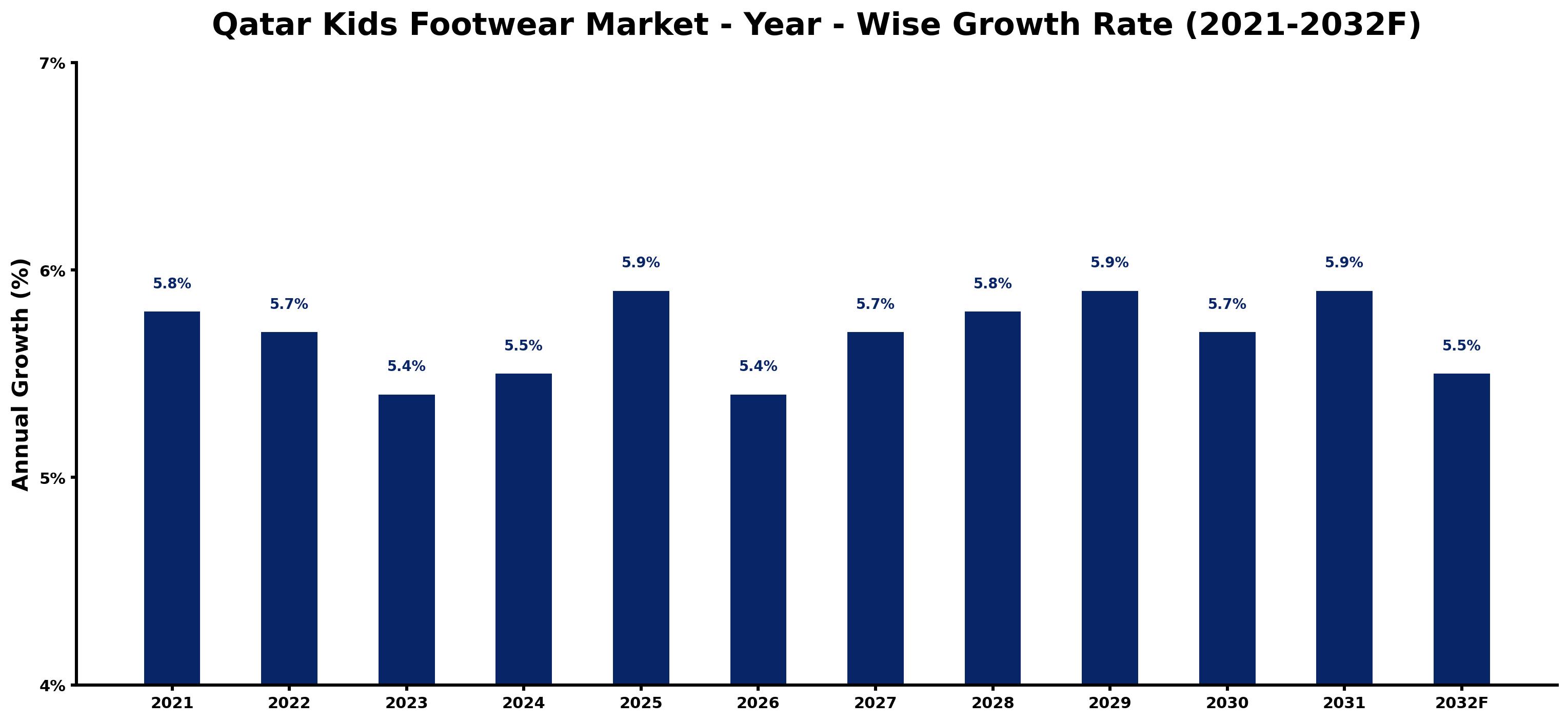
The table below presents the year wise growth rates along with the key drivers influencing the market
| Year | Growth Rate | Major Drivers |
| 2021 | 5.8% | The re-opening of schools sparked an immediate increase in children's footwear sales. |
| 2022 | 5.7% | Cultural shifts towards more outdoor activities influenced stronger demand for durable footwear. |
| 2023 | 5.4% | Retailers increasingly focused on branded collaborations to resonate with young consumers' preferences. |
| 2024 | 5.5% | Growing awareness of sustainable materials led to a rise in eco-friendly footwear options. |
| 2025 | 5.9% | Localized production initiatives reduced lead times, enhancing product availability in Qatari markets. |
| 2026 | 5.4% | E-commerce platforms catered to busy parents, facilitating convenient shopping experiences for kids' shoes. |
| 2027 | 5.7% | Increasing urbanization contributed to a heightened interest in stylish yet functional footwear designs. |
| 2028 | 5.8% | Influencer marketing became vital, shaping trends and consumer preferences in children's footwear. |
| 2029 | 5.9% | Seasonal climate considerations prompted innovation in breathable materials suitable for year-round wear. |
| 2030 | 5.7% | Collaborative designs with local artists captured the imagination of Qatar's youth market segment. |
| 2031 | 5.9% | Economic diversification strategies enriched consumer spending power, benefiting the footwear industry. |
| 2032 | 5.5% | A growing emphasis on health and wellness inspired parents to prioritize supportive shoe options. |
Note - Market size estimations and growth projections presented in this report are based on 6Wresearch's advanced forecasting approach, validated with industry datasets as of June 2026.
Qatar Kids Footwear Market Synopsis
The Qatar Kids Footwear Market is projected to reach 5.4% and witness significant growth during the forecast period (2026-2032). This market is characterized by a rising demand for both fashionable and comfortable footwear among children, driven by several socio-economic factors and evolving consumer preferences. As the region continues to adapt to changing lifestyles and economic conditions, the Qatar Kids Footwear Market is expected to flourish, supported by various trends that highlight the need for quality children's footwear.
Qatar Kids Footwear Market Growth Drivers
A multitude of factors is propelling the growth of the Qatar Kids Footwear Market. Key drivers include:
- The increasing investment from parents in fashionable and comfortable footwear for their children, which reflects the rising awareness of style and quality in kids' products.
- The trend of premiumization, where consumers show a marked preference for designer shoes from established international brands. This shift towards luxury footwear options has incentivized manufacturers to enhance their offerings.
- Rising per capita income among the population is enabling families to spend more on children's footwear, thus expanding the market significantly during this forecast period.
- An expanding middle-class demographic is facilitating greater access to disposable income, allowing more families to invest in quality footwear for their children.
- Technological advancements in manufacturing processes have led to innovative designs that improve comfort, durability, and style, appealing to both parents and kids.
Qatar Kids Footwear Market Trends and Opportunities
The Qatar Kids Footwear Market is undergoing several noteworthy trends that present substantial opportunities for growth. These include a marked shift towards online shopping, driven by increased digital engagement among consumers. Additionally, there is a rising demand for eco-friendly and sustainable footwear, with parents looking for products that align with their values.
Moreover, lifestyle changes resulting from higher disposable income are fostering a demand for diverse ranges of children's shoes that cater to various activities, from sports to casual wear. There is also an emerging trend towards personalization, where consumers seek unique designs that reflect their child's personality.
Qatar Kids Footwear Market Challenges and Restraints
While opportunities abound, the Qatar Kids Footwear Market faces several challenges. High production costs associated with quality materials could deter manufacturers from targeting budget-conscious segments effectively. Additionally, the market is constrained by a limited availability of attractive designs compared to adult footwear, which may affect consumer adoption rates.
Furthermore, economic fluctuations and potential market saturation could pose threats to sustained growth in the sector. Building brand loyalty in an increasingly competitive landscape and ensuring affordability without compromising on quality are challenges that stakeholders must navigate.
Qatar Kids Footwear Market Government Investment and Initiatives
Government initiatives in Qatar play a crucial role in fostering the growth of the Kids Footwear Market. Ongoing investments in education and youth-oriented programs underscore the government's commitment to enhancing the quality of life for families. Such investments are likely to stimulate demand for children's products, including footwear.
Additionally, policies aimed at increasing access to e-commerce platforms and bolstering the retail industry will further facilitate online shopping trends. Public spending initiatives, especially those focused on developing infrastructure that supports retail and e-commerce, will create a favorable environment for market growth.
Qatar Kids Footwear Market Latest Developments (May 2025 - June 2026)
Recent developments in the Qatar Kids Footwear Market indicate a gradual recovery post-pandemic, with a heightened focus on online sales channels. As educational institutions reopen, there is a resurgence in the demand for children's footwear, with consumers increasingly prioritizing convenience in shopping experiences.
Innovations in product offerings, particularly the introduction of smart footwear incorporating technology for comfort and enhanced performance, have begun to capture consumer interest. Additionally, the market is seeing an uptick in collaborations between designers and manufacturers, which is enriching the variety of styles and options available to consumers.
Qatar Kids Footwear Market - Key Attractiveness of the Report
- 10 Years of Market Numbers
- Historical Data Starting from 2022 to 2025
- Base Year: 2025
- Forecast Data until 2032
- Key Performance Indicators Impacting the Market
- Major Upcoming Developments and Projects
Key Highlights of the Report:
- Qatar Kids Footwear Market Outlook
- Market Size of Qatar Kids Footwear Market, 2025
- Forecast of Qatar Kids Footwear Market, 2032
- Historical Data and Forecast of Qatar Kids Footwear Revenues & Volume for the Period 2022-2032F
- Qatar Kids Footwear Market Trend Evolution
- Qatar Kids Footwear Market Drivers and Challenges
- Qatar Kids Footwear Price Trends
- Qatar Kids Footwear Porter's Five Forces
- Qatar Kids Footwear Industry Life Cycle
- Historical Data and Forecast of Qatar Kids Footwear Market Revenues & Volume By Product Type for the Period 2022-2032F
- Historical Data and Forecast of Qatar Kids Footwear Market Revenues & Volume By Casual for the Period 2022-2032F
- Historical Data and Forecast of Qatar Kids Footwear Market Revenues & Volume By Sports for the Period 2022-2032F
- Historical Data and Forecast of Qatar Kids Footwear Market Revenues & Volume By Formal for the Period 2022-2032F
- Historical Data and Forecast of Qatar Kids Footwear Market Revenues & Volume By Others for the Period 2022-2032F
- Historical Data and Forecast of Qatar Kids Footwear Market Revenues & Volume By End-users for the Period 2022-2032F
- Historical Data and Forecast of Qatar Kids Footwear Market Revenues & Volume By Boys for the Period 2022-2032F
- Historical Data and Forecast of Qatar Kids Footwear Market Revenues & Volume By Girls for the Period 2022-2032F
- Historical Data and Forecast of Qatar Kids Footwear Market Revenues & Volume By Unisex for the Period 2022-2032F
- Qatar Kids Footwear Import Export Trade Statistics
- Market Opportunity Assessment By Product Type
- Market Opportunity Assessment By End-users
- Qatar Kids Footwear Top Companies Market Share
- Qatar Kids Footwear Competitive Benchmarking By Technical and Operational Parameters
- Qatar Kids Footwear Company Profiles
- Qatar Kids Footwear Key Strategic Recommendations






































