Qatar Leather Market Summary
The qatar leather market was estimated at USD 466 Million in 2025 and is projected to reach USD 655 Million by 2032, growing at a CAGR of 6.0% from 2026 to 2032.
Qatar Leather Market Year-wise Growth Rate and Key Drivers
This graph highlights how the Qatar Leather Market has steadily grown over the past five years, supported by major growth factors.
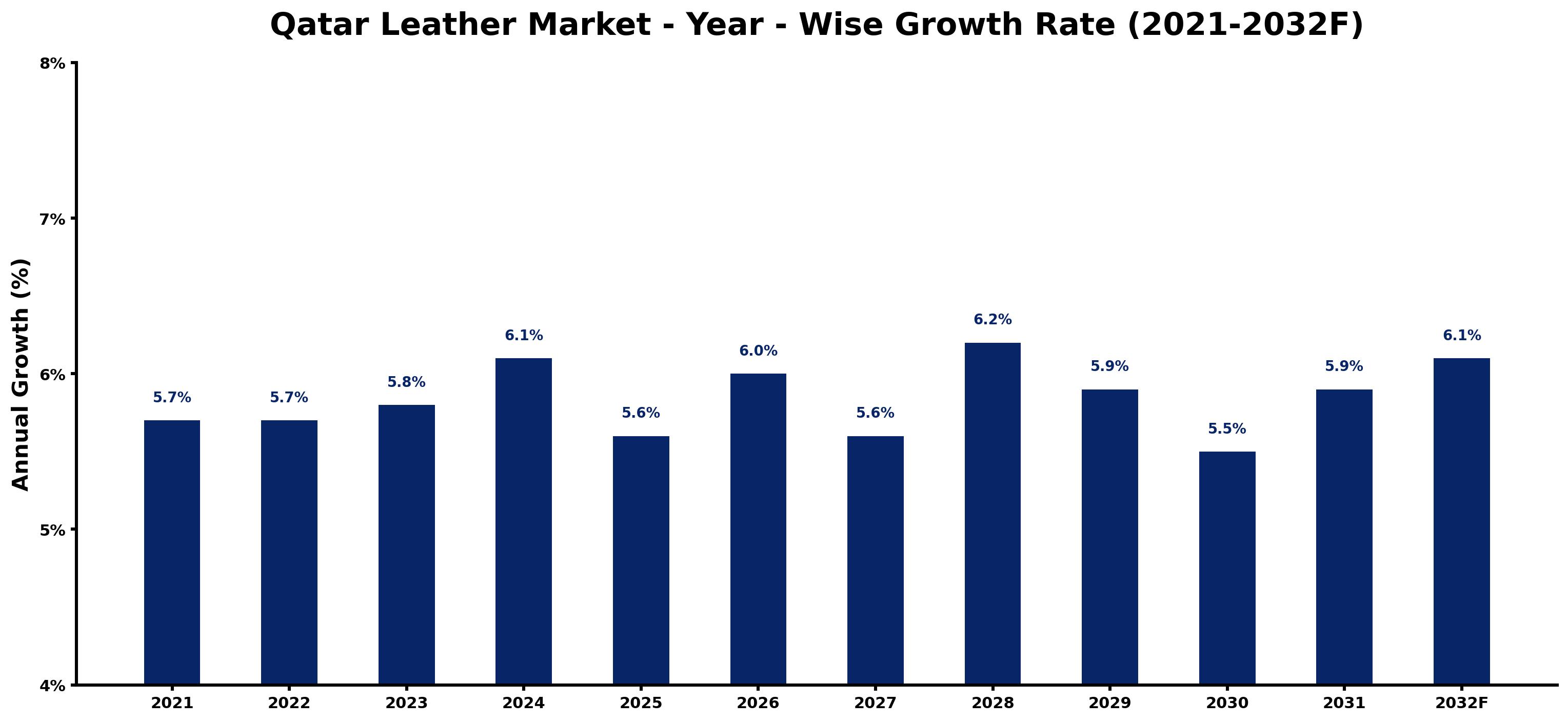
The table below presents the year wise growth rates along with the key drivers influencing the market
| Year | Growth Rate | Major Drivers |
| 2021 | 5.7% | Post-lockdown retail projects ignited enthusiasm for luxury goods, boosting leather sales. |
| 2022 | 5.7% | Emergence of high-end fashion brands in Qatar elevated consumer interest in leather products. |
| 2023 | 5.8% | Construction pipelines for mega-projects increased demand for durable, high-quality leather materials. |
| 2024 | 6.1% | Cultural festivals and events showcased local artisans, enhancing the visibility of leather craftsmanship. |
| 2025 | 5.6% | Regional tourism influx encouraged luxury retailers to expand leather offerings in market. |
| 2026 | 6.0% | Sustainability trends urged brands to adopt eco-friendly leather alternatives, influencing consumer choices. |
| 2027 | 5.6% | E-commerce growth allowed local leather brands to reach broader audiences efficiently. |
| 2028 | 6.2% | Emerging designers tapped into traditional craftsmanship, revitalizing Qatar's leather heritage. |
| 2029 | 5.9% | Increased disposable income among millennials fostered a shift towards premium leather goods. |
| 2030 | 5.5% | Consumer awareness of ethical sourcing drove demand for locally produced leather products. |
| 2031 | 5.9% | Collaborations between international brands and local artisans enhanced product diversity significantly. |
| 2032 | 6.1% | Technological innovations in leather production improved efficiency and sustainability across the sector. |
Note - Market size estimations and growth projections presented in this report are based on 6Wresearch's advanced forecasting approach, validated with industry datasets as of June 2026.
Qatar Leather Market Synopsis
The Qatar Leather Market is projected to reach 6.0% and witness significant growth during the forecast period (2026-2032). This upward trajectory is primarily driven by the increasing demand for leather products in both domestic and international arenas. As Qatar's economy continues to develop, consumer spending is anticipated to rise, subsequently boosting the production and sales of leather goods. Furthermore, the government's commitment to enhancing infrastructure and its proactive stance on foreign direct investment are key elements that will stimulate market expansion. In addition, the growing environmental consciousness among consumers is expected to augment the demand for eco-friendly leather products, further contributing to market dynamics.
Qatar Leather Market Growth Drivers
A myriad of factors is propelling growth within the Qatar Leather Market. The increasing disposable income among consumers is one of the most significant drivers, allowing individuals to invest in premium leather goods. As Qatar's middle class expands, there is an evident shift towards high-quality, durable products that leather offers. Furthermore, the growing tourism sector in Qatar is driving demand for leather accessories, as visitors often seek locally made, authentic products as souvenirs. Another critical factor is the rising popularity of online shopping, which provides consumers access to a broader range of leather goods, consequently increasing market penetration. Additionally, the government's focus on diversifying the economy is opening new avenues for the leather industry, fostering innovation and product development.
Qatar Leather Market Trends and Opportunities
The Qatar Leather Market is witnessing several emerging trends that present lucrative opportunities for growth. One notable trend is the increasing shift towards sustainable and ethically produced leather. Consumers are becoming more socially conscious, prompting manufacturers to adopt sustainable practices in production. Moreover, the integration of technology in leather production, such as digital printing and automated processes, is enhancing product quality and reducing costs. This technological advancement is creating a niche market for tech-enabled leather goods. Furthermore, collaborations with fashion designers and brands are becoming more prominent, allowing for creative expressions that appeal to modern consumers. The upcoming FIFA World Cup in Qatar is also generating heightened interest in locally crafted leather products, providing a unique opportunity for local artisans and manufacturers.
Qatar Leather Market Challenges and Restraints
Despite the positive outlook, the Qatar Leather Market faces several challenges that could impede growth. One significant constraint is the competition from synthetic leather alternatives, which are often cheaper and perceived as more environmentally friendly. This competitive landscape may influence consumer choices and affect traditional leather sales. Additionally, fluctuations in raw material prices can pose a financial challenge for manufacturers, impacting profit margins and overall market stability. The stringent regulations concerning environmental impacts and waste management may also present hurdles, requiring companies to adapt their processes accordingly. Moreover, the ongoing global economic uncertainties can affect consumer spending habits, leading to an unpredictable market environment.
Qatar Leather Market Government Investment and Initiatives
The Qatari government has taken a proactive approach to foster growth within the leather industry through various investment initiatives and policies. With a focus on economic diversification, government infrastructure development plans are set to enhance the manufacturing capabilities within the leather sector. Public spending on innovation and technology in manufacturing processes is being prioritized, thereby elevating production standards and competitiveness. Additionally, incentives for foreign direct investment are being promoted to attract global players, fostering a climate of collaboration and skill transfer. Such initiatives aim to create a robust ecosystem that not only supports local manufacturers but also places Qatar on the global leather market map.
Qatar Leather Market Latest Developments (May 2025 - June 2026)
During the period from May 2025 to June 2026, the Qatar Leather Market has experienced significant shifts that indicate a promising future. The introduction of new eco-friendly leather production techniques has been a noteworthy development, as manufacturers strive to meet the rising consumer demand for sustainable products. Furthermore, collaborations between local artisans and international brands have gained momentum, enhancing the visibility of Qatari leather goods in global markets. Trade fairs and exhibitions have also played a crucial role in showcasing local products, providing a platform for business growth and networking. Overall, the market is evolving in response to both consumer preferences and technological advancements, setting a positive tone for the upcoming years.
Qatar Leather Market - Key Attractiveness of the Report
- 10 Years of Market Numbers
- Historical Data Starting from 2022 to 2025
- Base Year: 2025
- Forecast Data until 2032
- Key Performance Indicators Impacting the Market
- Major Upcoming Developments and Projects
Key Highlights of the Report:
- Qatar Leather Market Outlook
- Market Size of Qatar Leather Market, 2025
- Forecast of Qatar Leather Market, 2032F
- Historical Data and Forecast of Qatar Leather Revenues & Volume for the Period 2022-2032F
- Qatar Leather Market Trend Evolution
- Qatar Leather Market Drivers and Challenges
- Qatar Leather Price Trends
- Qatar Leather Porter's Five Forces
- Qatar Leather Industry Life Cycle
- Historical Data and Forecast of Qatar Leather Market Revenues & Volume By Type for the Period 2022-2032F
- Historical Data and Forecast of Qatar Leather Market Revenues & Volume By Luggage for the Period 2022-2032F
- Historical Data and Forecast of Qatar Leather Market Revenues & Volume By Footwear for the Period 2022-2032F
- Historical Data and Forecast of Qatar Leather Market Revenues & Volume By Accessories for the Period 2022-2032F
- Historical Data and Forecast of Qatar Leather Market Revenues & Volume By Distribution Channel for the Period 2022-2032F
- Historical Data and Forecast of Qatar Leather Market Revenues & Volume By Online for the Period 2022-2032F
- Historical Data and Forecast of Qatar Leather Market Revenues & Volume By Offline for the Period 2022-2032F
- Qatar Leather Import Export Trade Statistics
- Market Opportunity Assessment By Type
- Market Opportunity Assessment By Distribution Channel
- Qatar Leather Top Companies Market Share
- Qatar Leather Competitive Benchmarking By Technical and Operational Parameters
- Qatar Leather Company Profiles
- Qatar Leather Key Strategic Recommendations






































