Qatar Lubrication System Market Summary
The qatar lubrication system market was estimated at USD 176 Million in 2025 and is projected to reach USD 246 Million by 2032, growing at a CAGR of 5.6% from 2026 to 2032.
Qatar Lubrication System Market Year-wise Growth Rate and Key Drivers
This graph highlights how the Qatar Lubrication System Market has steadily grown over the past five years, supported by major growth factors.
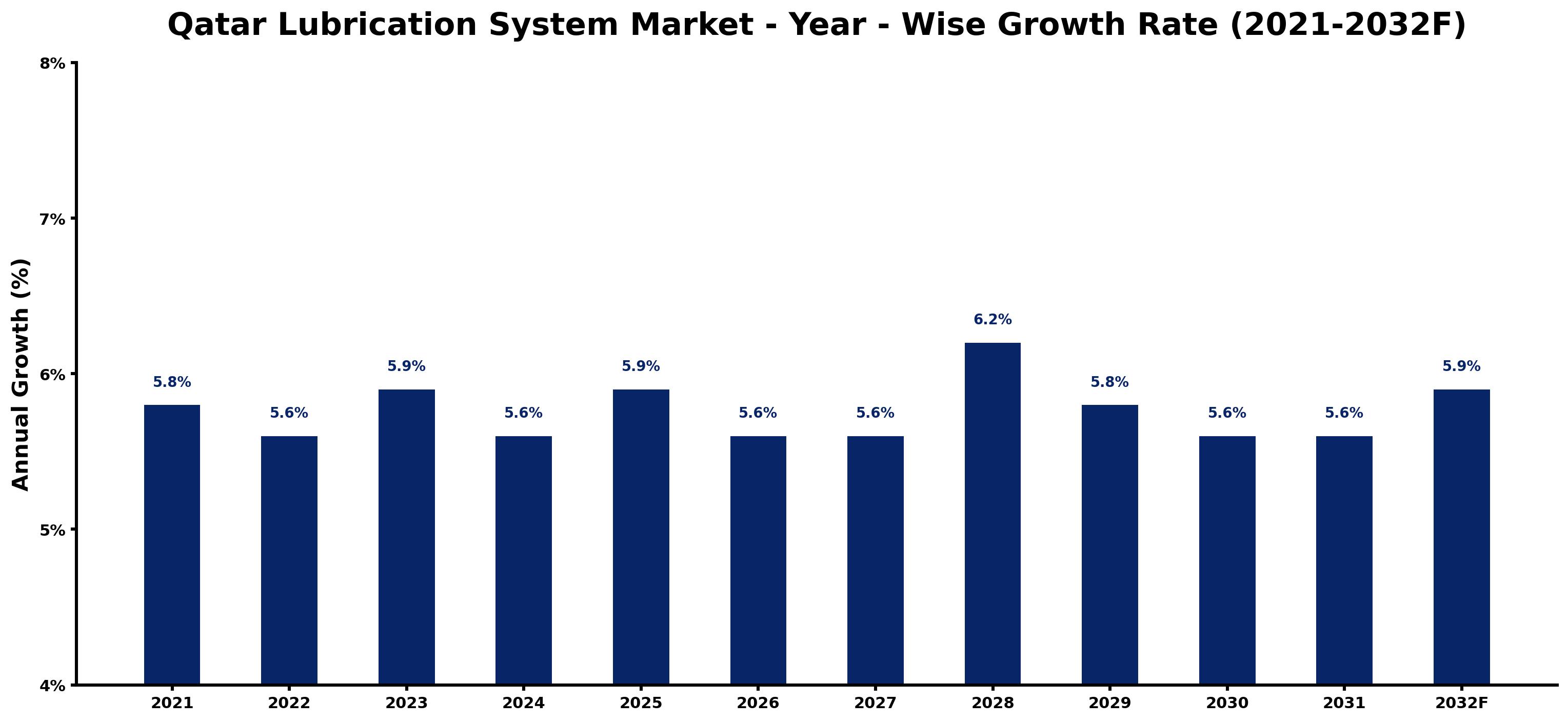
The table below presents the year wise growth rates along with the key drivers influencing the market
| Year | Growth Rate | Major Drivers |
| 2021 | 5.8% | Investment in infrastructure projects continues to support lubricant demand across various sectors. |
| 2022 | 5.6% | Local manufacturing capabilities emerge, reducing dependency on imported lubrication products significantly. |
| 2023 | 5.9% | The construction boom in Qatar creates a high demand for industrial lubricants and greases. |
| 2024 | 5.6% | Climate challenges prompt the introduction of more efficient, environmentally friendly lubricant solutions. |
| 2025 | 5.9% | As automotive sales rebound, demand for high-performance engine oils sees notable increases. |
| 2026 | 5.6% | Innovations in synthetic lubricants cater to evolving customer preferences and operational efficiency. |
| 2027 | 5.6% | Energy sector expansion drives the need for reliable lubrication in machinery and equipment. |
| 2028 | 6.2% | Partnerships with global lubricant brands enhance local distribution channels and market penetration. |
| 2029 | 5.8% | Increasing regulatory awareness leads to a shift towards eco-friendly lubricant formulations. |
| 2030 | 5.6% | The development of smart lubrication systems integrates technology into traditional lubrication practices. |
| 2031 | 5.6% | Local research initiatives focus on optimizing lubricant formulations for extreme climatic conditions. |
| 2032 | 5.9% | Evolving consumer preferences demand specialized lubricants for electric and hybrid vehicle applications. |
Note - Market size estimations and growth projections presented in this report are based on 6Wresearch's advanced forecasting approach, validated with industry datasets as of June 2026.
Qatar Lubrication System Market Synopsis
The Qatar Lubrication System Market is projected to reach 5.6% and witness significant growth during the forecast period (2026-2032). Lubrication systems play a critical role in minimizing friction, heat, and wear among moving machinery components, ensuring smooth operation and prolonged equipment lifespan across various industries, including manufacturing, automotive, construction, and oil and gas.
Qatar Lubrication System Market Growth Drivers
The demand for lubrication systems in Qatar is shaped by several key factors.
- Proper lubrication is essential for efficient equipment maintenance, enhancing performance while reducing downtime. Industries are increasingly recognizing the value of investing in advanced lubrication systems to optimize operational efficiency.
- The move towards automation in manufacturing processes necessitates reliable lubrication systems that can maintain performance levels and prevent equipment failures, thereby supporting operational continuity.
- Rapid industrialization and ongoing infrastructure projects in Qatar are escalating the need for effective lubrication solutions across sectors such as construction and manufacturing, driving growth in the market.
- Stringent environmental regulations are pushing companies to adopt lubrication systems that not only reduce friction but also lower energy consumption, hence minimizing carbon emissions in line with sustainability goals.
- The focus on enhancing equipment reliability and maintenance practices, particularly in critical industries like oil and gas, is fueling the demand for advanced lubrication systems to ensure operational effectiveness.
Qatar Lubrication System Market Trends and Opportunities
Several trends are shaping the Qatar Lubrication System Market, presenting opportunities for businesses to innovate and expand.
- The integration of automation and smart technologies, such as Industry 4.0 and the Internet of Things (IoT), is revolutionizing traditional lubrication practices, offering enhanced monitoring and management capabilities.
- Adoption of biodegradable and eco-friendly lubricants is rising, driven by regulatory pressures and a growing awareness of environmental sustainability among industries.
- Increased investment in research and development is expected to foster innovations in lubrication systems, enabling better performance across a wider range of operating conditions and equipment types.
- The inclination towards predictive maintenance strategies and condition-based monitoring will further enhance the importance of lubrication systems in extending equipment life and performance efficiency.
- There is a noticeable shift towards multifunctional lubrication systems capable of servicing diverse applications, which can appeal to a broader customer base and fulfill varying industrial requirements.
Qatar Lubrication System Market Challenges and Restraints
Despite the positive growth prospects, the market faces several challenges that could impact development.
- The complexity of developing advanced lubrication systems that cater to diverse machinery and equipment is a significant technological hurdle that requires ongoing innovation.
- High initial investment costs for installing lubrication systems, coupled with ongoing maintenance expenses, may be prohibitive for small and medium-sized enterprises, limiting market participation.
- The competitive landscape is characterized by numerous global and regional players offering a wide range of products, making it challenging for new entrants to establish their market presence.
- Emerging technologies may disrupt traditional lubrication practices, necessitating adaptation and innovation within existing product offerings to meet evolving market demands.
- Lastly, the fluctuating global economic environment affects industrial investments, which may influence the demand for lubrication systems in the short term.
Qatar Lubrication System Market Covid-19 Impact
The Covid-19 pandemic presented a dual impact on the Qatar Lubrication System Market. Initially, the temporary shutdowns of manufacturing facilities and reduced industrial activity resulted in a downturn in lubrication system demand.
Conversely, as industries began to recover, there was a renewed focus on equipment maintenance and reliability to meet new operational standards, which could lead to an increased demand for lubrication systems moving forward.
Qatar Lubrication System Market Government Investment and Initiatives
The Qatari government has recognized the importance of industrial efficiency and sustainability, leading to several initiatives aimed at bolstering the lubrication systems sector. Public investment is directed towards enhancing industrial infrastructure, which will inherently drive demand for advanced lubrication systems.
Additionally, development plans focused on diversifying the economy and promoting innovation are set to encourage the adoption of modern lubrication technologies across various sectors.
These initiatives include incentives for industries adopting green technologies, thereby fostering a market conducive to the growth of eco-friendly lubrication systems.
In summary, government policies are geared towards improving industrial efficiency while adhering to environmental standards, fundamentally supporting the growth trajectory of the Qatar Lubrication System Market.
Qatar Lubrication System Market Latest Developments (May 2025 - June 2026)
During the period from May 2025 to June 2026, the Qatar Lubrication System Market has seen several noteworthy developments. There has been a growing emphasis on innovation, with companies focusing on integrating advanced technology solutions for lubrication management.
Additionally, shifts in consumer preferences towards sustainability have prompted more industries to explore eco-friendly lubrication options, aligning with broader environmental goals.
Moreover, rising investment in infrastructure development has catalyzed an uptick in demand for lubrication systems, particularly in construction and manufacturing, as companies seek to enhance operational reliability and efficiency.
Overall, the period reflects a positive shift in market dynamics, underscoring the importance of lubrication systems in supporting industrial resiliency and sustainability efforts.
Qatar Lubrication System Market - Key Attractiveness of the Report
- 10 Years of Market Numbers
- Historical Data Starting from 2022 to 2025
- Base Year: 2025
- Forecast Data until 2032
- Key Performance Indicators Impacting the Market
- Major Upcoming Developments and Projects
Key Highlights of the Report:
- Qatar Lubrication System Market Outlook
- Market Size of Qatar Lubrication System Market, 2025
- Forecast of Qatar Lubrication System Market, 2032
- Historical Data and Forecast of Qatar Lubrication System Revenues & Volume for the Period 2022-2032F
- Qatar Lubrication System Market Trend Evolution
- Qatar Lubrication System Market Drivers and Challenges
- Qatar Lubrication System Price Trends
- Qatar Lubrication System Porter's Five Forces
- Qatar Lubrication System Industry Life Cycle
- Historical Data and Forecast of Qatar Lubrication System Market Revenues & Volume By Line Type for the Period 2022-2032F
- Historical Data and Forecast of Qatar Lubrication System Market Revenues & Volume By Manual Lubrication Systems for the Period 2022-2032F
- Historical Data and Forecast of Qatar Lubrication System Market Revenues & Volume By Automatic Lubrication Systems for the Period 2022-2032F
- Historical Data and Forecast of Qatar Lubrication System Market Revenues & Volume By Product Type for the Period 2022-2032F
- Historical Data and Forecast of Qatar Lubrication System Market Revenues & Volume By Single-Product Lubrication Systems for the Period 2022-2032F
- Historical Data and Forecast of Qatar Lubrication System Market Revenues & Volume By Dual-Product Lubrication Systems for the Period 2022-2032F
- Historical Data and Forecast of Qatar Lubrication System Market Revenues & Volume By Multi-Product Lubrication Systems for the Period 2022-2032F
- Historical Data and Forecast of Qatar Lubrication System Market Revenues & Volume By Series Progressive for the Period 2022-2032F
- Historical Data and Forecast of Qatar Lubrication System Market Revenues & Volume By Circulating Oil for the Period 2022-2032F
- Historical Data and Forecast of Qatar Lubrication System Market Revenues & Volume By Oil & Air for the Period 2022-2032F
- Historical Data and Forecast of Qatar Lubrication System Market Revenues & Volume By Application for the Period 2022-2032F
- Historical Data and Forecast of Qatar Lubrication System Market Revenues & Volume By Cement Plants for the Period 2022-2032F
- Historical Data and Forecast of Qatar Lubrication System Market Revenues & Volume By Steel Industry for the Period 2022-2032F
- Historical Data and Forecast of Qatar Lubrication System Market Revenues & Volume By Mining & Mineral Processing for the Period 2022-2032F
- Historical Data and Forecast of Qatar Lubrication System Market Revenues & Volume By Paper & Printing for the Period 2022-2032F
- Historical Data and Forecast of Qatar Lubrication System Market Revenues & Volume By Automotive for the Period 2022-2032F
- Historical Data and Forecast of Qatar Lubrication System Market Revenues & Volume By Industrial Machine & Machine Tools for the Period 2022-2032F
- Historical Data and Forecast of Qatar Lubrication System Market Revenues & Volume By Construction Machines Machines for the Period 2022-2032F
- Qatar Lubrication System Import Export Trade Statistics
- Market Opportunity Assessment By Line Type
- Market Opportunity Assessment By Product Type
- Market Opportunity Assessment By Application
- Qatar Lubrication System Top Companies Market Share
- Qatar Lubrication System Competitive Benchmarking By Technical and Operational Parameters
- Qatar Lubrication System Company Profiles
- Qatar Lubrication System Key Strategic Recommendations






































