Qatar Medical Tubing Market Size, Share & Growth Rate
The Qatar Medical Tubing Market was estimated at USD 764 Million in 2025 and is projected to reach USD 1098 Million by 2032, growing at a CAGR of 5.3% from 2026 to 2032. This upward trajectory is largely fueled by the rapid expansion of the healthcare sector in Qatar, where an increase in healthcare facilities correlates with a burgeoning demand for specialized tubing solutions, including those used in fluid management and drug delivery. Furthermore, the heightened focus on patient safety and infection control has propelled healthcare providers to adopt advanced tubing technologies, fostering sustained growth in the market.
Qatar Medical Tubing Market Year-wise Growth Rate and Key Drivers
This graph highlights how the Qatar Medical Tubing Market has steadily grown over the years, supported by major growth factors.
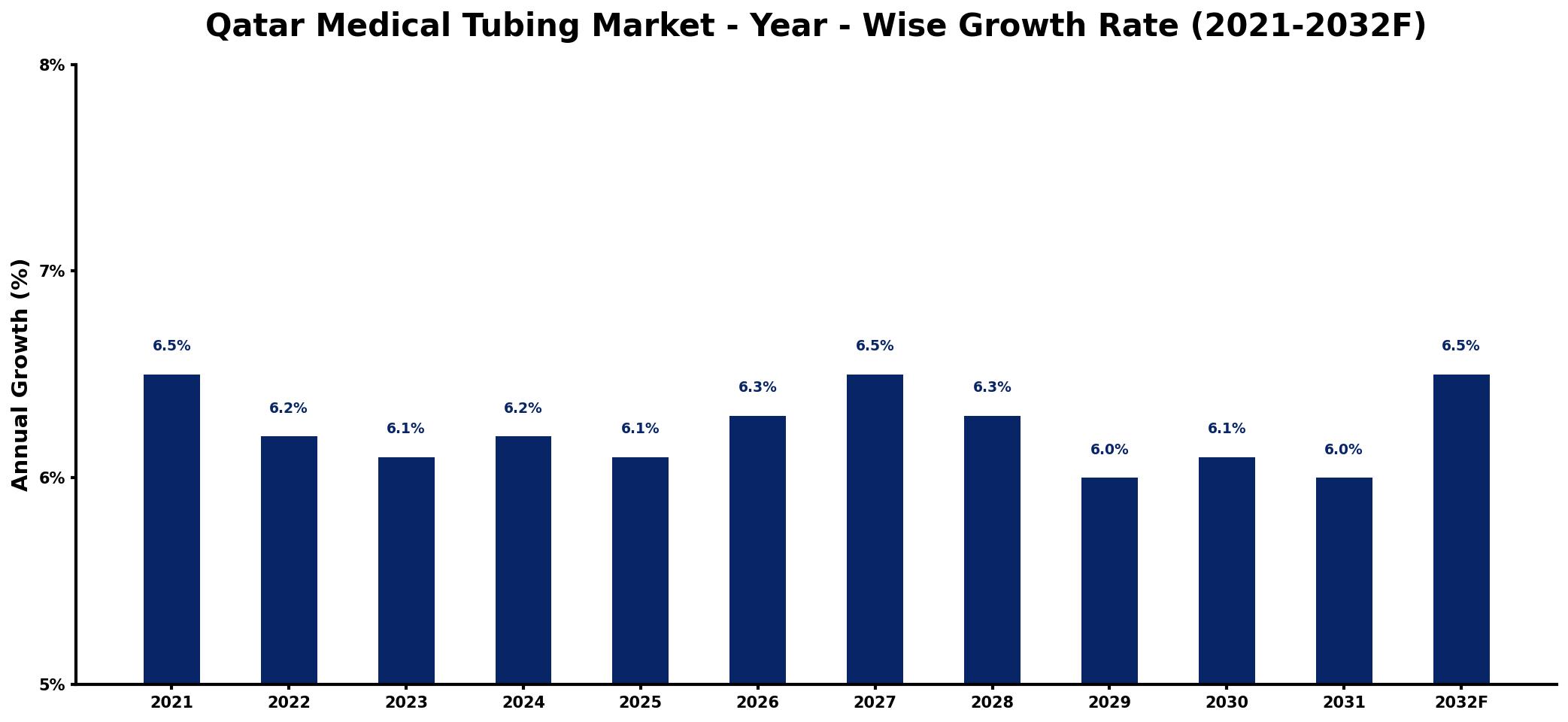
The table below presents the year‑wise growth rates along with the key drivers influencing the market
| Year | Growth Rate | Major Drivers |
| 2021 | 6.5% | Rising healthcare infrastructure investments |
| 2022 | 6.2% | Increased demand for healthcare services |
| 2023 | 6.1% | Technological advancements in healthcare |
| 2024 | 6.2% | Growing aging population demographics |
| 2025 | 6.1% | Expansion of healthcare facilities network |
| 2026 | 6.3% | Surge in chronic disease prevalence |
| 2027 | 6.5% | Innovations in healthcare delivery methods |
| 2028 | 6.3% | Enhanced focus on patient safety |
| 2029 | 6.0% | Growing trend of home healthcare |
| 2030 | 6.1% | Increased government healthcare funding |
| 2031 | 6.0% | Rising awareness of health standards |
| 2032 | 6.5% | Strengthened partnerships in healthcare sector |
Note: Market size estimations and growth projections presented in this report are based on 6Wresearch's proprietary forecasting methodology, utilizing the latest available industry data, government publications, and primary research inputs.
Qatar Medical Tubing Market Synopsis
In Qatar, the medical tubing market is evolving rapidly, reflecting the nation's commitment to enhancing healthcare infrastructure. As the population grows, so does the necessity for high-quality medical supplies, particularly medical tubing that ensures safe and effective patient care.
Recent trends indicate an increasing preference for materials that offer better sterility and biocompatibility. This shift not only addresses patient safety concerns but also aligns with international standards, making it essential for manufacturers to innovate continuously to stay competitive in this dynamic market.
Qatar Medical Tubing Market Key Takeaways
- The market is driven by an expanding healthcare sector requiring specialized medical tubing solutions.
- Infection control and patient safety are pivotal in the adoption of advanced tubing materials.
- Chronic disease prevalence is increasing the demand for devices utilizing medical tubing.
- Technological advancements in manufacturing processes are enhancing product reliability.
- COVID-19 has accelerated the need for innovative tubing applications in critical medical equipment.
Evaluation of Restraints in Qatar Medical Tubing Market
Despite the robust growth prospects, the Qatar Medical Tubing market faces critical challenges. A primary concern is ensuring that all medical tubing maintains its sterile and biocompatible properties, which is essential for use in various healthcare applications. The stringent requirements imposed by health authorities necessitate continuous investment in quality assurance and compliance measures. Additionally, the need to keep pace with rapid advancements in materials and production technologies poses a significant operational challenge for manufacturers striving to maintain competitiveness and meet evolving regulatory standards.
Qatar Medical Tubing Market Trends
Several emerging trends are shaping the Qatar Medical Tubing market landscape. There is a noticeable shift towards eco-friendly materials as healthcare providers increasingly prioritize sustainability alongside patient safety. Furthermore, digitalization and automation in manufacturing processes are enhancing operational efficiency and product precision. The rising demand for minimally invasive procedures is also driving innovation in medical tubing designs, enabling better patient outcomes and reducing recovery times.
Qatar Medical Tubing Market Opportunities
The Qatar Medical Tubing market presents substantial opportunities for growth, particularly in the realm of specialized and customized tubing solutions. As healthcare providers look to improve patient care and operational efficiency, manufacturers that can offer tailored products will be well-positioned. Additionally, the government's push to bolster domestic healthcare infrastructure presents opportunities for investment, especially in regions experiencing higher population growth.
Government Initiatives in the Qatar Medical Tubing Market
The Qatari government is actively investing in healthcare development through various initiatives aimed at enhancing the medical infrastructure. Policies that promote local manufacturing and innovation within the healthcare sector, coupled with public-private partnerships, are likely to stimulate growth in the medical tubing market. Furthermore, government incentives designed to increase production capabilities and improve quality standards are fostering a conducive environment for manufacturers.
Future Insights of the Qatar Medical Tubing Market
Looking ahead to the period from 2026 to 2032, the Qatar Medical Tubing market is expected to continue its upward trend driven by healthcare advancements and demographic changes. With a sustained focus on enhancing medical technologies and patient safety, the sector is likely to attract further investments. As manufacturers adopt innovative materials and technologies, there will be increased opportunities for market expansion and diversification, ensuring that Qatar remains at the forefront of medical supply excellence.
Qatar Medical Tubing Market Latest Developments (2025 - 2026)
Recent developments in the Qatar medical tubing market indicate a strong push towards integrating advanced materials and manufacturing processes. Industry players are focusing on enhancing product quality while simultaneously working to address supply chain challenges. The governments ongoing commitment to healthcare infrastructure improvements is expected to drive further innovations in medical tubing applications, paving the way for enhanced patient care across various healthcare settings.
Qatar Medical Tubing Market - Key Attractiveness of the Report
- 10 Years of Market Numbers
- Historical Data Starting from 2022 to 2025
- Base Year: 2025
- Forecast Data until 2032
- Key Performance Indicators Impacting the Market
- Major Upcoming Developments and Projects
Key Highlights of the Report:
- Qatar Medical Tubing Market Outlook
- Market Size of Qatar Medical Tubing Market, 2025
- Forecast of Qatar Medical Tubing Market, 2032
- Historical Data and Forecast of Qatar Medical Tubing Revenues & Volume for the Period 2022-2032F
- Qatar Medical Tubing Market Trend Evolution
- Qatar Medical Tubing Market Drivers and Challenges
- Qatar Medical Tubing Price Trends
- Qatar Medical Tubing Porter's Five Forces
- Qatar Medical Tubing Industry Life Cycle
- Historical Data and Forecast of Qatar Medical Tubing Market Revenues & Volume By Material for the Period 2022-2032F
- Historical Data and Forecast of Qatar Medical Tubing Market Revenues & Volume By Plastics for the Period 2022-2032F
- Historical Data and Forecast of Qatar Medical Tubing Market Revenues & Volume By Rubbers for the Period 2022-2032F
- Historical Data and Forecast of Qatar Medical Tubing Market Revenues & Volume By Specialty Polymers for the Period 2022-2032F
- Historical Data and Forecast of Qatar Medical Tubing Market Revenues & Volume By Structure for the Period 2022-2032F
- Historical Data and Forecast of Qatar Medical Tubing Market Revenues & Volume By Single-lumen for the Period 2022-2032F
- Historical Data and Forecast of Qatar Medical Tubing Market Revenues & Volume By Co-extruded for the Period 2022-2032F
- Historical Data and Forecast of Qatar Medical Tubing Market Revenues & Volume By Multi-lumen for the Period 2022-2032F
- Historical Data and Forecast of Qatar Medical Tubing Market Revenues & Volume By Tapered Or Bump Tubing for the Period 2022-2032F
- Historical Data and Forecast of Qatar Medical Tubing Market Revenues & Volume By Braided Tubing for the Period 2022-2032F
- Historical Data and Forecast of Qatar Medical Tubing Market Revenues & Volume By Application for the Period 2022-2032F
- Historical Data and Forecast of Qatar Medical Tubing Market Revenues & Volume By Bulk Disposable Tubing for the Period 2022-2032F
- Historical Data and Forecast of Qatar Medical Tubing Market Revenues & Volume By Catheters & Cannulas for the Period 2022-2032F
- Historical Data and Forecast of Qatar Medical Tubing Market Revenues & Volume By Drug Delivery System for the Period 2022-2032F
- Historical Data and Forecast of Qatar Medical Tubing Market Revenues & Volume By Special Applications for the Period 2022-2032F
- Qatar Medical Tubing Import Export Trade Statistics
- Market Opportunity Assessment By Material
- Market Opportunity Assessment By Structure
- Market Opportunity Assessment By Application
- Qatar Medical Tubing Top Companies Market Share
- Qatar Medical Tubing Competitive Benchmarking By Technical and Operational Parameters
- Qatar Medical Tubing Company Profiles
- Qatar Medical Tubing Key Strategic Recommendations






































