Qatar Metal Fabrication Market Size, Share & Growth Rate
The Qatar Metal Fabrication Market was estimated at USD 204 Million in 2025 and is projected to reach USD 273 Million by 2032, growing at a CAGR of 4.3% from 2026 to 2032. This growth trajectory is largely driven by robust demand stemming from the flourishing construction and automotive sectors, coupled with the ongoing initiatives towards economic diversification. As Qatar continues to evolve into a knowledge-based economy, there is increasing investment in innovative metal fabrication technologies that cater to custom-made components across various industries.
Qatar Metal Fabrication Market Year-wise Growth Rate and Key Drivers
This graph highlights how the Qatar Metal Fabrication Market has steadily grown over the years, supported by major growth factors.
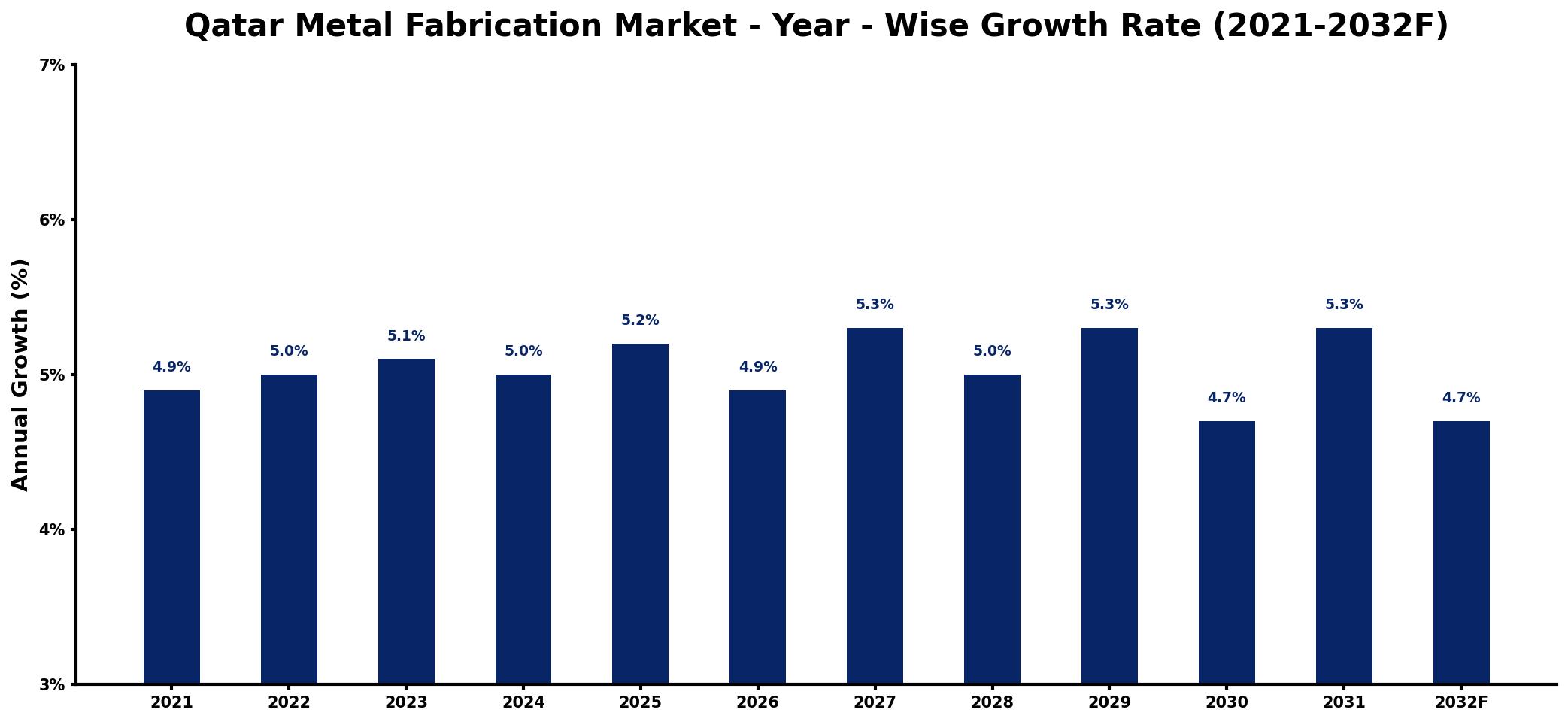
The table below presents the year‑wise growth rates along with the key drivers influencing the market
| Year | Growth Rate | Major Drivers |
| 2021 | 4.9% | Infrastructure projects driving demand |
| 2022 | 5.0% | Increased investments in construction |
| 2023 | 5.1% | Rising energy sector requirements |
| 2024 | 5.0% | Government incentives for development |
| 2025 | 5.2% | Growing manufacturing sector needs |
| 2026 | 4.9% | Urbanization boosting construction activities |
| 2027 | 5.3% | Expansion of transportation infrastructure |
| 2028 | 5.0% | Technological advancements in production |
| 2029 | 5.3% | Sustainability initiatives prompting upgrades |
| 2030 | 4.7% | Market saturation affecting new projects |
| 2031 | 5.3% | Revival of tourism related investments |
| 2032 | 4.7% | Regulatory changes impacting operations |
Note: Market size estimations and growth projections presented in this report are based on 6Wresearch's proprietary forecasting methodology, utilizing the latest available industry data, government publications, and primary research inputs.
Qatar Metal Fabrication Market Synopsis
Currently, the Qatar metal fabrication market stands as a vital component of the nations industrial landscape, reflecting the countrys broader economic ambitions. With a focus on high-quality craftsmanship, local manufacturers are well-positioned to meet the diverse needs of sectors such as construction, automotive, and manufacturing.
Furthermore, the market's dynamism is buoyed by an influx of advanced technologies and a skilled workforce that enhances production capabilities. This synergy not only meets local demand but also opens avenues for export, reinforcing Qatar's growing influence in the regional metal fabrication arena.
Qatar Metal Fabrication Market Key Takeaways
- The market is poised for steady growth, reflecting increased industrial activity in construction and manufacturing.
- Technological innovations are paving the way for efficiency and competitiveness within the sector.
- A skilled labor force is a significant asset contributing to enhanced production standards.
- Government initiatives aimed at economic diversification are providing momentum for market expansion.
- Strong demand for custom metal components is driving investment in advanced fabrication technologies.
Evaluation of Restraints in Qatar Metal Fabrication Market
Despite its promising outlook, the Qatar metal fabrication market faces several challenges that could impact growth. Intense competition among local players necessitates a focus on cost efficiency, which may lead to pressure on profit margins. Additionally, the rapid pace of technological advancement in fabrication techniques requires continuous adaptation from market participants. Companies must invest in training and equipment upgrades to remain relevant, which can pose financial burdens, especially for smaller enterprises. Staying ahead in innovation while maintaining operational efficiency remains a delicate balance in this competitive landscape.
Qatar Metal Fabrication Market Trends
The ongoing digital transformation in the manufacturing sector is a key trend shaping the Qatar metal fabrication landscape. Automation, robotics, and advanced materials are increasingly being integrated into fabrication processes, enhancing productivity and precision. Moreover, sustainability is becoming a significant focus, as companies seek to adopt eco-friendly practices and materials. The push for lightweight metals in industries like automotive and aerospace is also gaining momentum, steering R&D towards more innovative solutions.
Qatar Metal Fabrication Market Opportunities
Opportunities for growth in the Qatar metal fabrication market lie significantly in the expansion of the construction sector, particularly with the countrys ambitious infrastructure projects ahead of major global events. As Qatar continues to invest in smart cities and large-scale developments, there is a concurrent demand for advanced metal components that meet intricate specifications. Additionally, the automotive sector is ripe for innovation, especially with the increasing focus on electric vehicles and sustainable transport solutions.
Government Initiatives in the Qatar Metal Fabrication Market
The Qatari government is actively supporting the metal fabrication industry through various initiatives aimed at economic diversification and technological advancement. Investments in infrastructure and public works are opening new avenues for metal fabrication services, while policies encouraging research and development are promoting innovation in the sector. Additionally, government-backed incentives for local manufacturing are designed to bolster homegrown companies, ensuring they can compete both locally and in the international arena.
Future Insights of the Qatar Metal Fabrication Market
Looking ahead to the period between 2026 and 2032, the Qatar metal fabrication market is expected to witness significant transformation driven by technological advancements and increased industrial activity. The focus on sustainable practices will likely reshape how fabrication services are delivered, with an emphasis on resource efficiency and reduced waste. As the sector continues to align with global trends, emerging markets and innovative product offerings will be crucial for sustaining growth, enhancing Qatar's position as a key player in the regional manufacturing landscape.
Qatar Metal Fabrication Market Latest Developments (2025 - 2026)
Recent developments in the Qatar metal fabrication market indicate a shift towards more automated and technologically advanced fabrication processes. Companies are increasingly adopting cutting-edge technologies to enhance productivity and reduce lead times. Furthermore, collaborations between local firms and international technology providers are becoming more common, aiming to leverage global expertise to elevate local manufacturing standards. As the market adapts to these advancements, the focus on quality and custom solutions continues to strengthen.
Qatar Metal Fabrication Market - Key Attractiveness of the Report
- 10 Years of Market Numbers
- Historical Data Starting from 2022 to 2025
- Base Year: 2025
- Forecast Data until 2032
- Key Performance Indicators Impacting the Market
- Major Upcoming Developments and Projects
Key Highlights of the Report:
- Qatar Metal Fabrication Market Outlook
- Market Size of Qatar Metal Fabrication Market, 2025
- Forecast of Qatar Metal Fabrication Market, 2032
- Historical Data and Forecast of Qatar Metal Fabrication Revenues & Volume for the Period 2022-2032F
- Qatar Metal Fabrication Market Trend Evolution
- Qatar Metal Fabrication Market Drivers and Challenges
- Qatar Metal Fabrication Price Trends
- Qatar Metal Fabrication Porter's Five Forces
- Qatar Metal Fabrication Industry Life Cycle
- Historical Data and Forecast of Qatar Metal Fabrication Market Revenues & Volume By End-user Industry for the Period 2022-2032F
- Historical Data and Forecast of Qatar Metal Fabrication Market Revenues & Volume By Manufacturing for the Period 2022-2032F
- Historical Data and Forecast of Qatar Metal Fabrication Market Revenues & Volume By Power and Utilities for the Period 2022-2032F
- Historical Data and Forecast of Qatar Metal Fabrication Market Revenues & Volume By Construction for the Period 2022-2032F
- Historical Data and Forecast of Qatar Metal Fabrication Market Revenues & Volume By Oil and Gas for the Period 2022-2032F
- Historical Data and Forecast of Qatar Metal Fabrication Market Revenues & Volume By Other End-user Industries for the Period 2022-2032F
- Historical Data and Forecast of Qatar Metal Fabrication Market Revenues & Volume By Metal Folding for the Period 2022-2032F
- Historical Data and Forecast of Qatar Metal Fabrication Market Revenues & Volume By Product category for the Period 2022-2032F
- Historical Data and Forecast of Qatar Metal Fabrication Market Revenues & Volume By Structural steel fabrication for the Period 2022-2032F
- Historical Data and Forecast of Qatar Metal Fabrication Market Revenues & Volume By Process Equipment Fabrication for the Period 2022-2032F
- Qatar Metal Fabrication Import Export Trade Statistics
- Market Opportunity Assessment By End-user Industry
- Market Opportunity Assessment By Product category
- Qatar Metal Fabrication Top Companies Market Share
- Qatar Metal Fabrication Competitive Benchmarking By Technical and Operational Parameters
- Qatar Metal Fabrication Company Profiles
- Qatar Metal Fabrication Key Strategic Recommendations






































