Qatar Metal & Metallurgy Machinery Market Summary
The qatar metal & metallurgy machinery market was estimated at USD 313 Million in 2025 and is projected to reach USD 412 Million by 2032, growing at a CAGR of 4.8% from 2026 to 2032.
Qatar Metal & Metallurgy Machinery Market Year-wise Growth Rate and Key Drivers
This graph highlights how the Qatar Metal & Metallurgy Machinery Market has steadily grown over the past five years, supported by major growth factors.
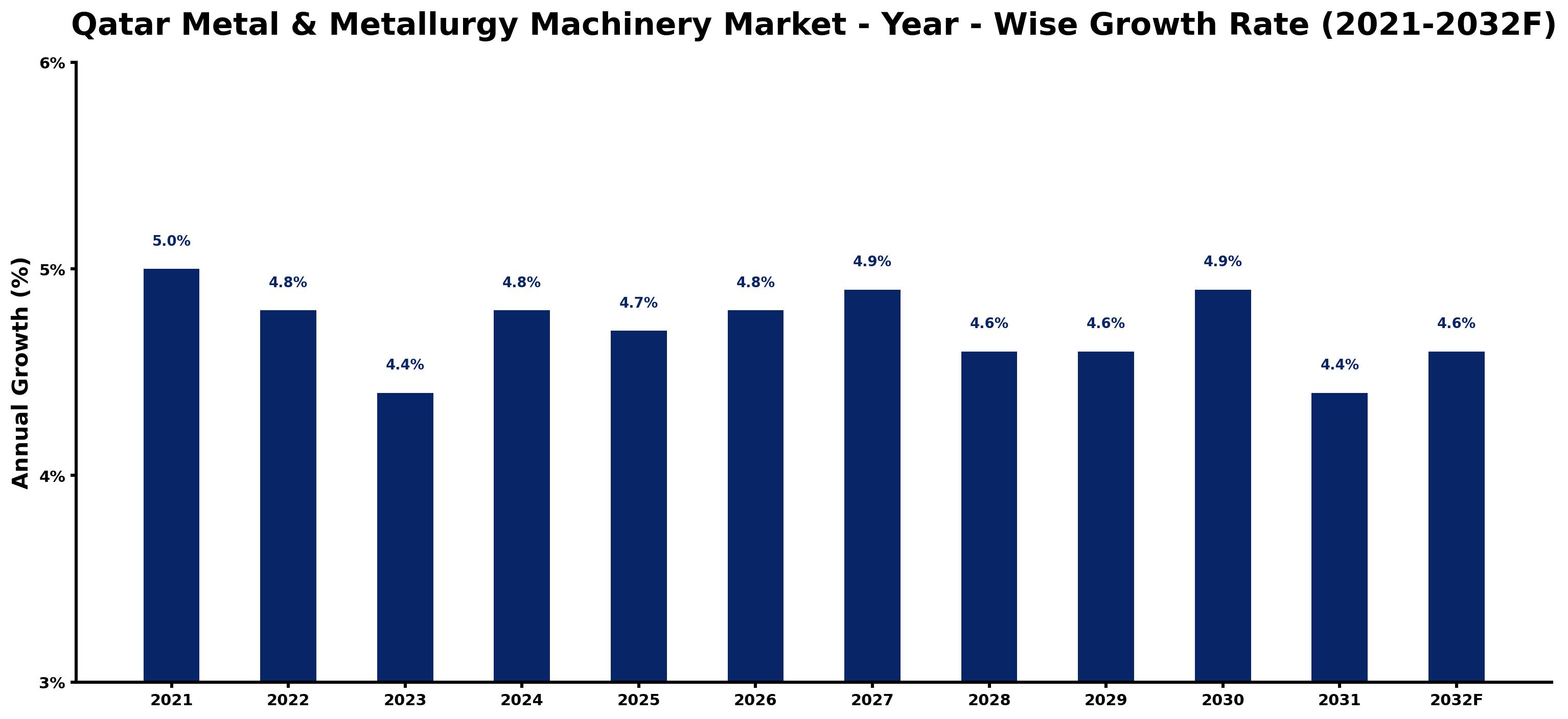
The table below presents the year wise growth rates along with the key drivers influencing the market
| Year | Growth Rate | Major Drivers |
| 2021 | 5.0% | Post-lockdown retail projects in Qatar sparked renewed investment in machinery upgrades. |
| 2022 | 4.8% | Construction pipelines expanded significantly, fueling demand for metal processing technologies. |
| 2023 | 4.4% | Local manufacturing initiatives gained traction, stimulating interest in metallurgy machinery solutions. |
| 2024 | 4.8% | Qatar's vision for economic diversification attracted foreign investments in the machinery sector. |
| 2025 | 4.7% | Infrastructure developments under Qatar National Vision prompted increased machinery procurement for projects. |
| 2026 | 4.8% | Technological innovations in automation presented new opportunities for metallurgical process efficiency. |
| 2027 | 4.9% | Collaborations between academia and industry bolstered advancements in metallurgy machinery research. |
| 2028 | 4.6% | Sustainability goals influenced procurement standards, encouraging eco-friendly machinery innovations. |
| 2029 | 4.6% | Regional industrial hubs in GCC fostered competitive landscape for metal machinery suppliers. |
| 2030 | 4.9% | Smart manufacturing trends reshaped the metallurgical landscape, increasing demand for intelligent systems. |
| 2031 | 4.4% | Export-focused strategies motivated local manufacturers to enhance their metallurgy machinery capabilities. |
| 2032 | 4.6% | Growing need for precision engineering in high-tech sectors drove advanced machinery adoption. |
Note - Market size estimations and growth projections presented in this report are based on 6Wresearch's advanced forecasting approach, validated with industry datasets as of June 2026.
Qatar Metal & Metallurgy Machinery Market Synopsis
The Qatar Metal Metallurgy Machinery Market is projected to reach 4.8% and witness significant growth during the forecast period (2026-2032). This market is anticipated to evolve as Qatar's economic landscape shifts towards diversification, driven by strategic governmental initiatives. As a result, the demand for metal and metallurgy machinery is expected to rise, supported by substantial investments in various infrastructure projects throughout the country.
Qatar Metal & Metallurgy Machinery Market Growth Drivers
Several critical factors are expected to fuel the growth of the Qatar Metal & Metallurgy Machinery Market. These include:
- Accelerated industrialization, stemming from rising economic activities that stimulate demand for advanced machinery.
- Increased investments in infrastructure development projects, particularly in energy, transport, and telecommunications, which require robust metal solutions.
- An expanding manufacturing sector, bolstered by government policies favoring domestic production and technological advancement.
- Heightened demand for sustainable construction materials, prompting innovations in metallurgy machinery.
- The proliferation of international manufacturers within Qatar, offering competitive pricing and enhancing local supply chains.
Qatar Metal & Metallurgy Machinery Market Challenges and Restraints
While the market exhibits potential, it also faces several challenges that may hinder its growth. These include:
- High maintenance costs associated with advanced machinery, which can result in reduced profit margins if not managed effectively.
- A shortage of trained personnel skilled in operating sophisticated machinery, potentially leading to operational inefficiencies.
- Stringent regulations imposed by international certification agencies, which could complicate compliance for local manufacturers.
- Frequent power outages, causing operational delays that negatively impact productivity and revenue generation.
- The ever-evolving safety standards that require constant updating of equipment and training, increasing operational complexities.
Qatar Metal & Metallurgy Machinery Market Government Investment and Initiatives
The Government of Qatar has recognized the importance of the metal and metallurgy machinery sector as a vital component in achieving its economic diversification goals outlined in Vision 2031. Substantial public spending is directed toward infrastructure development projects, thereby generating significant opportunities for investments in metallurgy machinery. Additionally, incentives have been established to encourage foreign direct investment in this sector, aiming to foster technological transfer and local capability development. Furthermore, initiatives focused on training and education in technical fields are designed to address the skilled labor shortage, thereby enhancing the workforce's ability to support the growing machinery demands.
Qatar Metal & Metallurgy Machinery Market Latest Developments (May 2025 - June 2026)
Recent developments within the Qatar Metal & Metallurgy Machinery Market indicate a strategic shift towards innovation and sustainability. The period from May 2025 to June 2026 has seen increasing efforts from both the public and private sectors to integrate advanced technologies, such as automation and digital solutions, into machinery manufacturing processes. Additionally, environmental considerations are becoming paramount, leading to an increased focus on energy-efficient machinery that minimizes the ecological footprint. Partnerships and collaborations among local and international firms have also been noted as a means to leverage expertise and resources, ensuring that the sector remains competitive on a global scale. As industries recover from pandemic-induced slowdowns, the outlook for machinery demand is expected to strengthen considerably.
Qatar Metal & Metallurgy Machinery Market - Key Attractiveness of the Report
- 10 Years of Market Numbers
- Historical Data Starting from 2022 to 2025
- Base Year: 2025
- Forecast Data until 2032
- Key Performance Indicators Impacting the Market
- Major Upcoming Developments and Projects
Key Highlights of the Report:
- Qatar Metal & Metallurgy Machinery Market Outlook
- Market Size of Qatar Metal & Metallurgy Machinery Market, 2025
- Forecast of Qatar Metal & Metallurgy Machinery Market, 2032
- Historical Data and Forecast of Qatar Metal & Metallurgy Machinery Revenues & Volume for the Period 2022-2032F
- Qatar Metal & Metallurgy Machinery Market Trend Evolution
- Qatar Metal & Metallurgy Machinery Market Drivers and Challenges
- Qatar Metal & Metallurgy Machinery Price Trends
- Qatar Metal & Metallurgy Machinery Porter's Five Forces
- Qatar Metal & Metallurgy Machinery Industry Life Cycle
- Historical Data and Forecast of Qatar Metal & Metallurgy Machinery Market Revenues & Volume By Product Types for the Period 2022-2032F
- Historical Data and Forecast of Qatar Metal & Metallurgy Machinery Market Revenues & Volume By Metal Rolling Machinery for the Period 2022-2032F
- Historical Data and Forecast of Qatar Metal & Metallurgy Machinery Market Revenues & Volume By Steelmaking Equipment for the Period 2022-2032F
- Historical Data and Forecast of Qatar Metal & Metallurgy Machinery Market Revenues & Volume By Ironmaking Equipment for the Period 2022-2032F
- Historical Data and Forecast of Qatar Metal & Metallurgy Machinery Market Revenues & Volume By Applications for the Period 2022-2032F
- Historical Data and Forecast of Qatar Metal & Metallurgy Machinery Market Revenues & Volume By Cutting for the Period 2022-2032F
- Historical Data and Forecast of Qatar Metal & Metallurgy Machinery Market Revenues & Volume By Welding for the Period 2022-2032F
- Historical Data and Forecast of Qatar Metal & Metallurgy Machinery Market Revenues & Volume By Non-Metal Processing for the Period 2022-2032F
- Historical Data and Forecast of Qatar Metal & Metallurgy Machinery Market Revenues & Volume By Additive Manufacturing for the Period 2022-2032F
- Historical Data and Forecast of Qatar Metal & Metallurgy Machinery Market Revenues & Volume By Others for the Period 2022-2032F
- Qatar Metal & Metallurgy Machinery Import Export Trade Statistics
- Market Opportunity Assessment By Product Types
- Market Opportunity Assessment By Applications
- Qatar Metal & Metallurgy Machinery Top Companies Market Share
- Qatar Metal & Metallurgy Machinery Competitive Benchmarking By Technical and Operational Parameters
- Qatar Metal & Metallurgy Machinery Company Profiles
- Qatar Metal & Metallurgy Machinery Key Strategic Recommendations






































