Qatar Motorcycle components Market Size, Share & Growth Rate
The Qatar Motorcycle components Market was estimated at USD 247 Million in 2025 and is projected to reach USD 345 Million by 2032, growing at a CAGR of 4.9% from 2026 to 2032. This anticipated growth reflects an increasing enthusiasm for motorcycles within the country, driven by cultural shifts towards personal mobility and an expansion in recreational riding activities. Alongside this, the market is poised to benefit from government initiatives aimed at promoting sustainable transportation options, including electric motorcycles.
Qatar Motorcycle components Market Year-wise Growth Rate and Key Drivers
This graph highlights how the Qatar Motorcycle components Market has steadily grown over the years, supported by major growth factors.
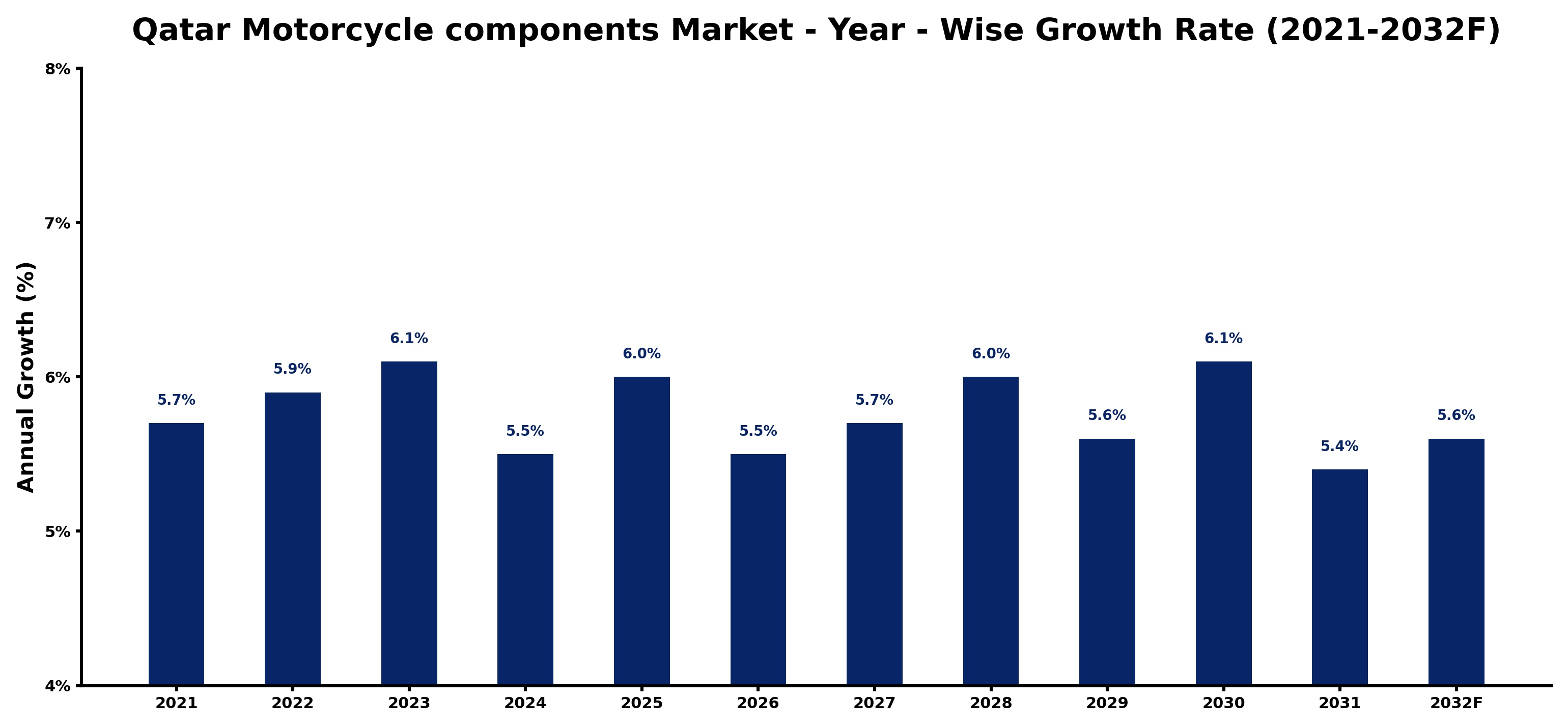
The table below presents the year‑wise growth rates along with the key drivers influencing the market
| Year | Growth Rate | Major Drivers |
| 2021 | 5.7% | LNG infrastructure development boosted demand for motorcycle component supplies |
| 2022 | 5.9% | Modernized supply chains enhanced precision component manufacturing capabilities |
| 2023 | 6.1% | Manufacturing investments in motorcycle parts drive regional supply chain growth |
| 2024 | 5.5% | Advanced welding technologies boost efficiency in motorcycle component fabrication |
| 2025 | 6.0% | Manufacturing investments boosted local supply chains for motorcycle components |
| 2026 | 5.5% | Technology integration streamlined production processes in motorcycle components manufacturing |
| 2027 | 5.7% | Investment in CNC machining tools enhances precision motorcycle component production |
| 2028 | 6.0% | Manufacturing investments in aluminum components boost export capabilities significantly |
| 2029 | 5.6% | Export driven demand for motorcycle components supports local manufacturing investments |
| 2030 | 6.1% | Manufacturing investments boost production capacity for motorcycle components |
| 2031 | 5.4% | Domestic motorcycle component manufacturers optimize production with advanced automation |
| 2032 | 5.6% | Manufacturing investments in Qatar boost motorcycle component production capabilities |
Note - Market size estimations and growth projections presented in this report are based on 6Wresearch’s advanced forecasting approach, validated with industry datasets as of June 2026.
Qatar Motorcycle components Market Synopsis
In recent years, the Qatar motorcycle components market has witnessed significant momentum, spurred by rising motorcycle ownership and a burgeoning interest in customization among enthusiasts. This trend is projected to continue, with an increasing variety of components entering the market to meet the diverse demands of riders.
As the Qatari population becomes more aware of environmental issues, there is a noticeable shift toward electric vehicles, including motorcycles. Such trends suggest a future where the market not only expands in size but also diversifies in the types of components available, catering to a more eco-conscious consumer base.
Qatar Motorcycle components Market Key Takeaways
- Projected growth driven by increasing motorcycle ownership and customization preferences.
- Shift towards electric motorcycles highlighting emerging trends in sustainability.
- Government policies favoring transportation innovation aiding market expansion.
- Opportunities for manufacturers to improve local production and quality standards.
- Market recovery anticipated post-COVID-19, buoyed by improving economic conditions.
Evaluation of Restraints in Qatar Motorcycle components Market
The Qatar motorcycle components market faces challenges primarily due to its heavy reliance on imported parts. This dependency makes it vulnerable to fluctuations in supply chains and import regulations, which can hinder availability and pricing stability. Additionally, maintaining consistent quality and safety standards for these imported components poses a significant challenge for market players, necessitating robust quality control measures to ensure customer satisfaction and safety. These factors create an environment where local manufacturing capabilities must be enhanced to build a more self-sustaining and resilient components market.
Qatar Motorcycle components Market Trends
Several current and emerging trends are shaping the Qatar motorcycle components market. A significant trend is the growing affinity for electric motorcycles, reflecting a broader global movement towards sustainable transportation solutions. Alongside this, customization continues to gain traction, with consumers increasingly seeking components that enhance performance and aesthetics. Digital platforms for aftermarket sales are also emerging, simplifying access to components for consumers and enriching their overall purchasing experience.
Qatar Motorcycle components Market Opportunities
Genuine growth and investment opportunities in the Qatar motorcycle components market lie in enhancing local manufacturing capabilities. By investing in local production, companies can mitigate the risks associated with import dependencies while also meeting the rising demand for high-quality components. Additionally, tapping into the electric motorcycle segment presents a lucrative avenue, as government incentives and consumer interest in green technologies grow. Expanding distribution networks and leveraging digital marketing strategies can also provide significant opportunities for industry players.
Government Initiatives in the Qatar Motorcycle components Market
The Qatari government has been proactive in creating a favorable environment for the motorcycle components market. Policies that promote sustainable transportation alternatives, including electric vehicles, have emerged as a priority. Furthermore, government investment in infrastructure improvements and public awareness campaigns on motorcycle safety and environmental benefits are fostering a more robust market. These initiatives support the growth of the motorcycle components sector, encouraging both domestic manufacturing and consumer adoption.
Future Insights of the Qatar Motorcycle components Market
Looking ahead to the 2026-2032 period, the Qatar motorcycle components market is expected to experience significant evolution. With the continued growth in motorcycle ownership and an increasing emphasis on electric mobility, manufacturers will need to adapt quickly to meet changing consumer preferences. The strengthening of local production capabilities, coupled with a favorable regulatory environment, will be crucial for sustained market growth. Overall, the outlook remains positive, driven by a combination of cultural shifts, technological advancements, and supportive government policies.
Qatar Motorcycle components Market Latest Developments (May 2025 - June 2026)
In the latest developments, industry stakeholders are focusing on enhancing local production to reduce import reliance. Collaborations between local manufacturers and international suppliers have emerged, aiming to improve the quality of components available in Qatar. Additionally, the market has seen a rise in the introduction of electric motorcycle models, driven by government incentives. As consumer awareness of environmental issues increases, more companies are prioritizing sustainable practices and electric offerings.
Qatar Motorcycle components Market - Key Attractiveness of the Report
- 10 Years of Market Numbers
- Historical Data Starting from 2022 to 2025
- Base Year: 2025
- Forecast Data until 2032
- Key Performance Indicators Impacting the Market
- Major Upcoming Developments and Projects
Key Highlights of the Report:
- Qatar Motorcycle components Market Outlook
- Market Size of Qatar Motorcycle components Market, 2025
- Forecast of Qatar Motorcycle components Market, 2032
- Historical Data and Forecast of Qatar Motorcycle components Revenues & Volume for the Period 2022-2032F
- Qatar Motorcycle components Market Trend Evolution
- Qatar Motorcycle components Market Drivers and Challenges
- Qatar Motorcycle components Price Trends
- Qatar Motorcycle components Porter's Five Forces
- Qatar Motorcycle components Industry Life Cycle
- Historical Data and Forecast of Qatar Motorcycle components Market Revenues & Volume By Type for the Period 2022-2032F
- Historical Data and Forecast of Qatar Motorcycle components Market Revenues & Volume By Engine & Drivetrain for the Period 2022-2032F
- Historical Data and Forecast of Qatar Motorcycle components Market Revenues & Volume By Tires for the Period 2022-2032F
- Historical Data and Forecast of Qatar Motorcycle components Market Revenues & Volume By Structural for the Period 2022-2032F
- Historical Data and Forecast of Qatar Motorcycle components Market Revenues & Volume By Electrical and Electronic for the Period 2022-2032F
- Historical Data and Forecast of Qatar Motorcycle components Market Revenues & Volume By Other for the Period 2022-2032F
- Historical Data and Forecast of Qatar Motorcycle components Market Revenues & Volume By Applications for the Period 2022-2032F
- Historical Data and Forecast of Qatar Motorcycle components Market Revenues & Volume By Electric Bicycles for the Period 2022-2032F
- Historical Data and Forecast of Qatar Motorcycle components Market Revenues & Volume By Motorcycles for the Period 2022-2032F
- Qatar Motorcycle components Import Export Trade Statistics
- Market Opportunity Assessment By Type
- Market Opportunity Assessment By Applications
- Qatar Motorcycle components Top Companies Market Share
- Qatar Motorcycle components Competitive Benchmarking By Technical and Operational Parameters
- Qatar Motorcycle components Company Profiles
- Qatar Motorcycle components Key Strategic Recommendations






































