Qatar Music Recording Market Size, Share & Growth Rate
The Qatar Music Recording Market was estimated at USD 118 Million in 2025 and is projected to reach USD 130 Million by 2032, growing at a CAGR of 1.4% from 2026 to 2032. This steady growth trajectory is supported by the country's commitment to nurturing local talent and enhancing its cultural landscape. As Qatar strives to position itself as a creative hub, increased investments in recording studios and music production services are fueling this promising expansion.
Qatar Music Recording Market Year-wise Growth Rate and Key Drivers
This graph highlights how the Qatar Music Recording Market has steadily grown over the years, supported by major growth factors.
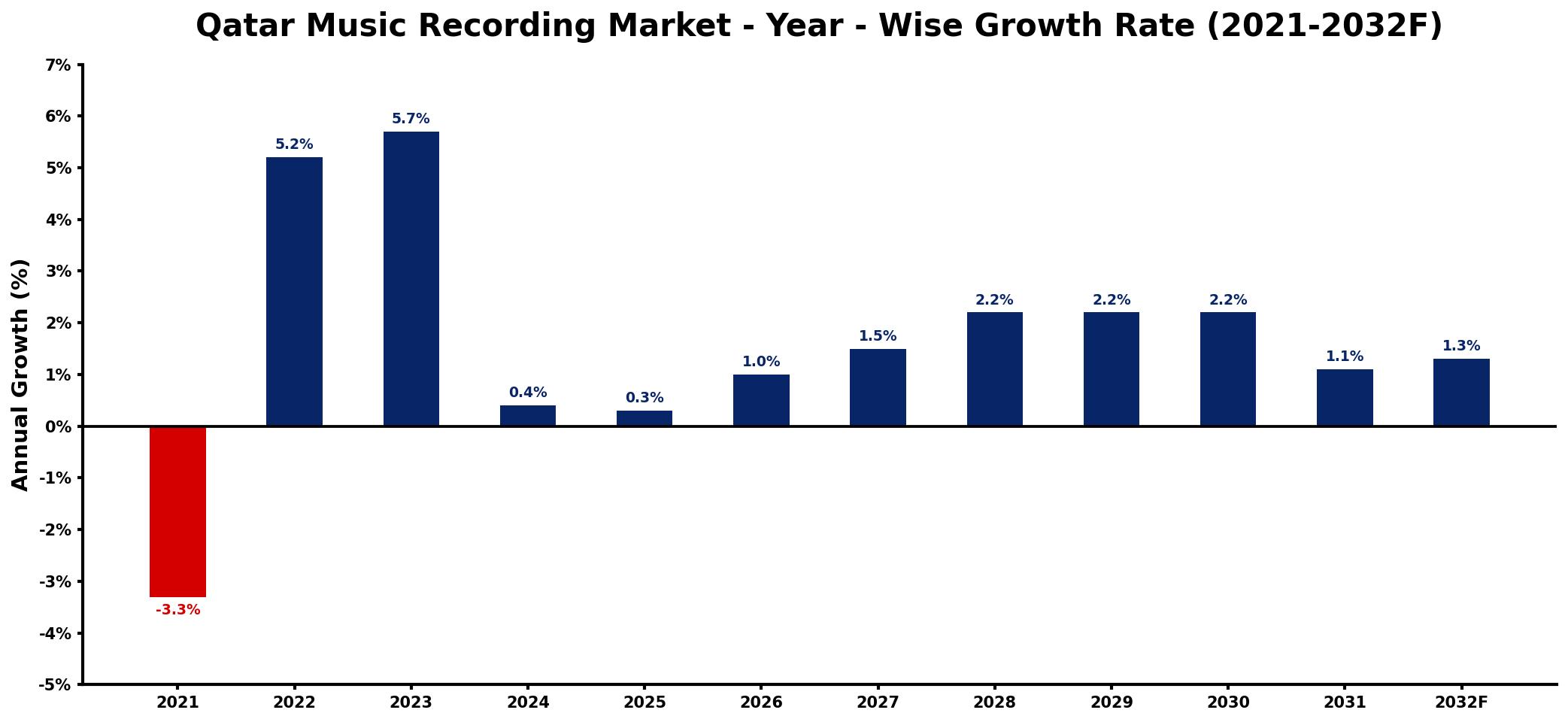
The table below presents the year‑wise growth rates along with the key drivers influencing the market
| Year | Growth Rate | Major Drivers |
| 2021 | -3.3% | decreased consumer interest in entertainment |
| 2022 | 5.2% | rise in digital content consumption |
| 2023 | 5.7% | expansion of streaming platforms availability |
| 2024 | 0.4% | increased investment in local talent |
| 2025 | 0.3% | growth in live performance events |
| 2026 | 1.0% | enhanced collaboration across genres |
| 2027 | 1.5% | emergence of innovative technologies |
| 2028 | 2.2% | increased production capacity utilization |
| 2029 | 2.2% | increased focus on regional festivals |
| 2030 | 2.2% | growing commercial sector adoption |
| 2031 | 1.1% | enhanced marketing strategies implemented |
| 2032 | 1.3% | increased demand for personalized experiences |
Note: Market size estimations and growth projections presented in this report are based on 6Wresearch's proprietary forecasting methodology, utilizing the latest available industry data, government publications, and primary research inputs.
Qatar Music Recording Market Synopsis
The Qatar music recording market is currently experiencing an upsurge, driven by a surge of local artists and a burgeoning interest in music as a form of cultural expression. However, despite this recent momentum, the market is still in a nascent stage, and its future hinges on the ability to address key infrastructural and regulatory challenges.
As the local scene flourishes, the demand for professional recording facilities and quality equipment is on the rise. Simultaneously, Qatar's commitment to promoting its cultural identity through music is fostering a more vibrant artistic environment. This evolution is creating both opportunities and necessary shifts within the market.
Qatar Music Recording Market Key Takeaways
- The market is poised for growth as Qatar invests in developing its creative industries.
- There is a strong demand for high-quality recording studios and production services.
- Technological advancements are shaping how music is created, distributed, and consumed.
- Local talent is increasingly gaining recognition, contributing to cultural diversification.
- Government initiatives are vital in providing support and resources for the music industry.
Evaluation of Restraints in Qatar Music Recording Market
The Qatar music recording market encounters several limitations that impede its full potential. Cultural sensitivities play a significant role, as artists navigate the delicate balance between creative freedom and regulatory compliance. Additionally, the local industry may struggle with inadequate infrastructure, which can stifle the growth of emerging talents. As the digital landscape evolves, issues such as copyright infringement and fair revenue distribution remain persistent challenges that need addressing for the market to thrive sustainably.
Qatar Music Recording Market Trends
Current trends within the Qatar music recording market reflect a dynamic shift towards digital platforms, facilitating remote collaborations and virtual performances. The rise of social media and streaming services is reshaping how artists connect with audiences. Moreover, a growing appreciation for local genres and cultural music forms is influencing recording preferences. Innovations in recording technology, such as digital audio workstations and mobile recording applications, are becoming increasingly integrated into the creative process, making high-quality music production more accessible.
Qatar Music Recording Market Opportunities
The opportunity landscape for the Qatar music recording market is expanding, driven by a combination of local talent and government support. Investment in modern recording facilities and technology presents a chance to enhance production quality and cater to an evolving consumer base. Additionally, partnerships with international music entities can provide knowledge transfer and support for local artists. As the demand for unique and culturally relevant content increases, businesses focused on niche genres and authentic cultural expressions stand to benefit significantly.
Government Initiatives in the Qatar Music Recording Market
The Qatari government has made substantial efforts to foster a vibrant music scene by implementing various initiatives aimed at promoting cultural arts. Supportive policies and funding programs for the arts encourage the development of local talent and the establishment of recording studios. Additionally, events such as music festivals and cultural exchanges are being promoted to enhance visibility for Qatari artists on international platforms. This governmental backing is essential for building a sustainable and thriving music recording market.
Future Insights of the Qatar Music Recording Market
Looking ahead to 2026-2032, the Qatar music recording market is expected to mature as local artists gain more traction both regionally and internationally. The commitment to cultural identity will likely continue shaping the types of music produced, fostering a richer diversity of genres. Technological innovations will further streamline the recording process, allowing for higher-quality outputs. As the market overcomes current obstacles, the infrastructure supporting music production is anticipated to evolve, creating a more robust environment for creativity and commercial success.
Qatar Music Recording Market Latest Developments (2025 - 2026)
In recent months, the Qatar music recording market has seen notable shifts, including the emergence of new local recording studios focusing on diverse music genres. Additionally, musicians have begun utilizing online platforms more extensively for promotions, leveraging social media to engage with wider audiences. Events celebrating local talent have gained traction, further fostering a sense of community and collaboration among artists. Discussions on royalty distribution and digital rights are becoming increasingly relevant as the market adapts to a more digital-centric approach.
Qatar Music Recording Market - Key Attractiveness of the Report
- 10 Years of Market Numbers
- Historical Data Starting from 2022 to 2025
- Base Year: 2025
- Forecast Data until 2032
- Key Performance Indicators Impacting the Market
- Major Upcoming Developments and Projects
Key Highlights of the Report:
- Qatar Music Recording Market Outlook
- Market Size of Qatar Music Recording Market, 2025
- Forecast of Qatar Music Recording Market, 2032
- Historical Data and Forecast of Qatar Music Recording Revenues & Volume for the Period 2022-2032F
- Qatar Music Recording Market Trend Evolution
- Qatar Music Recording Market Drivers and Challenges
- Qatar Music Recording Price Trends
- Qatar Music Recording Porter's Five Forces
- Qatar Music Recording Industry Life Cycle
- Historical Data and Forecast of Qatar Music Recording Market Revenues & Volume By Type for the Period 2022-2032F
- Historical Data and Forecast of Qatar Music Recording Market Revenues & Volume By Record Production for the Period 2022-2032F
- Historical Data and Forecast of Qatar Music Recording Market Revenues & Volume By Music Publishers for the Period 2022-2032F
- Historical Data and Forecast of Qatar Music Recording Market Revenues & Volume By Record Distribution for the Period 2022-2032F
- Historical Data and Forecast of Qatar Music Recording Market Revenues & Volume By Sound Recording Studios for the Period 2022-2032F
- Historical Data and Forecast of Qatar Music Recording Market Revenues & Volume By Application for the Period 2022-2032F
- Historical Data and Forecast of Qatar Music Recording Market Revenues & Volume By Mechanical for the Period 2022-2032F
- Historical Data and Forecast of Qatar Music Recording Market Revenues & Volume By Performance for the Period 2022-2032F
- Historical Data and Forecast of Qatar Music Recording Market Revenues & Volume By Synchronization for the Period 2022-2032F
- Historical Data and Forecast of Qatar Music Recording Market Revenues & Volume By Digital for the Period 2022-2032F
- Historical Data and Forecast of Qatar Music Recording Market Revenues & Volume By Others for the Period 2022-2032F
- Historical Data and Forecast of Qatar Music Recording Market Revenues & Volume By End-User for the Period 2022-2032F
- Historical Data and Forecast of Qatar Music Recording Market Revenues & Volume By Individual for the Period 2022-2032F
- Historical Data and Forecast of Qatar Music Recording Market Revenues & Volume By Commercial for the Period 2022-2032F
- Historical Data and Forecast of Qatar Music Recording Market Revenues & Volume By Genre for the Period 2022-2032F
- Historical Data and Forecast of Qatar Music Recording Market Revenues & Volume By Rock for the Period 2022-2032F
- Historical Data and Forecast of Qatar Music Recording Market Revenues & Volume By Hip Hop for the Period 2022-2032F
- Historical Data and Forecast of Qatar Music Recording Market Revenues & Volume By Pop for the Period 2022-2032F
- Historical Data and Forecast of Qatar Music Recording Market Revenues & Volume By Jazz for the Period 2022-2032F
- Historical Data and Forecast of Qatar Music Recording Market Revenues & Volume By Others for the Period 2022-2032F
- Qatar Music Recording Import Export Trade Statistics
- Market Opportunity Assessment By Type
- Market Opportunity Assessment By Application
- Market Opportunity Assessment By End-User
- Market Opportunity Assessment By Genre
- Qatar Music Recording Top Companies Market Share
- Qatar Music Recording Competitive Benchmarking By Technical and Operational Parameters
- Qatar Music Recording Company Profiles
- Qatar Music Recording Key Strategic Recommendations






































