Qatar Nonmetallic Mineral Product Market Size, Share & Growth Rate
The Qatar Nonmetallic Mineral Product Market was estimated at USD 298 Million in 2025 and is projected to reach USD 399 Million by 2032, growing at a CAGR of 4.3% from 2026 to 2032. This upward trajectory is primarily driven by Qatars robust construction sector, fueled by major infrastructure projects and real estate developments. As the nation continues its rapid urbanization, the demand for essential nonmetallic minerals such as cement and ceramics is expected to rise significantly, further cementing the market's growth.
Qatar Nonmetallic Mineral Product Market Year-wise Growth Rate and Key Drivers
This graph highlights how the Qatar Nonmetallic Mineral Product Market has steadily grown over the years, supported by major growth factors.
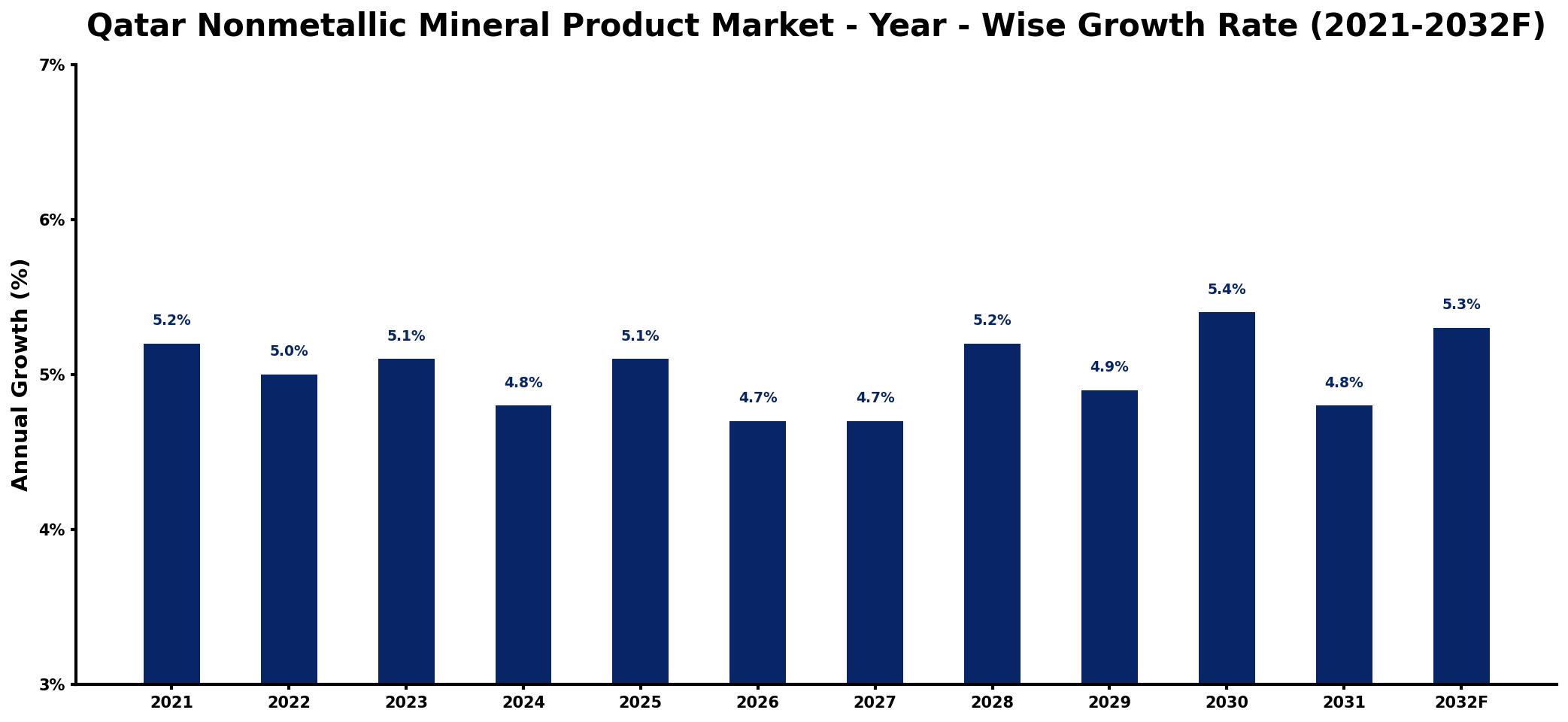
The table below presents the year‑wise growth rates along with the key drivers influencing the market
| Year | Growth Rate | Major Drivers |
| 2021 | 5.2% | Increased construction sector investments |
| 2022 | 5.0% | Growing infrastructure development projects |
| 2023 | 5.1% | Rising demand from energy sector |
| 2024 | 4.8% | Expansion of manufacturing capabilities |
| 2025 | 5.1% | Boost in housing market activities |
| 2026 | 4.7% | Increased government infrastructure initiatives |
| 2027 | 4.7% | Higher demand from construction industry |
| 2028 | 5.2% | Surge in real estate investments |
| 2029 | 4.9% | Rising exports to neighboring markets |
| 2030 | 5.4% | Growth in renewable energy projects |
| 2031 | 4.8% | Increased urbanization and population |
| 2032 | 5.3% | stronger distribution network expansion |
Note: Market size estimations and growth projections presented in this report are based on 6Wresearch's proprietary forecasting methodology, utilizing the latest available industry data, government publications, and primary research inputs.
Qatar Nonmetallic Mineral Product Market Synopsis
Currently, the Qatar Nonmetallic Mineral Product Market is positioned as a cornerstone of the nations construction and infrastructure initiatives. The increasing investments in residential and commercial properties reflect a booming demand for cement, glass, ceramics, and related building materials.
The nonmetallic mineral product industry is integral to Qatar's ambitions to diversify its economy and enhance its manufacturing capabilities. As governmental strategies prioritize sustainable development, the sector finds itself at a crucial crossroads, balancing growth and ecological responsibility.
Qatar Nonmetallic Mineral Product Market Key Takeaways
- The market is driven by Qatar's extensive infrastructure projects and urban development plans.
- There is a growing emphasis on sustainability and minimizing environmental impacts in production practices.
- Manufacturers are adapting to increasing competition from global suppliers while focusing on maintaining quality standards.
- Recovery from the COVID-19 pandemic has prompted renewed focus on contingency planning in the supply chain.
- The market is supported by ongoing governmental initiatives aimed at economic diversification and investment in construction.
Evaluation of Restraints in Qatar Nonmetallic Mineral Product Market
Despite its growth prospects, the Qatar Nonmetallic Mineral Product Market faces several constraints. Environmental concerns related to the extraction and processing of nonmetallic minerals pose significant challenges, particularly regarding habitat disruption and energy consumption. Furthermore, the local market must grapple with maintaining quality standards while competing against established global players. This dual pressure creates an environment where balancing cost efficiency with sustainability becomes imperative for market players.
Qatar Nonmetallic Mineral Product Market Trends
A notable trend within the Qatar Nonmetallic Mineral Product Market is the increasing adoption of innovative technologies aimed at improving production efficiencies and reducing environmental footprints. Companies are investing in advanced manufacturing techniques, such as eco-friendly cement and recycled materials. Additionally, the ongoing shift towards sustainable construction practices and the utilization of nonmetallic minerals with lower carbon footprints is influencing both demand and supply chain strategies.
Qatar Nonmetallic Mineral Product Market Opportunities
Opportunities for growth in this market are vast, particularly as Qatar continues to invest heavily in mega infrastructure projects as part of its national development plans. The focus on creating sustainable urban environments opens pathways for innovation, such as the development of environmentally friendly building materials. Moreover, the strategic positioning of Qatar as a hub for trade in the Gulf region presents additional avenues for export and international collaboration in nonmetallic mineral production.
Government Initiatives in the Qatar Nonmetallic Mineral Product Market
The Qatari government has launched various initiatives to boost the nonmetallic mineral sector as part of its broader economic diversification agenda. These initiatives include significant public spending on infrastructure, favorable regulations to encourage foreign investment, and programs aimed at enhancing local production capabilities. Efforts to promote sustainability within the sector are also notable, as the government emphasizes environmental stewardship alongside economic growth.
Future Insights of the Qatar Nonmetallic Mineral Product Market
Looking ahead to 2026-2032, the Qatar Nonmetallic Mineral Product Market is poised for sustained growth, driven by ongoing infrastructure projects and national development strategies. The integration of sustainability into construction processes will likely catalyze demand for innovative nonmetallic products. As urbanization accelerates, local manufacturers are expected to expand their capabilities, ultimately enhancing the sector's resilience in a changing global landscape.
Qatar Nonmetallic Mineral Product Market Latest Developments (2025 - 2026)
Recent developments in the Qatar Nonmetallic Mineral Product Market indicate a shift towards more sustainable production methods, aligning with global best practices. The industry is seeing increased collaboration between local manufacturers and international partners to adopt advanced technologies. Additionally, government-backed initiatives continue to catalyze significant infrastructure projects, ensuring a robust demand for nonmetallic mineral products in the foreseeable future.
Qatar Nonmetallic Mineral Product Market - Key Attractiveness of the Report
- 10 Years of Market Numbers
- Historical Data Starting from 2022 to 2025
- Base Year: 2025
- Forecast Data until 2032
- Key Performance Indicators Impacting the Market
- Major Upcoming Developments and Projects
Key Highlights of the Report:
- Qatar Nonmetallic Mineral Product Market Outlook
- Market Size of Qatar Nonmetallic Mineral Product Market, 2025
- Forecast of Qatar Nonmetallic Mineral Product Market, 2032
- Historical Data and Forecast of Qatar Nonmetallic Mineral Product Revenues & Volume for the Period 2022-2032F
- Qatar Nonmetallic Mineral Product Market Trend Evolution
- Qatar Nonmetallic Mineral Product Market Drivers and Challenges
- Qatar Nonmetallic Mineral Product Price Trends
- Qatar Nonmetallic Mineral Product Porter's Five Forces
- Qatar Nonmetallic Mineral Product Industry Life Cycle
- Historical Data and Forecast of Qatar Nonmetallic Mineral Product Market Revenues & Volume By Form Type for the Period 2022-2032F
- Historical Data and Forecast of Qatar Nonmetallic Mineral Product Market Revenues & Volume By Powder Form for the Period 2022-2032F
- Historical Data and Forecast of Qatar Nonmetallic Mineral Product Market Revenues & Volume By Liquid Form for the Period 2022-2032F
- Historical Data and Forecast of Qatar Nonmetallic Mineral Product Market Revenues & Volume By End User for the Period 2022-2032F
- Historical Data and Forecast of Qatar Nonmetallic Mineral Product Market Revenues & Volume By Jewellery for the Period 2022-2032F
- Historical Data and Forecast of Qatar Nonmetallic Mineral Product Market Revenues & Volume By Construction for the Period 2022-2032F
- Historical Data and Forecast of Qatar Nonmetallic Mineral Product Market Revenues & Volume By Iron & Ore for the Period 2022-2032F
- Qatar Nonmetallic Mineral Product Import Export Trade Statistics
- Market Opportunity Assessment By Form Type
- Market Opportunity Assessment By End User
- Qatar Nonmetallic Mineral Product Top Companies Market Share
- Qatar Nonmetallic Mineral Product Competitive Benchmarking By Technical and Operational Parameters
- Qatar Nonmetallic Mineral Product Company Profiles
- Qatar Nonmetallic Mineral Product Key Strategic Recommendations






































