Qatar Oil And Gas Pipeline Market Size Growth Rate
The Qatar Oil And Gas Pipeline Market is likely to experience consistent growth rate gains over the period 2025 to 2029. From 2.66% in 2025, the growth rate steadily ascends to 5.08% in 2029.
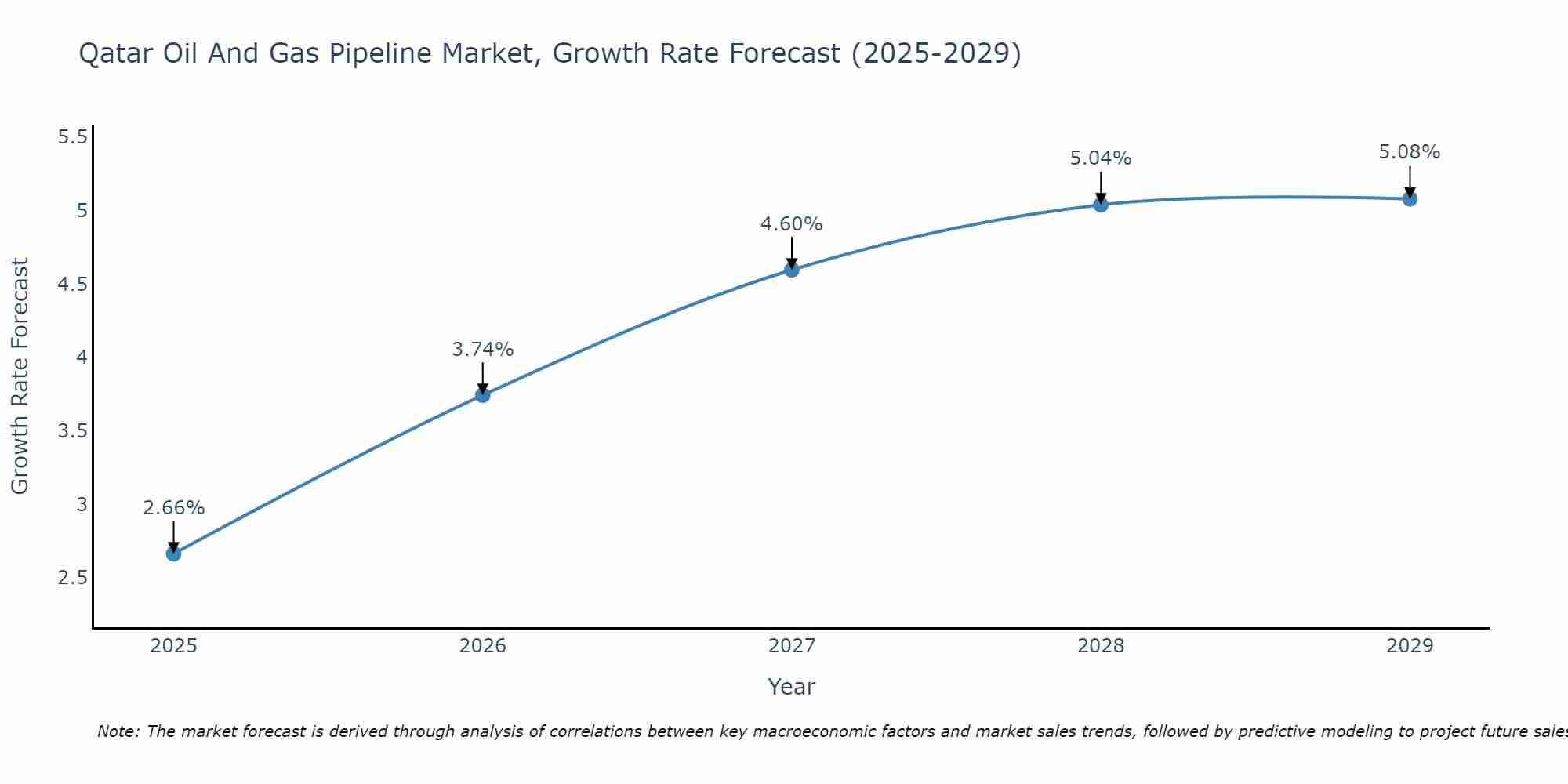
Qatar Oil and Gas Pipeline Market Synopsis
The oil and gas pipeline market in Qatar are closely linked to the nation`s energy sector. Qatar`s strategic investments in oil and gas exploration and production require a robust pipeline infrastructure. The market is expected to witness growth as Qatar expands its hydrocarbon operations and seeks to meet global energy demands. Companies involved in pipeline construction and maintenance should be prepared to contribute to Qatar`s energy security and sustainability goals.
Drivers of the Market
The oil and gas pipeline market in Qatar is experiencing significant growth, driven by various factors. Firstly, Qatar`s strategic position as a major exporter of natural gas and oil has led to substantial investments in pipeline infrastructure to transport these valuable resources efficiently. The development of new oil and gas fields and the expansion of existing ones are driving the need for pipeline networks, both domestically and for export purposes. Secondly, the government`s commitment to diversifying the energy sector and increasing production capacity is fueling investments in pipeline projects. Moreover, the growing demand for cleaner energy sources and the transition to natural gas as a primary fuel source are expected to further boost the construction of pipelines in Qatar. Additionally, the development of liquefied natural gas (LNG) facilities and the associated pipelines is contributing to the overall growth of the oil and gas pipeline market in the country.
Challenges of the Market
In the Qatar Oil and Gas Pipeline market, a significant challenge is ensuring pipeline integrity and safety. The harsh environmental conditions and corrosive nature of the substances transported through pipelines require robust materials and corrosion protection measures. Moreover, adhering to stringent safety and environmental regulations, as well as implementing effective monitoring and maintenance practices, is crucial in this industry.
COVID-19 Impact on the Market
The COVID-19 pandemic had a dual effect on the Qatar oil and gas pipeline market. Initially, there was a slowdown in construction and maintenance activities due to lockdowns and restrictions. However, Qatar`s strategic importance in the energy sector remained, and as global energy demand recovered, the market witnessed a resurgence. Investments in infrastructure, including pipelines, are expected to continue, driven by Qatar`s commitment to its natural gas production and exportation.
Key Players in the Market
The oil and gas pipeline market in Qatar is a cornerstone of the country`s energy infrastructure. Leading players such as Energy Pipeline Solutions and PetroConnect Industries have played a pivotal role in the development and maintenance of this critical infrastructure. Their expertise in pipeline engineering, commitment to safety standards, and strong partnerships with major energy companies have positioned them as indispensable players in this market.
Key Highlights of the Report:
- Qatar Oil And Gas Pipeline Market Outlook
- Market Size of Qatar Oil And Gas Pipeline Market, 2024
- Forecast of Qatar Oil And Gas Pipeline Market, 2031
- Historical Data and Forecast of Qatar Oil And Gas Pipeline Revenues & Volume for the Period 2021-2031
- Qatar Oil And Gas Pipeline Market Trend Evolution
- Qatar Oil And Gas Pipeline Market Drivers and Challenges
- Qatar Oil And Gas Pipeline Price Trends
- Qatar Oil And Gas Pipeline Porter's Five Forces
- Qatar Oil And Gas Pipeline Industry Life Cycle
- Historical Data and Forecast of Qatar Oil And Gas Pipeline Market Revenues & Volume By Location of Deployment for the Period 2021-2031
- Historical Data and Forecast of Qatar Oil And Gas Pipeline Market Revenues & Volume By Onshore for the Period 2021-2031
- Historical Data and Forecast of Qatar Oil And Gas Pipeline Market Revenues & Volume By Offshore for the Period 2021-2031
- Historical Data and Forecast of Qatar Oil And Gas Pipeline Market Revenues & Volume By Type for the Period 2021-2031
- Historical Data and Forecast of Qatar Oil And Gas Pipeline Market Revenues & Volume By Crude Oil Pipeline for the Period 2021-2031
- Historical Data and Forecast of Qatar Oil And Gas Pipeline Market Revenues & Volume By Gas Pipeline for the Period 2021-2031
- Qatar Oil And Gas Pipeline Import Export Trade Statistics
- Market Opportunity Assessment By Location of Deployment
- Market Opportunity Assessment By Type
- Qatar Oil And Gas Pipeline Top Companies Market Share
- Qatar Oil And Gas Pipeline Competitive Benchmarking By Technical and Operational Parameters
- Qatar Oil And Gas Pipeline Company Profiles
- Qatar Oil And Gas Pipeline Key Strategic Recommendations






































