Qatar Paints & varnishes Market Summary
The qatar paints & varnishes market was estimated at USD 1135 Million in 2025 and is projected to reach USD 1935 Million by 2032, growing at a CAGR of 9.1% from 2026 to 2032.
Qatar Paints & varnishes Market Year-wise Growth Rate and Key Drivers
This graph highlights how the Qatar Paints & varnishes Market has steadily grown over the past five years, supported by major growth factors.
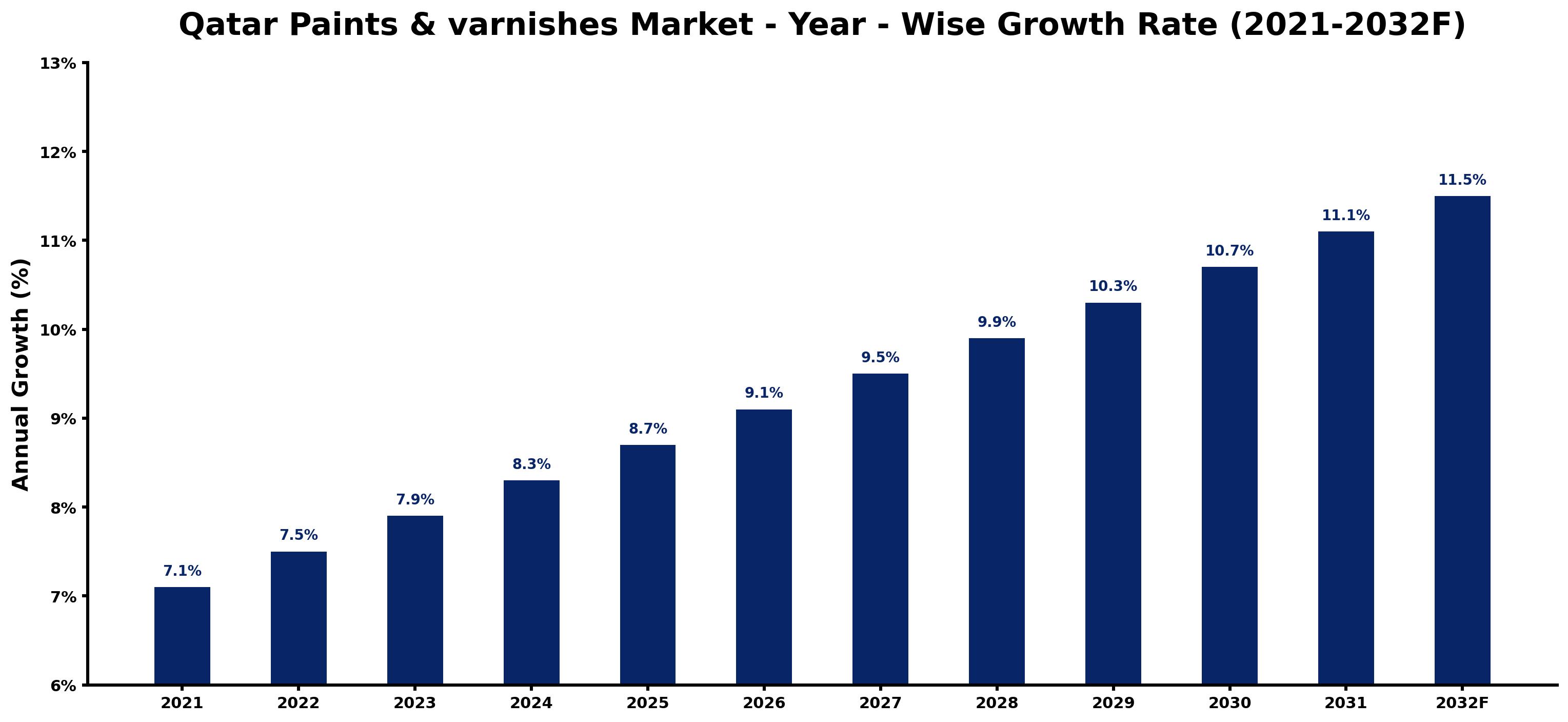
The table below presents the year wise growth rates along with the key drivers influencing the market
| Year | Growth Rate | Major Drivers |
| 2021 | 7.1% | Post-pandemic recovery ignites increased construction projects across Qatar's urban landscape. |
| 2022 | 7.5% | Enhanced focus on sustainable practices reshapes paint formulations and customer expectations. |
| 2023 | 7.9% | Major construction developments in Lusail City expand the need for high-quality coatings. |
| 2024 | 8.3% | Local manufacturers invest in innovative technologies to improve product performance and durability. |
| 2025 | 8.7% | Growing expatriate population fuels demand for diverse paint styles and finishes. |
| 2026 | 9.1% | Expansion of retail spaces in mega-projects drives increasing sales of home improvement products. |
| 2027 | 9.5% | Emergence of eco-friendly paints captures attention amidst rising environmental awareness. |
| 2028 | 9.9% | Technological integration with IoT devices enhances customer experience in paint selection processes. |
| 2029 | 10.3% | Qatar's hosting of international events accelerates infrastructure development and associated paint needs. |
| 2030 | 10.7% | Collaboration between local artists and brands promotes custom paint solutions and local culture. |
| 2031 | 11.1% | Investment in smart city initiatives emphasizes the need for functional, aesthetic coatings. |
| 2032 | 11.5% | Market diversification leads to an expanded range of applications beyond traditional sectors. |
Note - Market size estimations and growth projections presented in this report are based on 6Wresearch's advanced forecasting approach, validated with industry datasets as of June 2026.
Qatar Paints & varnishes Market Synopsis
The Qatar Paints varnishes Market is projected to reach 9.1% and witness significant growth during the forecast period (2026-2032). This growth is driven by various factors, including a robust residential construction industry, increasing urbanization, a surge in infrastructure projects, and favorable governmental policies that promote investment from international players. Additionally, the rapid expansion of the tourism sector is anticipated to further bolster the demand for paints and varnishes across the country.
Qatar Paints & varnishes Market Growth Drivers
The growth trajectory of the Qatar paints and varnishes market can be largely attributed to several critical elements:
- The ongoing expansion in the construction industry has significantly increased the demand for paints and varnishes. This is particularly evident in the residential and commercial segments, where the need for high-quality finishes is paramount.
- Urbanization is fueling the requirement for residential properties, leading to a surge in housing projects. The influx of people into urban areas necessitates the development of housing, which in turn drives the demand for decorative and protective coatings.
- Government initiatives aimed at upgrading and expanding infrastructure are providing much-needed momentum. Projects such as roads, bridges, and public facilities contribute significantly to the consumption of paints and varnishes.
- The rise in disposable incomes among the Qatari population has led to enhanced spending on home improvement and aesthetics, directly influencing the paints and varnishes market.
- The significant public and private sector investments from countries like China and South Korea into Qatar's economy are creating a favorable business environment, promoting growth in various sectors including paints and varnishes.
Qatar Paints & varnishes Market Challenges and Restraints
Despite the optimistic growth outlook for the Qatar paints and varnishes market, there are several challenges that could hinder progress:
- The high cost of raw materials used in production poses a significant challenge for manufacturers, impacting their profitability margins and competitive positioning.
- Smaller manufacturers often struggle to keep pace with larger international players that benefit from economies of scale, which can lead to pricing pressures within the market.
- Fluctuations in global supply chains, particularly in the wake of disruptions like the COVID-19 pandemic, can pose risks to consistent availability and pricing of paint and varnish products.
- The market is also sensitive to changes in architectural trends, which may lead to shifts in demand that some manufacturers may find difficult to adapt to quickly.
- Environmental regulations concerning volatile organic compounds in paint formulations may necessitate additional investments in compliance, further straining producers' margins.
Qatar Paints & varnishes Market Government Investment and Initiatives
The government of Qatar has actively sought to enhance the business landscape for sectors like paints and varnishes through various policies and initiatives. Significant public spending on infrastructure projects has created a conducive environment for growth. Additionally, the Qatar National Vision 2030 emphasizes sustainable development, which is likely to influence regulations and provide incentives for using environmentally friendly materials in construction and renovation projects.
Policies aimed at attracting foreign investment, especially in construction-related fields, are likely to increase competition and improve product offerings in the local market. The government's commitment to boosting tourism infrastructure is further expected to support the paints and varnishes market by increasing the demand for high-quality finishes in both commercial and residential projects.
Qatar Paints & varnishes Market Latest Developments (May 2025 - June 2026)
The period between May 2025 and June 2026 has been characterized by a series of developments within the Qatar paints and varnishes market. Industry stakeholders have reported an overall resilience to prior challenges, with market demand remaining strong amid ongoing construction projects and infrastructure development initiatives.
Governments, in collaboration with private enterprises, have launched several initiatives focused on sustainability, pushing manufacturers towards producing eco-friendly paints and coatings. Innovations in product formulations and the introduction of new technologies have gained traction, aimed at improving performance characteristics while lowering environmental impacts.
Furthermore, trade partnerships with international manufacturers have facilitated knowledge transfer and introduced advanced product lines to the local market. This strategic alignment is expected to enhance competition among local manufacturers while improving product availability and quality across the region.
Qatar Paints & varnishes Market - Key Attractiveness of the Report
- 10 Years of Market Numbers
- Historical Data Starting from 2022 to 2025
- Base Year: 2025
- Forecast Data until 2032
- Key Performance Indicators Impacting the Market
- Major Upcoming Developments and Projects
Key Highlights of the Report:
- Qatar Paints & varnishes Market Outlook
- Market Size of Qatar Paints & varnishes Market, 2025
- Forecast of Qatar Paints & varnishes Market, 2032
- Historical Data and Forecast of Qatar Paints & varnishes Revenues & Volume for the Period 2022-2032F
- Qatar Paints & varnishes Market Trend Evolution
- Qatar Paints & varnishes Market Drivers and Challenges
- Qatar Paints & varnishes Price Trends
- Qatar Paints & varnishes Porter's Five Forces
- Qatar Paints & varnishes Industry Life Cycle
- Historical Data and Forecast of Qatar Paints & varnishes Market Revenues & Volume By Type for the Period 2022-2032F
- Historical Data and Forecast of Qatar Paints & varnishes Market Revenues & Volume By Water-borne paints and varnishes for the Period 2022-2032F
- Historical Data and Forecast of Qatar Paints & varnishes Market Revenues & Volume By Solvent-borne paints and varnishes for the Period 2022-2032F
- Historical Data and Forecast of Qatar Paints & varnishes Market Revenues & Volume By Others for the Period 2022-2032F
- Historical Data and Forecast of Qatar Paints & varnishes Market Revenues & Volume By Applications for the Period 2022-2032F
- Historical Data and Forecast of Qatar Paints & varnishes Market Revenues & Volume By Transportations paints and varnishes for the Period 2022-2032F
- Historical Data and Forecast of Qatar Paints & varnishes Market Revenues & Volume By Industrial paints and varnishes for the Period 2022-2032F
- Historical Data and Forecast of Qatar Paints & varnishes Market Revenues & Volume By Construction paints and varnishes for the Period 2022-2032F
- Qatar Paints & varnishes Import Export Trade Statistics
- Market Opportunity Assessment By Type
- Market Opportunity Assessment By Applications
- Qatar Paints & varnishes Top Companies Market Share
- Qatar Paints & varnishes Competitive Benchmarking By Technical and Operational Parameters
- Qatar Paints & varnishes Company Profiles
- Qatar Paints & varnishes Key Strategic Recommendations






































