Qatar Parking Meter Market Size, Share & Growth Rate
The Qatar Parking Meter Market was estimated at USD 336 Million in 2025 and is projected to reach USD 464 Million by 2032, growing at a CAGR of 4.7% from 2026 to 2032. This growth is primarily driven by the rapid urbanization occurring in Qatar, alongside a marked increase in vehicle ownership. As cities become more densely populated, the necessity for efficient parking solutions has never been greater, pushing market participants to innovate and adapt to emerging technologies.
Qatar Parking Meter Market Year-wise Growth Rate and Key Drivers
This graph highlights how the Qatar Parking Meter Market has steadily grown over the years, supported by major growth factors.
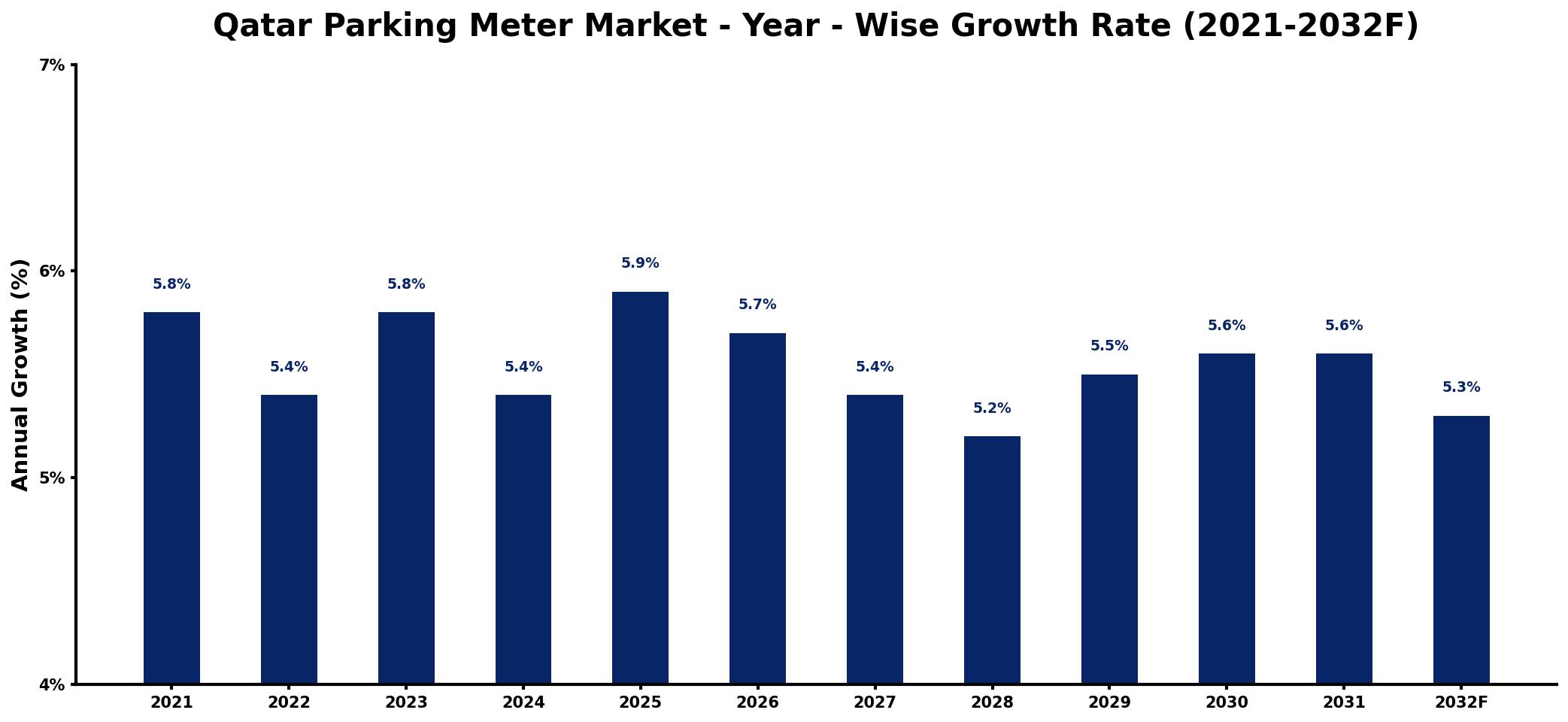
The table below presents the year‑wise growth rates along with the key drivers influencing the market
| Year | Growth Rate | Major Drivers |
| 2021 | 5.8% | Increased urban vehicle ownership rates |
| 2022 | 5.4% | Growing demand for smart solutions |
| 2023 | 5.8% | Expansion of public transport networks |
| 2024 | 5.4% | Rise in urban population density |
| 2025 | 5.9% | Investment in infrastructure development |
| 2026 | 5.7% | Focus on sustainability initiatives |
| 2027 | 5.4% | Adoption of digital payment systems |
| 2028 | 5.2% | Emergence of electric vehicle market |
| 2029 | 5.5% | Enhanced urban mobility strategies |
| 2030 | 5.6% | Integration of IoT technologies |
| 2031 | 5.6% | Government support for innovation |
| 2032 | 5.3% | Increasing urbanization trends observed |
Note: Market size estimations and growth projections presented in this report are based on 6Wresearch's proprietary forecasting methodology, utilizing the latest available industry data, government publications, and primary research inputs.
Qatar Parking Meter Market Synopsis
As urban spaces in Qatar evolve, there is a pressing need for advanced parking management solutions. The integration of electronic parking meters is critical to alleviating congestion and optimizing space usage, reflecting a broader commitment to smart city initiatives.
Moreover, the demand for cashless payment systems has surged, highlighting a significant shift in consumer preferences. This trend emphasizes the importance of user-friendly interfaces and robust customer support as essential components for fostering long-term relationships within the market.
Qatar Parking Meter Market Key Takeaways
- The market is driven by increasing urbanization and vehicle ownership.
- Integration with smart city projects is paramount for future growth.
- User-friendly interfaces and cashless payment options are becoming essential.
- Robust customer support and maintenance are critical for market success.
- Resilience has been demonstrated in recovering from COVID-19 impacts.
Evaluation of Restraints in Qatar Parking Meter Market
Despite the positive growth trajectory, the Qatar parking meter market faces specific restraints that may hinder progress. A crucial concern is the lack of comprehensive urban planning and infrastructure development. As vehicle numbers rise, the existing systems often struggle to meet the demand. Furthermore, the ongoing maintenance of parking meters, particularly in high-traffic areas, requires substantial financial and human resources. Addressing issues like vandalism and non-compliance is also vital, as they directly affect the efficiency and reliability of parking services.
Qatar Parking Meter Market Trends
Current trends in the Qatar parking meter market reflect a strong shift towards automation and technology integration. The emergence of smart parking solutions that utilize IoT and AI is gaining traction, enabling real-time monitoring and improved user experiences. Additionally, there is a growing focus on sustainability and eco-friendly practices, with companies exploring energy-efficient meter designs and eco-conscious materials. These trends signal a transformative phase in parking management that aligns with global smart city initiatives.
Qatar Parking Meter Market Opportunities
The Qatar parking meter market presents numerous growth opportunities, particularly through the expansion of cashless payment systems and the integration of mobile applications. As consumer behaviors shift toward digital solutions, there is an untapped potential for companies to develop innovative technologies that enhance the user experience. Additionally, the government's continued investment in urban infrastructure represents a fertile ground for parking meter solutions that are adaptive to evolving city landscapes.
Government Initiatives in the Qatar Parking Meter Market
The Qatari government is actively promoting smart city initiatives that include advancements in urban mobility and parking management. Through public spending on infrastructure projects, the government encourages the adoption of modern parking meters that align with the nations broader vision for a sustainable urban environment. Programs aimed at improving traffic flow and urban planning reinforce the need for sophisticated parking solutions, thereby bolstering market growth and innovation.
Future Insights of the Qatar Parking Meter Market
Looking ahead to the period between 2026 and 2032, the Qatar parking meter market is expected to undergo significant transformation. The shift towards comprehensive urban solutions, characterized by the integration of advanced technology and smart city elements, will redefine parking management. Increasing collaboration between private companies and government entities will further accelerate innovation, ensuring that parking solutions not only meet current needs but are also scalable for future urban developments.
Qatar Parking Meter Market Latest Developments (2025 - 2026)
Recent developments in the Qatar parking meter market indicate a trend towards enhanced functionality and user engagement. Initiatives are being launched to improve the efficiency of payment systems and the robustness of customer support services. Furthermore, there are discussions surrounding the adoption of energy-efficient technologies and automated monitoring systems that could streamline operations and improve overall user satisfaction.
Qatar Parking Meter Market - Key Attractiveness of the Report
- 10 Years of Market Numbers
- Historical Data Starting from 2022 to 2025
- Base Year: 2025
- Forecast Data until 2032
- Key Performance Indicators Impacting the Market
- Major Upcoming Developments and Projects
Key Highlights of the Report:
- Qatar Parking Meter Market Outlook
- Market Size of Qatar Parking Meter Market, 2025
- Forecast of Qatar Parking Meter Market, 2032
- Historical Data and Forecast of Qatar Parking Meter Revenues & Volume for the Period 2022-2032F
- Qatar Parking Meter Market Trend Evolution
- Qatar Parking Meter Market Drivers and Challenges
- Qatar Parking Meter Price Trends
- Qatar Parking Meter Porter's Five Forces
- Qatar Parking Meter Industry Life Cycle
- Historical Data and Forecast of Qatar Parking Meter Market Revenues & Volume By Technology for the Period 2022-2032F
- Historical Data and Forecast of Qatar Parking Meter Market Revenues & Volume By Parking Meter (Single Space) for the Period 2022-2032F
- Historical Data and Forecast of Qatar Parking Meter Market Revenues & Volume By Parking Kiosks (Multi Space) for the Period 2022-2032F
- Historical Data and Forecast of Qatar Parking Meter Market Revenues & Volume By Government Institutions for the Period 2022-2032F
- Historical Data and Forecast of Qatar Parking Meter Market Revenues & Volume By Application for the Period 2022-2032F
- Historical Data and Forecast of Qatar Parking Meter Market Revenues & Volume By Hospitals for the Period 2022-2032F
- Historical Data and Forecast of Qatar Parking Meter Market Revenues & Volume By Parks for the Period 2022-2032F
- Historical Data and Forecast of Qatar Parking Meter Market Revenues & Volume By Transit Systems for the Period 2022-2032F
- Historical Data and Forecast of Qatar Parking Meter Market Revenues & Volume By Malls & Stadiums for the Period 2022-2032F
- Historical Data and Forecast of Qatar Parking Meter Market Revenues & Volume By Others for the Period 2022-2032F
- Historical Data and Forecast of Qatar Parking Meter Market Revenues & Volume By Parking Mode for the Period 2022-2032F
- Historical Data and Forecast of Qatar Parking Meter Market Revenues & Volume By Pay & Display for the Period 2022-2032F
- Historical Data and Forecast of Qatar Parking Meter Market Revenues & Volume By Plate for the Period 2022-2032F
- Historical Data and Forecast of Qatar Parking Meter Market Revenues & Volume By Space for the Period 2022-2032F
- Historical Data and Forecast of Qatar Parking Meter Market Revenues & Volume By Others for the Period 2022-2032F
- Qatar Parking Meter Import Export Trade Statistics
- Market Opportunity Assessment By Technology
- Market Opportunity Assessment By Application
- Market Opportunity Assessment By Parking Mode
- Qatar Parking Meter Top Companies Market Share
- Qatar Parking Meter Competitive Benchmarking By Technical and Operational Parameters
- Qatar Parking Meter Company Profiles
- Qatar Parking Meter Key Strategic Recommendations






































