Qatar Petroleum Refining Products Market Summary
The qatar petroleum refining products market was estimated at USD 195 Million in 2025 and is projected to reach USD 257 Million by 2032, growing at a CAGR of 4.8% from 2026 to 2032.
Qatar Petroleum Refining Products Market Year-wise Growth Rate and Key Drivers
This graph highlights how the Qatar Petroleum Refining Products Market has steadily grown over the past five years, supported by major growth factors.
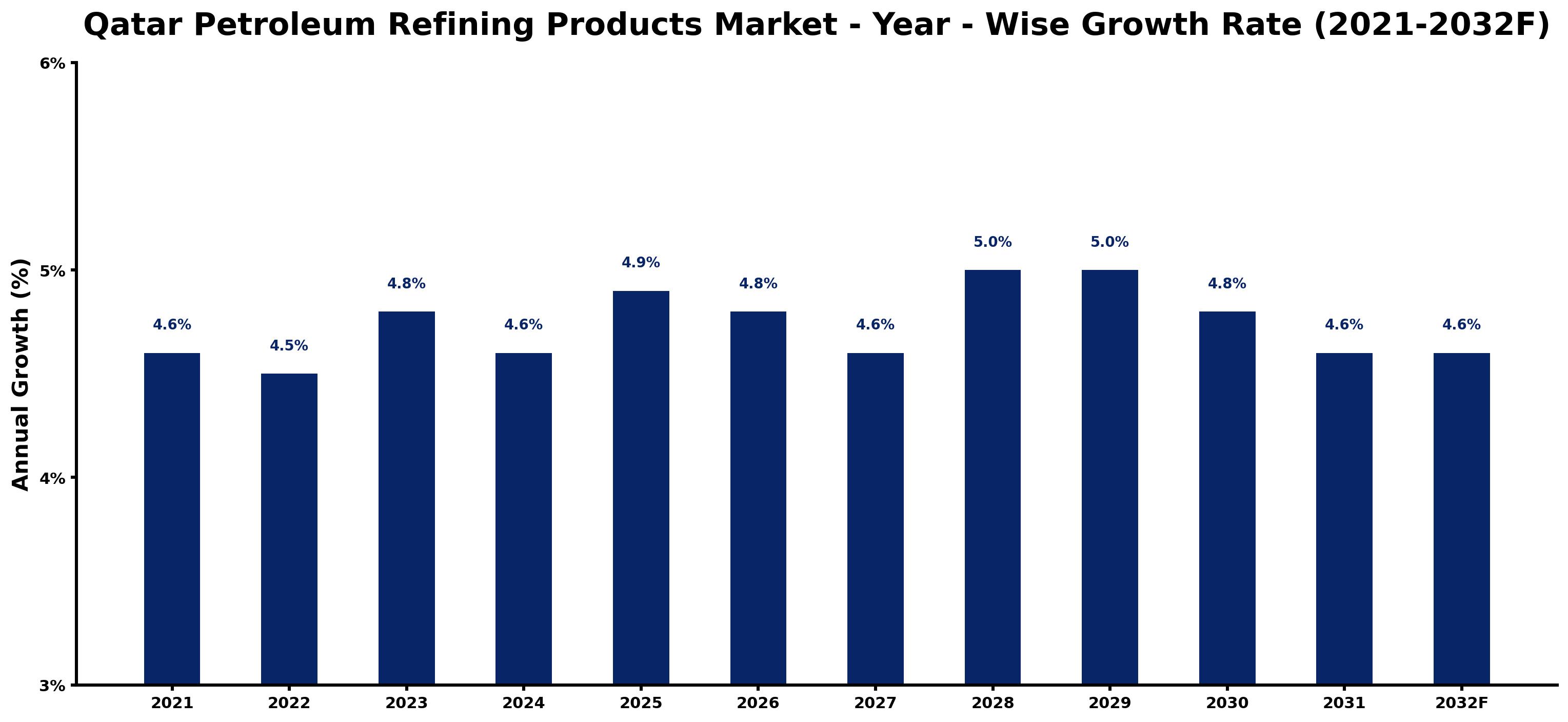
The table below presents the year wise growth rates along with the key drivers influencing the market
| Year | Growth Rate | Major Drivers |
| 2021 | 4.6% | Economic recovery post-COVID-19 prompts increased activity in refining operations. |
| 2022 | 4.5% | Rising global crude oil prices boost refining margins and profitability. |
| 2023 | 4.8% | New infrastructure projects emerge, enhancing refining capacity and regional exports. |
| 2024 | 4.6% | Technological upgrades enable more efficient processing of diverse crude types. |
| 2025 | 4.9% | Increased investments in petrochemical integration heighten product value across sectors. |
| 2026 | 4.8% | Regional collaboration within GCC fosters a competitive refining ecosystem. |
| 2027 | 4.6% | Demand for cleaner fuels drives innovation in refining processes and technologies. |
| 2028 | 5.0% | Current geopolitical dynamics prompt diversification of supply sources and partnerships. |
| 2029 | 5.0% | Emerging markets show growing appetite for high-quality refined products. |
| 2030 | 4.8% | Environmental regulations push refiners toward sustainable practices and investments. |
| 2031 | 4.6% | Shifts in consumer behavior demand more versatile and responsible fuel solutions. |
| 2032 | 4.6% | Advancements in refining technology unlock new pathways for product optimization. |
Note - Market size estimations and growth projections presented in this report are based on 6Wresearch's advanced forecasting approach, validated with industry datasets as of June 2026.
Qatar Petroleum Refining Products Market Synopsis
The Qatar Petroleum Refining Products Market is projected to reach 4.8% and witness significant growth during the forecast period (2026-2032). This market encompasses a variety of refined petroleum products derived from the refining process, including gasoline, diesel, jet fuel, liquefied petroleum gas (LPG), and several petrochemicals. These products are essential for fulfilling domestic energy requirements, supporting industrial applications, and facilitating exports to global markets.
Qatar Petroleum Refining Products Market Growth Drivers
The demand for refined petroleum products in Qatar is driven by a combination of demographic, economic, and industrial factors. Key drivers include:
- The rapid growth of Qatar's population, which increases energy consumption for transportation, residential, and commercial needs.
- Economic development initiatives that boost industrialization, leading to a higher demand for fuels and raw materials derived from refined petroleum.
- Significant exports of refined petroleum products which enhance the country's economic stability and contribute to national revenue generation.
- The petrochemical sector's reliance on refined petroleum products as feedstock for producing various essential materials such as plastics and chemicals.
- Government policies aimed at diversifying the economy and promoting sustainable industrial growth, which result in heightened demand for refined petroleum products.
Qatar Petroleum Refining Products Market Challenges and Restraints
While the Qatar Petroleum Refining Products Market presents substantial opportunities, it also faces several challenges that could impede growth. These include:
- Volatility in global crude oil prices, which can affect profitability and the competitive positioning of Qatar's petroleum products in international markets.
- Increasing scrutiny on the environmental impacts of refining operations, necessitating the adoption of sustainable practices and compliance with stringent regulations.
- The potential long-term threat posed by advancements in renewable energy technologies, which may reduce the demand for traditional petroleum products.
- The aftereffects of the Covid-19 pandemic, which highlighted vulnerabilities within the refining sector due to abrupt declines in energy demand.
- Supply chain disruptions that could arise from geopolitical tensions or economic sanctions, impacting the availability of necessary inputs for refining activities.
Qatar Petroleum Refining Products Market Covid-19 Impact
The Covid-19 pandemic had pronounced effects on the global energy landscape, significantly influencing the Qatar Petroleum Refining Products Market. As a result of widespread lockdowns and travel limitations, there was a marked decrease in the consumption of transportation fuels, which temporarily curtailed refining operations and affected pricing dynamics. Nevertheless, a gradual recovery in the global economy is projected to restore demand for refined petroleum products, allowing for a rebound in refining activities.
Qatar Petroleum Refining Products Market Government Investment and Initiatives
The Qatari government plays a pivotal role in shaping the landscape of the petroleum refining products market through various investments and initiatives. Current policies focus on enhancing the refining sector's infrastructure and capacity, with a commitment to diversifying the economy away from oil dependency. Government initiatives also encourage investment in cleaner, more sustainable refining technologies that align with global environmental standards. Furthermore, public spending on energy projects is directed towards modernizing existing facilities to enhance operational efficiency and reduce emissions, reinforcing Qatar's position in the global refining market.
Qatar Petroleum Refining Products Market Latest Developments (May 2025 - June 2026)
Recent developments within the Qatar Petroleum Refining Products Market reflect ongoing shifts toward sustainability and modernization of refining capabilities. As market demands evolve, the industry is witnessing significant initiatives aimed at reducing carbon footprints and optimizing output. Furthermore, international collaborations are increasingly common, focusing on technological advancements and best practices in refining processes. The anticipated rise in global energy consumption post-pandemic suggests a revitalization of refining activities, corresponding with increased investments focused on enhancing product quality and meeting specific customer requirements.
Qatar Petroleum Refining Products Market - Key Attractiveness of the Report
- 10 Years of Market Numbers
- Historical Data Starting from 2022 to 2025
- Base Year: 2025
- Forecast Data until 2032
- Key Performance Indicators Impacting the Market
- Major Upcoming Developments and Projects
Key Highlights of the Report:
- Qatar Petroleum Refining Products Market Outlook
- Market Size of Qatar Petroleum Refining Products Market, 2025
- Forecast of Qatar Petroleum Refining Products Market, 2032
- Historical Data and Forecast of Qatar Petroleum Refining Products Revenues & Volume for the Period 2022-2032F
- Qatar Petroleum Refining Products Market Trend Evolution
- Qatar Petroleum Refining Products Market Drivers and Challenges
- Qatar Petroleum Refining Products Price Trends
- Qatar Petroleum Refining Products Porter's Five Forces
- Qatar Petroleum Refining Products Industry Life Cycle
- Historical Data and Forecast of Qatar Petroleum Refining Products Market Revenues & Volume By Type for the Period 2022-2032F
- Historical Data and Forecast of Qatar Petroleum Refining Products Market Revenues & Volume By Ethane & LPG for the Period 2022-2032F
- Historical Data and Forecast of Qatar Petroleum Refining Products Market Revenues & Volume By Gasoline for the Period 2022-2032F
- Historical Data and Forecast of Qatar Petroleum Refining Products Market Revenues & Volume By Diesel/Gasoil for the Period 2022-2032F
- Historical Data and Forecast of Qatar Petroleum Refining Products Market Revenues & Volume By Jet/Kerosene for the Period 2022-2032F
- Historical Data and Forecast of Qatar Petroleum Refining Products Market Revenues & Volume By Naphtha for the Period 2022-2032F
- Historical Data and Forecast of Qatar Petroleum Refining Products Market Revenues & Volume By Fuel Oil for the Period 2022-2032F
- Historical Data and Forecast of Qatar Petroleum Refining Products Market Revenues & Volume By Others for the Period 2022-2032F
- Historical Data and Forecast of Qatar Petroleum Refining Products Market Revenues & Volume By End-users for the Period 2022-2032F
- Historical Data and Forecast of Qatar Petroleum Refining Products Market Revenues & Volume By Transportation for the Period 2022-2032F
- Historical Data and Forecast of Qatar Petroleum Refining Products Market Revenues & Volume By Others for the Period 2022-2032F
- Qatar Petroleum Refining Products Import Export Trade Statistics
- Market Opportunity Assessment By Type
- Market Opportunity Assessment By End-users
- Qatar Petroleum Refining Products Top Companies Market Share
- Qatar Petroleum Refining Products Competitive Benchmarking By Technical and Operational Parameters
- Qatar Petroleum Refining Products Company Profiles
- Qatar Petroleum Refining Products Key Strategic Recommendations






































