Qatar Polyester Spun Yarn Market Size, Share & Growth Rate
The Qatar Polyester Spun Yarn Market was estimated at USD 288 Million in 2025 and is projected to reach USD 378 Million by 2032, growing at a CAGR of 4.0% from 2026 to 2032. This growth trajectory is primarily fueled by the booming textile and apparel industry in Qatar, where polyester spun yarn is integral for producing diverse textile products. The strategic geographical location of Qatar as a trade hub further facilitates efficient supply chains, enhancing the markets potential for expansion.
Qatar Polyester Spun Yarn Market Year-wise Growth Rate and Key Drivers
This graph highlights how the Qatar Polyester Spun Yarn Market has steadily grown over the years, supported by major growth factors.
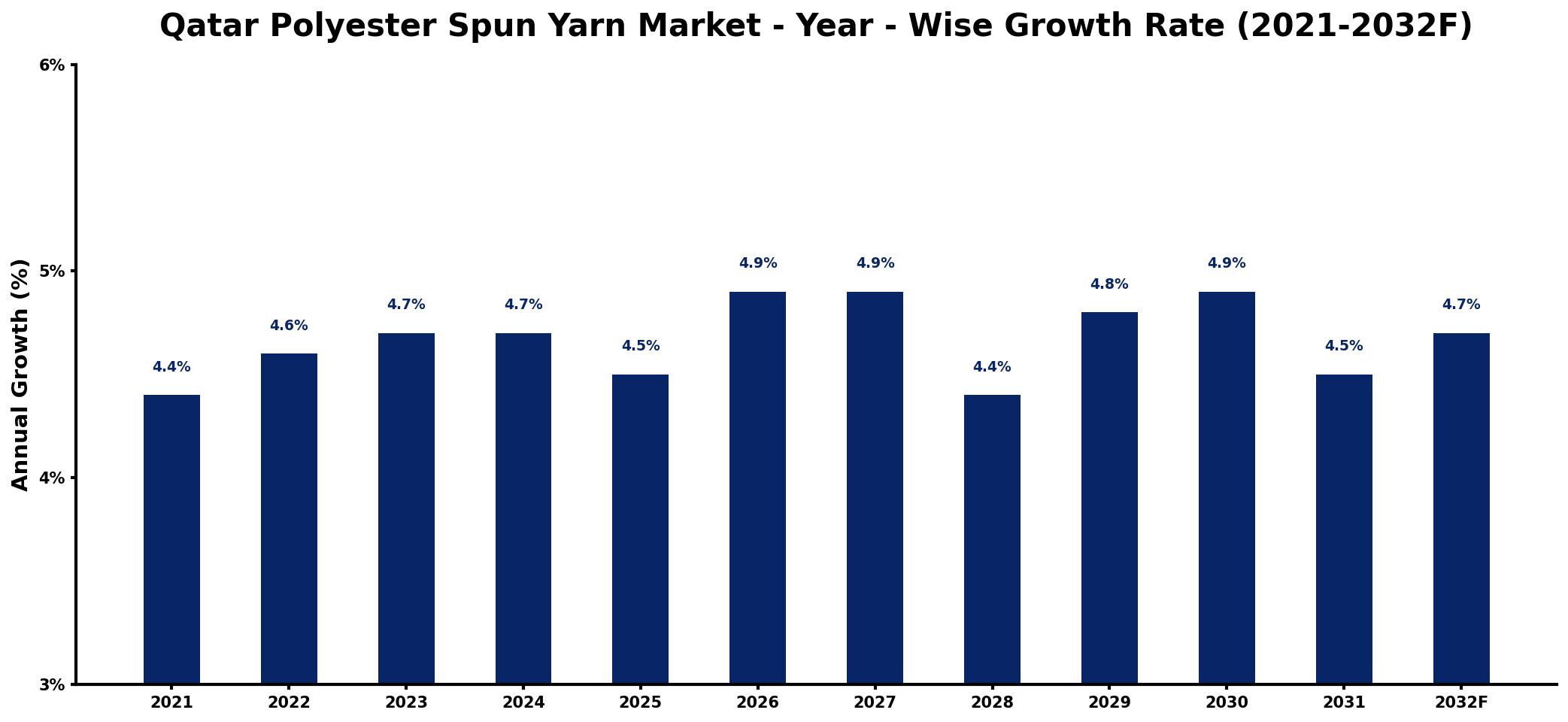
The table below presents the year‑wise growth rates along with the key drivers influencing the market
| Year | Growth Rate | Major Drivers |
| 2021 | 4.4% | Rising textile manufacturing investments |
| 2022 | 4.6% | Increased demand for sustainable materials |
| 2023 | 4.7% | Expansion in fashion retail sector |
| 2024 | 4.7% | Growth in home furnishing industry |
| 2025 | 4.5% | Strengthening construction sector activities |
| 2026 | 4.9% | Technological advancements in production |
| 2027 | 4.9% | Surge in export opportunities |
| 2028 | 4.4% | Shifts towards eco-friendly alternatives |
| 2029 | 4.8% | Growing consumer interest in customization |
| 2030 | 4.9% | Enhanced logistics and distribution networks |
| 2031 | 4.5% | Collaboration with global brands |
| 2032 | 4.7% | Rising awareness of quality standards |
Note: Market size estimations and growth projections presented in this report are based on 6Wresearch's proprietary forecasting methodology, utilizing the latest available industry data, government publications, and primary research inputs.
Qatar Polyester Spun Yarn Market Synopsis
In Qatar, the polyester spun yarn market benefits from a rising consumer base driven by an increasing demand for clothing, home textiles, and industrial fabrics. The unique attributes of polyester, such as its affordability and durability, have made it the preferred choice for both manufacturers and consumers, directly impacting market growth.
Additionally, the local textile industry is witnessing strategic investments that bolster production capabilities. This investment landscape is not just about scaling up output; it's about adopting innovative technologies that enhance quality and sustainability, setting the stage for a robust market in the years to come.
Qatar Polyester Spun Yarn Market Key Takeaways
- The market is projected to grow significantly, influenced by the expanding textile and apparel sector.
- Technological advancements are improving the quality and efficiency of yarn production.
- Polyester's favorable properties, including durability and cost-effectiveness, drive its adoption.
- Strategic geographical advantages facilitate imports and exports, strengthening market dynamics.
- There's a notable shift towards sustainable practices, aligning with global trends in recycled materials.
Evaluation of Restraints in Qatar Polyester Spun Yarn Market
Despite its growth prospects, the Qatar polyester spun yarn market faces restraints related to energy consumption and environmental impacts of production. The necessity to reduce carbon footprints while maintaining cost efficiency can present challenges for manufacturers. This tension is further exacerbated as sustainability becomes paramount, compelling producers to innovate without compromising profitability. As such, navigating these hurdles is essential for long-term market viability.
Qatar Polyester Spun Yarn Market Trends
Emerging trends within the Qatar polyester spun yarn market indicate a strong movement toward the adoption of smart manufacturing technologies. As companies invest in automation and data analytics, they improve operational efficiencies and product quality. Moreover, there is an increasing demand for eco-friendly materials, leading to a greater focus on the use of recycled polyester. Such trends are expected to shape future consumer preferences and influence production methods.
Qatar Polyester Spun Yarn Market Opportunities
The market presents significant growth opportunities through the exploration of niche applications and product diversification. Innovations in fabric technologies, particularly those targeting performance and sustainability, stand to attract investments and elevate market share. Moreover, collaborations with international brands can enhance visibility and expand distribution channels for locally produced polyester spun yarn.
Government Initiatives in the Qatar Polyester Spun Yarn Market
Qatar's government plays a pivotal role in promoting the textile sector through various initiatives aimed at enhancing local production capabilities. Policies that support innovation, encourage foreign direct investment, and foster partnerships between public and private sectors contribute significantly to market growth. Additionally, incentives focusing on sustainability initiatives are helping shape the future of the polyester spun yarn market.
Future Insights of the Qatar Polyester Spun Yarn Market
Looking ahead to 2026-2032, the Qatar polyester spun yarn market is expected to continue its upward trajectory, supported by ongoing investments in technology and sustainability practices. As consumers increasingly prioritize environmentally friendly products, the market will likely see a shift towards recycled yarns and enhanced quality standards. The continued expansion of the textile and apparel sectors, coupled with strategic positioning within global supply chains, will further underpin this growth, making Qatar a key player in the polyester yarn landscape.
Qatar Polyester Spun Yarn Market Latest Developments (2025 - 2026)
Recent developments in the Qatar polyester spun yarn market indicate a shift toward more sustainable manufacturing practices as companies respond to increasing consumer demand for eco-friendly textiles. Investments in technology have also been prominent, as local manufacturers explore automation and innovation to enhance production efficiency and reduce environmental impact. Furthermore, the market is witnessing stronger partnerships between textile producers and retailers, aiming to create more resilient supply chains.
Qatar Polyester Spun Yarn Market - Key Attractiveness of the Report
- 10 Years of Market Numbers
- Historical Data Starting from 2022 to 2025
- Base Year: 2025
- Forecast Data until 2032
- Key Performance Indicators Impacting the Market
- Major Upcoming Developments and Projects
Key Highlights of the Report:
- Qatar Polyester Spun Yarn Market Outlook
- Market Size of Qatar Polyester Spun Yarn Market, 2025
- Forecast of Qatar Polyester Spun Yarn Market, 2032
- Historical Data and Forecast of Qatar Polyester Spun Yarn Revenues & Volume for the Period 2022-2032F
- Qatar Polyester Spun Yarn Market Trend Evolution
- Qatar Polyester Spun Yarn Market Drivers and Challenges
- Qatar Polyester Spun Yarn Price Trends
- Qatar Polyester Spun Yarn Porter's Five Forces
- Qatar Polyester Spun Yarn Industry Life Cycle
- Historical Data and Forecast of Qatar Polyester Spun Yarn Market Revenues & Volume By Types for the Period 2022-2032F
- Historical Data and Forecast of Qatar Polyester Spun Yarn Market Revenues & Volume By Recycled Spun Yarn for the Period 2022-2032F
- Historical Data and Forecast of Qatar Polyester Spun Yarn Market Revenues & Volume By Non-recycled Spun Yarn for the Period 2022-2032F
- Historical Data and Forecast of Qatar Polyester Spun Yarn Market Revenues & Volume By Fields for the Period 2022-2032F
- Historical Data and Forecast of Qatar Polyester Spun Yarn Market Revenues & Volume By Apparel for the Period 2022-2032F
- Historical Data and Forecast of Qatar Polyester Spun Yarn Market Revenues & Volume By Household Textiles for the Period 2022-2032F
- Historical Data and Forecast of Qatar Polyester Spun Yarn Market Revenues & Volume By Others for the Period 2022-2032F
- Qatar Polyester Spun Yarn Import Export Trade Statistics
- Market Opportunity Assessment By Types
- Market Opportunity Assessment By Fields
- Qatar Polyester Spun Yarn Top Companies Market Share
- Qatar Polyester Spun Yarn Competitive Benchmarking By Technical and Operational Parameters
- Qatar Polyester Spun Yarn Company Profiles
- Qatar Polyester Spun Yarn Key Strategic Recommendations






































