Qatar Radio Broadcast Receivers Market Size, Share & Growth Rate
The Qatar Radio Broadcast Receivers Market was estimated at USD 334 Million in 2025 and is projected to reach USD 445 Million by 2032, growing at a CAGR of 4.2% from 2026 to 2032. This positive trajectory is largely driven by the increasing demand for high-quality audio solutions and advancements in digital broadcasting technology. The country's ongoing urbanization and cultural events further amplify interest in diverse broadcasting formats, making radio a relevant medium in a rapidly evolving media landscape.
Qatar Radio Broadcast Receivers Market Year-wise Growth Rate and Key Drivers
This graph highlights how the Qatar Radio Broadcast Receivers Market has steadily grown over the years, supported by major growth factors.
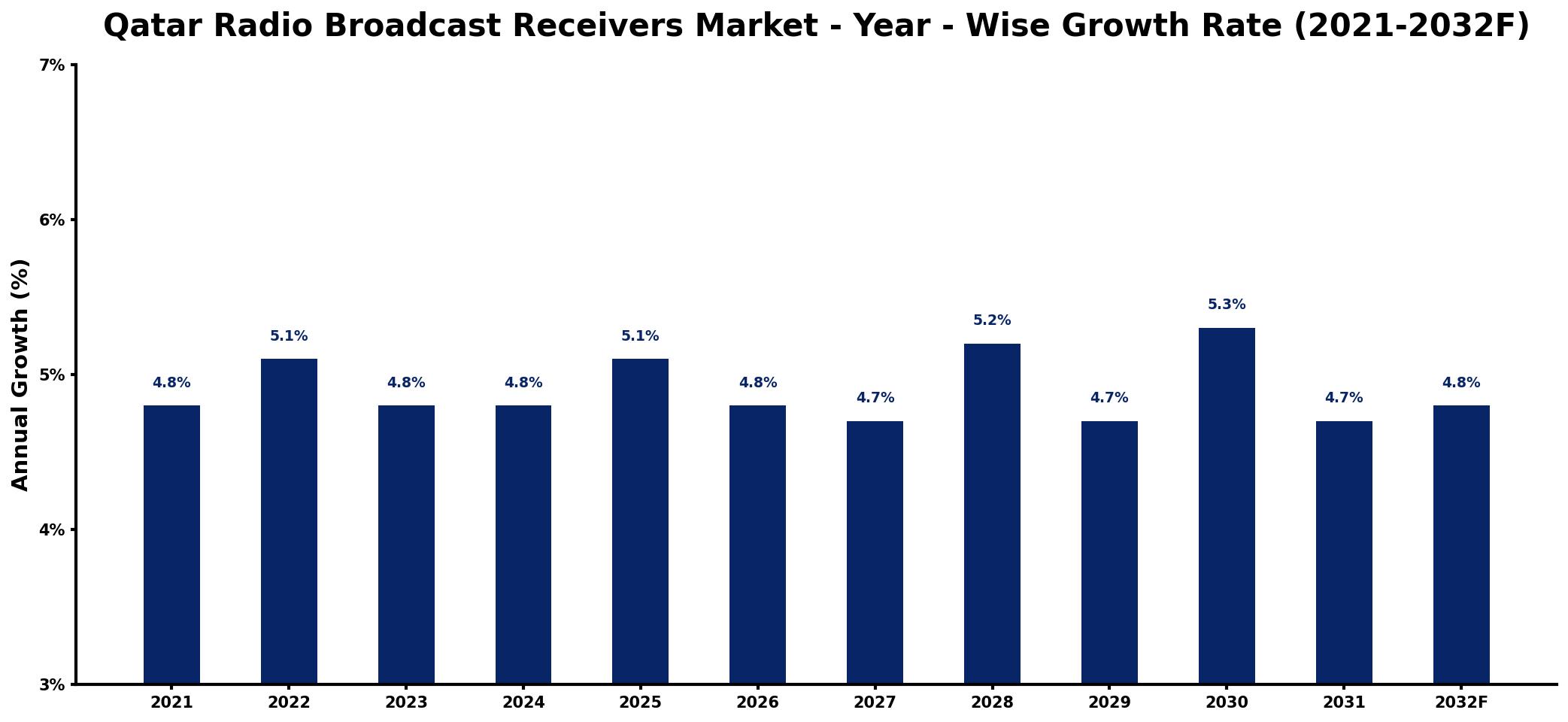
The table below presents the year‑wise growth rates along with the key drivers influencing the market
| Year | Growth Rate | Major Drivers |
| 2021 | 4.8% | Rising consumer electronics demand |
| 2022 | 5.1% | Increased investment in technology |
| 2023 | 4.8% | Growth in entertainment industry |
| 2024 | 4.8% | Expansion of digital content platforms |
| 2025 | 5.1% | Higher disposable income levels |
| 2026 | 4.8% | Technological advancements in audio |
| 2027 | 4.7% | Emergence of smart home solutions |
| 2028 | 5.2% | increased production capacity utilization |
| 2029 | 4.7% | Increased popularity of streaming |
| 2030 | 5.3% | Development of innovative features |
| 2031 | 4.7% | growing emerging market penetration |
| 2032 | 4.8% | Rising interest in portable devices |
Note: Market size estimations and growth projections presented in this report are based on 6Wresearch's proprietary forecasting methodology, utilizing the latest available industry data, government publications, and primary research inputs.
Qatar Radio Broadcast Receivers Market Synopsis
In Qatar, the radio broadcast receivers market has emerged as a pivotal segment within the audio equipment industry. As traditional media persists in adapting alongside digital advances, radio remains a significant source of information and entertainment for a diverse audience. The market is characterized by a blend of innovative technology and a resurgence of interest in local content, reflecting the unique cultural dynamics of the region.
Recent trends indicate a growing preference for versatile radio receivers capable of accessing multiple platforms, including AM, FM, and digital audio broadcasts. Enhanced features such as Bluetooth connectivity, high-definition sound, and user-friendly interfaces are also becoming increasingly desirable among consumers in Qatar, stimulating growth and diversification within the market.
Qatar Radio Broadcast Receivers Market Key Takeaways
- The market is experiencing steady growth fueled by urbanization and advancements in broadcasting technology.
- Consumer preference is shifting towards multifunctional radio receivers that integrate modern features.
- Local content and cultural programming are driving interest and engagement in radio broadcasting.
- Competition among manufacturers is encouraging innovative designs and improved sound quality.
- Accessibility and affordability are crucial factors influencing purchasing decisions in the market.
Evaluation of Restraints in Qatar Radio Broadcast Receivers Market
While the Qatar Radio Broadcast Receivers Market shows promising growth, it faces certain restraints that could impede its potential. A significant challenge is the rapid rise of digital audio platforms, which are diverting consumer attention away from traditional radio receivers. Additionally, the increasing popularity of streaming services and podcasting is reshaping how audiences consume audio content, leading to a decrease in the conventional radio listenership. Moreover, fluctuating import regulations and tariffs can complicate market accessibility for new entrants and established manufacturers alike.
Qatar Radio Broadcast Receivers Market Trends
Several trends are emerging in the Qatar Radio Broadcast Receivers Market that are shaping the future landscape. Notably, the incorporation of smart technology into radio devices is becoming more prevalent, allowing for integration with smartphones and smart home systems. Additionally, there is an increasing emphasis on sustainability, prompting manufacturers to explore eco-friendly materials and production processes. As the market evolves, consumer demand for high-fidelity sound and personalized listening experiences continues to drive innovation.
Qatar Radio Broadcast Receivers Market Opportunities
The market presents several growth and investment opportunities, particularly in enhancing the user experience through advanced technology. Collaborations with local content creators and media houses can broaden audience reach and foster cultural engagement. Furthermore, as Qatar gears up for various international events, including sports and cultural festivals, the demand for portable and versatile radio solutions is expected to rise significantly. These factors indicate a fertile ground for investment, especially in R&D for next-generation audio devices.
Government Initiatives in the Qatar Radio Broadcast Receivers Market
The Qatari government has made notable investments in media and broadcasting infrastructure, fostering an environment conducive to the growth of the radio broadcast receivers market. Policies aimed at enhancing digital broadcasting capabilities and promoting local content are vital components of the governments strategy. Additionally, initiatives to support local manufacturers and encourage technological advancements underscore the importance placed on cultivating a robust audio equipment sector.
Future Insights of the Qatar Radio Broadcast Receivers Market
Looking ahead to 2026-2032, the Qatar Radio Broadcast Receivers Market is poised for significant transformation. The integration of artificial intelligence and machine learning into audio technology is likely to enhance personalization in user experiences, appealing to a broader demographic. As consumer preferences continue to shift towards integrated solutions, the market will need to adapt, focusing on multifunctionality and advanced connectivity. With ongoing government support and evolving consumer trends, the market is well-positioned for sustained growth and innovation.
Qatar Radio Broadcast Receivers Market Latest Developments (2025 - 2026)
Recent developments in the Qatar Radio Broadcast Receivers Market indicate a notable shift towards more sophisticated devices that feature enhanced connectivity and sound quality. As manufacturers respond to changing consumer preferences, there has been a marked increase in the introduction of smart radios equipped with streaming capabilities. Additionally, partnerships between tech companies and local media stations are emerging, aimed at promoting localized content and improving listener engagement.
Qatar Radio Broadcast Receivers Market - Key Attractiveness of the Report
- 10 Years of Market Numbers
- Historical Data Starting from 2022 to 2025
- Base Year: 2025
- Forecast Data until 2032
- Key Performance Indicators Impacting the Market
- Major Upcoming Developments and Projects
Key Highlights of the Report:
- Qatar Radio Broadcast Receivers Market Outlook
- Market Size of Qatar Radio Broadcast Receivers Market, 2025
- Forecast of Qatar Radio Broadcast Receivers Market, 2032
- Historical Data and Forecast of Qatar Radio Broadcast Receivers Revenues & Volume for the Period 2022-2032F
- Qatar Radio Broadcast Receivers Market Trend Evolution
- Qatar Radio Broadcast Receivers Market Drivers and Challenges
- Qatar Radio Broadcast Receivers Price Trends
- Qatar Radio Broadcast Receivers Porter's Five Forces
- Qatar Radio Broadcast Receivers Industry Life Cycle
- Historical Data and Forecast of Qatar Radio Broadcast Receivers Market Revenues & Volume By Equipment for the Period 2022-2032F
- Historical Data and Forecast of Qatar Radio Broadcast Receivers Market Revenues & Volume By Modulators for the Period 2022-2032F
- Historical Data and Forecast of Qatar Radio Broadcast Receivers Market Revenues & Volume By Transmitters And Receivers for the Period 2022-2032F
- Historical Data and Forecast of Qatar Radio Broadcast Receivers Market Revenues & Volume By Encoders for the Period 2022-2032F
- Historical Data and Forecast of Qatar Radio Broadcast Receivers Market Revenues & Volume By Switches for the Period 2022-2032F
- Historical Data and Forecast of Qatar Radio Broadcast Receivers Market Revenues & Volume By Filters for the Period 2022-2032F
- Historical Data and Forecast of Qatar Radio Broadcast Receivers Market Revenues & Volume By Amplifiers for the Period 2022-2032F
- Historical Data and Forecast of Qatar Radio Broadcast Receivers Market Revenues & Volume By Frequency for the Period 2022-2032F
- Historical Data and Forecast of Qatar Radio Broadcast Receivers Market Revenues & Volume By Low Frequency for the Period 2022-2032F
- Historical Data and Forecast of Qatar Radio Broadcast Receivers Market Revenues & Volume By Medium Frequency for the Period 2022-2032F
- Historical Data and Forecast of Qatar Radio Broadcast Receivers Market Revenues & Volume By High Frequency for the Period 2022-2032F
- Qatar Radio Broadcast Receivers Import Export Trade Statistics
- Market Opportunity Assessment By Equipment
- Market Opportunity Assessment By Frequency
- Qatar Radio Broadcast Receivers Top Companies Market Share
- Qatar Radio Broadcast Receivers Competitive Benchmarking By Technical and Operational Parameters
- Qatar Radio Broadcast Receivers Company Profiles
- Qatar Radio Broadcast Receivers Key Strategic Recommendations






































