Qatar Recycled Plastics Market Size, Share & Growth Rate
The Qatar Recycled Plastics Market was estimated at USD 445 Million in 2025 and is projected to reach USD 588 Million by 2032, growing at a CAGR of 4.1% from 2026 to 2032. This growth trajectory is underpinned by a robust commitment from the Qatari government toward environmental sustainability and an increasing societal focus on combating plastic pollution. As both consumers and industries gravitate toward more sustainable practices, the demand for high-quality recycled plastics is set to rise significantly, aided by innovative recycling technologies that enhance product quality.
Qatar Recycled Plastics Market Year-wise Growth Rate and Key Drivers
This graph highlights how the Qatar Recycled Plastics Market has steadily grown over the years, supported by major growth factors.
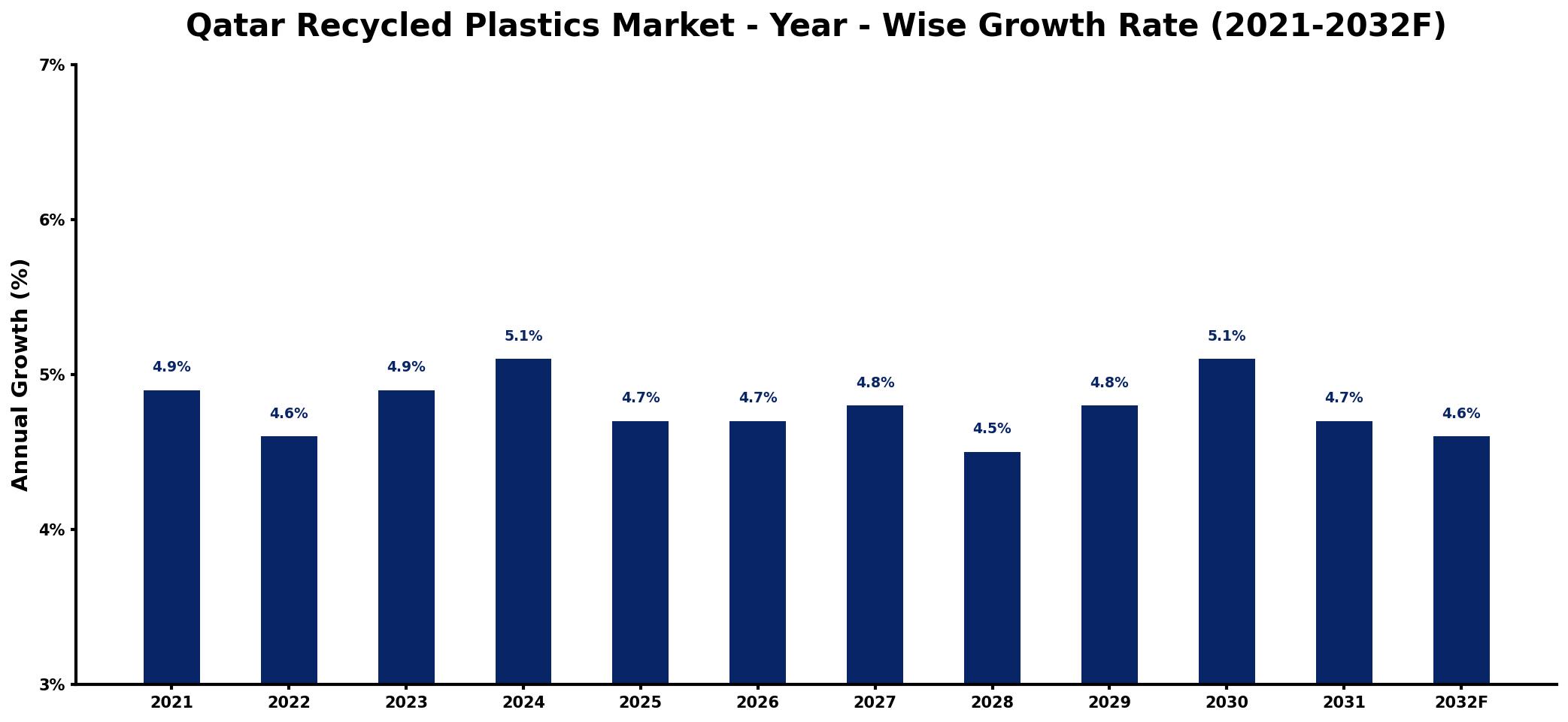
The table below presents the year‑wise growth rates along with the key drivers influencing the market
| Year | Growth Rate | Major Drivers |
| 2021 | 4.9% | Growing environmental sustainability initiatives |
| 2022 | 4.6% | Increased consumer awareness campaigns |
| 2023 | 4.9% | Expansion of collection infrastructure |
| 2024 | 5.1% | Government incentives for circular economy |
| 2025 | 4.7% | Rising demand in packaging sector |
| 2026 | 4.7% | Technological advancements in processing |
| 2027 | 4.8% | Corporate responsibility commitments rising |
| 2028 | 4.5% | Emerging markets adopting eco-friendly practices |
| 2029 | 4.8% | Investment in recycling facilities increasing |
| 2030 | 5.1% | Collaborations driving industry innovation |
| 2031 | 4.7% | Regulatory pressures enhancing compliance |
| 2032 | 4.6% | Shift towards sustainable manufacturing methods |
Note: Market size estimations and growth projections presented in this report are based on 6Wresearch's proprietary forecasting methodology, utilizing the latest available industry data, government publications, and primary research inputs.
Qatar Recycled Plastics Market Synopsis
In recent years, Qatar has seen a notable increase in the collection and processing of recycled plastics, reflecting a broader shift towards sustainability. Local initiatives have been aimed at educating the public and businesses about the benefits of recycled materials, fostering a culture of recycling that was previously underdeveloped.
Moreover, the Qatar Recycled Plastics Market is bolstered by favorable government policies that encourage the use of recycled materials across various industries, including packaging, automotive, and construction. This collaborative environment between manufacturers and regulators has not only improved the availability of recycled plastics but has also enhanced consumer trust in these products.
Qatar Recycled Plastics Market Key Takeaways
- The market is projected to grow significantly, reaching USD 588 Million by 2032.
- Government initiatives are pivotal in promoting the use of recycled plastics across various sectors.
- Technological advancements are enhancing the quality and applicability of recycled plastics.
- Increasing public awareness about sustainability is driving demand for eco-friendly alternatives.
- Key players are investing in advanced recycling technologies to meet growing industry standards.
Evaluation of Restraints in Qatar Recycled Plastics Market
Despite its promising outlook, the Qatar recycled plastics market faces challenges that could hinder growth. One significant restraint is the limited supply of high-quality recycled materials, which often necessitates substantial investments in recycling infrastructure and technology. Additionally, gaining widespread acceptance among consumers remains a challenge; overcoming misconceptions about recycled products is vital for fostering greater market adoption. Continued education and effective communication strategies will be essential to build trust and understanding around the benefits of recycled plastics.
Qatar Recycled Plastics Market Trends
Current trends indicate a shift toward increased innovation in recycling technologies, enabling higher quality standards and a wider range of applications for recycled plastics. Furthermore, the focus on circular economy principles is gaining traction, with industries seeking to reduce waste and improve resource efficiency. As sustainability becomes a cornerstone of corporate strategy across sectors, the integration of recycled materials into product design is expected to grow, encouraging manufacturers to adopt more responsible practices.
Qatar Recycled Plastics Market Opportunities
The market presents numerous growth and investment opportunities, particularly in sectors committed to sustainability. As companies face pressure to reduce their environmental footprints, partnerships with recycled plastics providers can offer significant competitive advantages. Additionally, emerging technologies in recycling processes that improve material quality and reduce costs will likely attract further investments, paving the way for innovative product development and expanded market share.
Government Initiatives in the Qatar Recycled Plastics Market
Qatar's government is actively promoting initiatives aimed at enhancing recycling rates and reducing plastic waste. Policies encouraging the adoption of recycled materials in manufacturing processes are being implemented, alongside programs aimed at improving public awareness about the importance of recycling. These initiatives are crucial in establishing a framework that supports the growth of the recycled plastics market, positioning Qatar as a leader in sustainable practices within the region.
Future Insights of the Qatar Recycled Plastics Market
Looking ahead to 2026-2032, the Qatar recycled plastics market is poised for robust expansion, bolstered by ongoing governmental support and an increasing shift toward sustainable business practices. Innovations in recycling technology are expected to continue improving product quality, broadening applications and enhancing consumer acceptance. As the global emphasis on environmental responsibility intensifies, Qatar's proactive approach to integrating recycled materials will likely position it favorably on the international stage.
Qatar Recycled Plastics Market Latest Developments (2025 - 2026)
In the recent period, industry developments have focused on enhancing collection and sorting techniques to improve the supply chain for recycled plastics. New partnerships between local manufacturers and recycling firms have emerged, aiming to streamline processes and increase efficiency. Additionally, innovative marketing campaigns are being launched to educate consumers about the benefits of recycled plastics, further driving demand in the market.
Qatar Recycled Plastics Market - Key Attractiveness of the Report
- 10 Years of Market Numbers
- Historical Data Starting from 2022 to 2025
- Base Year: 2025
- Forecast Data until 2032
- Key Performance Indicators Impacting the Market
- Major Upcoming Developments and Projects
Key Highlights of the Report:
- Qatar Recycled Plastics Market Outlook
- Market Size of Qatar Recycled Plastics Market, 2025
- Forecast of Qatar Recycled Plastics Market, 2032
- Historical Data and Forecast of Qatar Recycled Plastics Revenues & Volume for the Period 2022-2032F
- Qatar Recycled Plastics Market Trend Evolution
- Qatar Recycled Plastics Market Drivers and Challenges
- Qatar Recycled Plastics Price Trends
- Qatar Recycled Plastics Porter's Five Forces
- Qatar Recycled Plastics Industry Life Cycle
- Historical Data and Forecast of Qatar Recycled Plastics Market Revenues & Volume By Plastic Type for the Period 2022-2032F
- Historical Data and Forecast of Qatar Recycled Plastics Market Revenues & Volume By Polyethylene Terephthalate (Pet) for the Period 2022-2032F
- Historical Data and Forecast of Qatar Recycled Plastics Market Revenues & Volume By High Density Polyethylene (Hdpe) for the Period 2022-2032F
- Historical Data and Forecast of Qatar Recycled Plastics Market Revenues & Volume By Polypropylene (Pp) for the Period 2022-2032F
- Historical Data and Forecast of Qatar Recycled Plastics Market Revenues & Volume By Low Density Polyethylene (Ldpe) for the Period 2022-2032F
- Historical Data and Forecast of Qatar Recycled Plastics Market Revenues & Volume By Others for the Period 2022-2032F
- Historical Data and Forecast of Qatar Recycled Plastics Market Revenues & Volume By Application for the Period 2022-2032F
- Historical Data and Forecast of Qatar Recycled Plastics Market Revenues & Volume By Non-food Contact Packaging for the Period 2022-2032F
- Historical Data and Forecast of Qatar Recycled Plastics Market Revenues & Volume By Food Contact Packaging for the Period 2022-2032F
- Historical Data and Forecast of Qatar Recycled Plastics Market Revenues & Volume By Construction for the Period 2022-2032F
- Historical Data and Forecast of Qatar Recycled Plastics Market Revenues & Volume By Automotive for the Period 2022-2032F
- Historical Data and Forecast of Qatar Recycled Plastics Market Revenues & Volume By Others for the Period 2022-2032F
- Historical Data and Forecast of Qatar Recycled Plastics Market Revenues & Volume By Raw Material for the Period 2022-2032F
- Historical Data and Forecast of Qatar Recycled Plastics Market Revenues & Volume By Plastic Bottles for the Period 2022-2032F
- Historical Data and Forecast of Qatar Recycled Plastics Market Revenues & Volume By Plastic Films for the Period 2022-2032F
- Historical Data and Forecast of Qatar Recycled Plastics Market Revenues & Volume By Rigid Plastic And Foam for the Period 2022-2032F
- Historical Data and Forecast of Qatar Recycled Plastics Market Revenues & Volume By Fibres for the Period 2022-2032F
- Historical Data and Forecast of Qatar Recycled Plastics Market Revenues & Volume By Others for the Period 2022-2032F
- Qatar Recycled Plastics Import Export Trade Statistics
- Market Opportunity Assessment By Plastic Type
- Market Opportunity Assessment By Application
- Market Opportunity Assessment By Raw Material
- Qatar Recycled Plastics Top Companies Market Share
- Qatar Recycled Plastics Competitive Benchmarking By Technical and Operational Parameters
- Qatar Recycled Plastics Company Profiles
- Qatar Recycled Plastics Key Strategic Recommendations






































