Qatar Refrigeration and Heating Equipment Market Summary
The qatar refrigeration and heating equipment market was estimated at USD 1276 Million in 2025 and is projected to reach USD 1845 Million by 2032, growing at a CAGR of 6.6% from 2026 to 2032.
Qatar Refrigeration and Heating Equipment Market Year-wise Growth Rate and Key Drivers
This graph highlights how the Qatar Refrigeration and Heating Equipment Market has steadily grown over the past five years, supported by major growth factors.
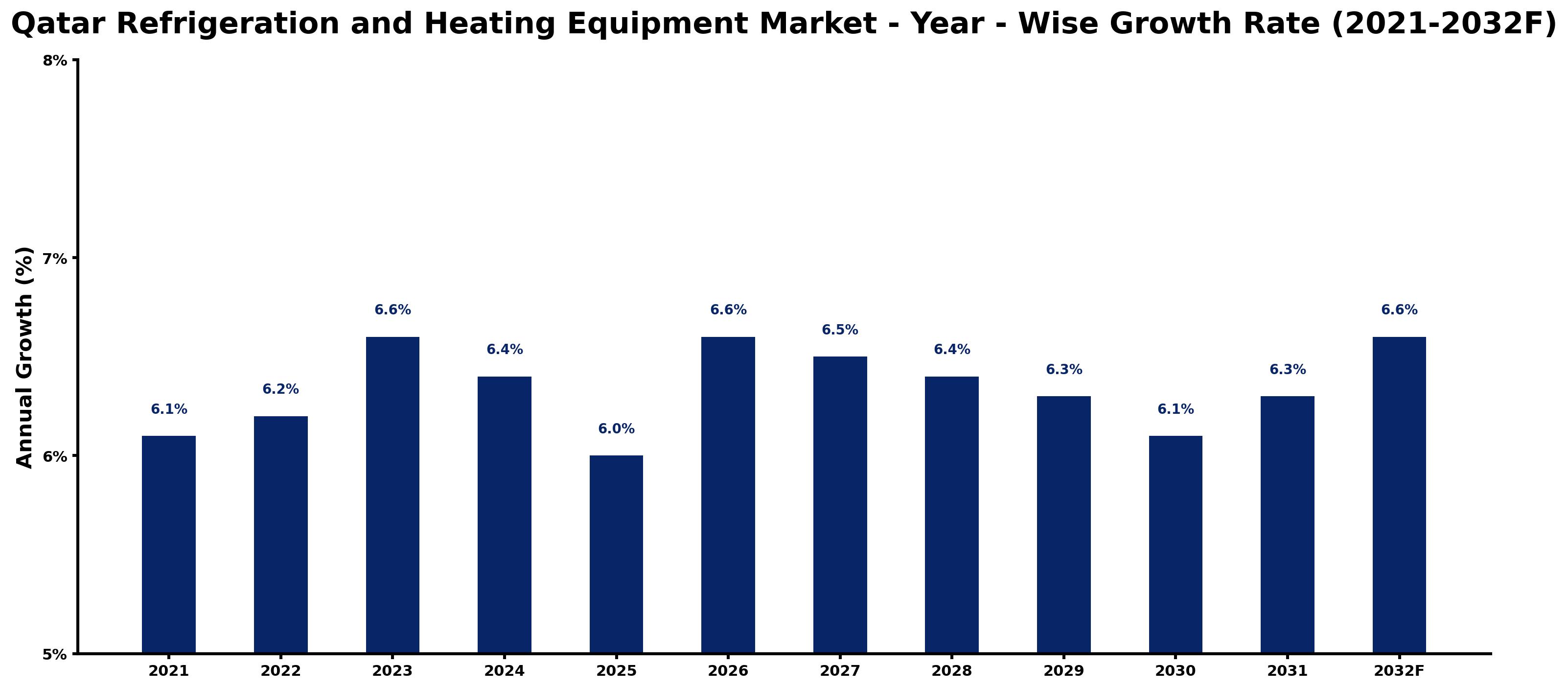
The table below presents the year wise growth rates along with the key drivers influencing the market
| Year | Growth Rate | Major Drivers |
| 2021 | 6.1% | Post-lockdown retail projects accelerate the demand for efficient refrigeration solutions. |
| 2022 | 6.2% | Legacy systems struggle under increasing load, prompting urgent upgrades in equipment. |
| 2023 | 6.6% | Enterprise budgets prioritize energy-efficient heating equipment amidst soaring energy costs. |
| 2024 | 6.4% | New construction pipelines in Qatar necessitate advanced HVAC systems for climate control. |
| 2025 | 6.0% | Local manufacturers focus on creating tailored solutions for diverse regional climates. |
| 2026 | 6.6% | Technological integration of IoT devices enhances operational efficiency in refrigeration systems. |
| 2027 | 6.5% | Sustainability commitments drive innovation in eco-friendly heating and cooling technologies. |
| 2028 | 6.4% | Rising awareness of energy conservation influences consumer preferences towards modern systems. |
| 2029 | 6.3% | Increased residential developments lead to higher demand for comprehensive HVAC solutions. |
| 2030 | 6.1% | Competitive pressures prompt manufacturers to focus on product differentiation and quality. |
| 2031 | 6.3% | Investment in smart city initiatives boosts demand for integrated heating and cooling systems. |
| 2032 | 6.6% | Regional climate challenges persist, ensuring ongoing need for innovative cooling technologies. |
Note - Market size estimations and growth projections presented in this report are based on 6Wresearch's advanced forecasting approach, validated with industry datasets as of June 2026.
Qatar Refrigeration and Heating Equipment Market Synopsis
The Qatar Refrigeration and Heating Equipment Market is projected to reach 6.6% and witness significant growth during the forecast period (2026-2032). The market is poised to benefit from the country's increasing economic activities, a growing population, and high per capita income, which position Qatar as a prominent importer of HVAC products in the region. This upward trajectory is driven primarily by the rising demand for energy-efficient systems such as heat pumps and air conditioners.
Qatar Refrigeration and Heating Equipment Market Growth Drivers
Several factors are propelling the growth of the Qatar refrigeration and heating equipment market.
- The increasing consumer awareness regarding energy efficiency is fostering a demand for air conditioning systems with higher Seasonal Energy Efficiency Ratio (SEER) ratings. This shift is leading to a significant increase in the sales of advanced central AC units across the region, effectively aligning with Qatar's sustainability goals.
- Government regulations and initiatives are playing a crucial role in shaping the market landscape. The government's mandate for the installation of minimum SEER-rated systems across all residential buildings starting in 2025 is expected to further stimulate demand, ensuring compliance with energy efficiency standards.
- The rapid urbanization occurring in Qatar, particularly in major cities like Doha, is spurring growth in construction activities. This boom is resulting in a heightened adoption of HVAC solutions across various commercial establishments, including offices, shopping malls, and retail outlets.
- The influx of foreign investments in Qatar's construction sector contributes to increased demand for refrigeration and heating equipment. As more businesses establish operations in the country, the need for reliable HVAC systems is anticipated to rise significantly.
- Technological advancements in refrigeration and heating solutions, including smart and automated systems, are increasing consumer interest. These innovations not only enhance comfort but also improve energy efficiency, driving consumer preference towards modern equipment.
Qatar Refrigeration and Heating Equipment Market Challenges and Restraints
While the market shows prospects for growth, several challenges exist that could inhibit its potential.
- The high costs associated with the installation and maintenance of advanced refrigeration and heating systems present a significant barrier for widespread adoption among end-users. Consumers and businesses may hesitate to invest in these systems due to the initial financial outlay required.
- Despite advancements in technology, many manufacturers face difficulties in providing after-sales support that meets customer expectations. This lack of satisfactory service can lead to dissatisfaction, ultimately affecting overall revenues in the market.
- The presence of certain local and regional competitors offering lower-cost alternatives could impact market dynamics, presenting a challenge for premium brands to maintain market share.
- Fluctuations in global supply chains, especially in the backdrop of geopolitical situations, may also pose risks to the consistent supply of refrigeration and heating equipment in Qatar.
- Consumer reluctance to transition from older systems to modern, energy-efficient solutions persists, often due to a lack of understanding of long-term benefits. This mindset can slow the market's growth trajectory.
Qatar Refrigeration and Heating Equipment Market Government Investment and Initiatives
The Qatari government is actively investing in initiatives aimed at fostering a sustainable and energy-efficient environment. This commitment is reflected in a range of policies and public spending directed towards the promotion of HVAC systems.
- As part of its goal to facilitate sustainable urban development, the government is implementing initiatives that promote the use of energy-efficient HVAC solutions, aligning with Qatar's National Vision 2030.
- There are plans to enhance public building standards, requiring the incorporation of energy-efficient systems in new projects. This mandates compliance with specific energy consumption benchmarks, further driving the demand for advanced refrigeration and heating equipment.
- Investment into research and development in the HVAC sector is being prioritized, aimed at fostering innovation and enhancing the performance of heating and cooling technologies.
- Government subsidies and incentives are being introduced to ease the financial burden on consumers and businesses adopting these energy-efficient systems, encouraging a transition towards greener technologies.
- Through strategic partnerships with private sectors, Qatar is fostering knowledge exchange and expertise in the HVAC field, thus enhancing the overall industry capacity.
Qatar Refrigeration and Heating Equipment Market Latest Developments (May 2025 - June 2026)
Recently, the Qatar refrigeration and heating equipment market has witnessed a variety of developments and industry trends.
- Manufacturers have been increasingly focusing on the development of smart HVAC systems that utilize IoT and automation technologies, catering to the rising consumer demand for convenience and efficiency.
- Collaborations between local distributors and international manufacturers have intensified, aimed at enhancing market outreach and service efficiency, reflecting a dynamic shift in market strategy.
- Trade exhibitions and industry conferences have resumed, providing platforms for stakeholders to showcase innovations and network, significantly boosting visibility for new entrants in the market.
- Sustainability has become a central theme for many companies as they launch new lines of products specifically designed to reduce carbon footprints, in alignment with global sustainability standards.
- Supply chain adjustments are being made in response to global economic shifts, with companies exploring diversified sourcing options to mitigate risks associated with raw material shortages.
Qatar Refrigeration and Heating Equipment Market - Key Attractiveness of the Report
- 10 Years of Market Numbers
- Historical Data Starting from 2022 to 2025
- Base Year: 2025
- Forecast Data until 2032
- Key Performance Indicators Impacting the Market
- Major Upcoming Developments and Projects
Key Highlights of the Report:
- Qatar Refrigeration and Heating Equipment Market Outlook
- Market Size of Qatar Refrigeration and Heating Equipment Market, 2025
- Forecast of Qatar Refrigeration and Heating Equipment Market, 2032
- Historical Data and Forecast of Qatar Refrigeration and Heating Equipment Revenues & Volume for the Period 2022-2032F
- Qatar Refrigeration and Heating Equipment Market Trend Evolution
- Qatar Refrigeration and Heating Equipment Market Drivers and Challenges
- Qatar Refrigeration and Heating Equipment Price Trends
- Qatar Refrigeration and Heating Equipment Porter's Five Forces
- Qatar Refrigeration and Heating Equipment Industry Life Cycle
- Historical Data and Forecast of Qatar Refrigeration and Heating Equipment Market Revenues & Volume By Heating equipments for the Period 2022-2032F
- Historical Data and Forecast of Qatar Refrigeration and Heating Equipment Market Revenues & Volume By Heating Pumps for the Period 2022-2032F
- Historical Data and Forecast of Qatar Refrigeration and Heating Equipment Market Revenues & Volume By Furnaces for the Period 2022-2032F
- Historical Data and Forecast of Qatar Refrigeration and Heating Equipment Market Revenues & Volume By Boilers for the Period 2022-2032F
- Historical Data and Forecast of Qatar Refrigeration and Heating Equipment Market Revenues & Volume By Space heaters for the Period 2022-2032F
- Historical Data and Forecast of Qatar Refrigeration and Heating Equipment Market Revenues & Volume By Unitary heaters for the Period 2022-2032F
- Historical Data and Forecast of Qatar Refrigeration and Heating Equipment Market Revenues & Volume By Others for the Period 2022-2032F
- Historical Data and Forecast of Qatar Refrigeration and Heating Equipment Market Revenues & Volume By Cooling Equipments for the Period 2022-2032F
- Historical Data and Forecast of Qatar Refrigeration and Heating Equipment Market Revenues & Volume By Cooling towers for the Period 2022-2032F
- Historical Data and Forecast of Qatar Refrigeration and Heating Equipment Market Revenues & Volume By Chillers for the Period 2022-2032F
- Historical Data and Forecast of Qatar Refrigeration and Heating Equipment Market Revenues & Volume By Coolers for the Period 2022-2032F
- Historical Data and Forecast of Qatar Refrigeration and Heating Equipment Market Revenues & Volume By Air conditioners for the Period 2022-2032F
- Historical Data and Forecast of Qatar Refrigeration and Heating Equipment Market Revenues & Volume By Others for the Period 2022-2032F
- Historical Data and Forecast of Qatar Refrigeration and Heating Equipment Market Revenues & Volume By General Components for the Period 2022-2032F
- Historical Data and Forecast of Qatar Refrigeration and Heating Equipment Market Revenues & Volume By Condensers for the Period 2022-2032F
- Historical Data and Forecast of Qatar Refrigeration and Heating Equipment Market Revenues & Volume By Compressors for the Period 2022-2032F
- Historical Data and Forecast of Qatar Refrigeration and Heating Equipment Market Revenues & Volume By Radiators for the Period 2022-2032F
- Historical Data and Forecast of Qatar Refrigeration and Heating Equipment Market Revenues & Volume By Sensors for the Period 2022-2032F
- Historical Data and Forecast of Qatar Refrigeration and Heating Equipment Market Revenues & Volume By Transducers for the Period 2022-2032F
- Historical Data and Forecast of Qatar Refrigeration and Heating Equipment Market Revenues & Volume By Others for the Period 2022-2032F
- Historical Data and Forecast of Qatar Refrigeration and Heating Equipment Market Revenues & Volume By End-User Industries for the Period 2022-2032F
- Historical Data and Forecast of Qatar Refrigeration and Heating Equipment Market Revenues & Volume By Residential for the Period 2022-2032F
- Historical Data and Forecast of Qatar Refrigeration and Heating Equipment Market Revenues & Volume By Commercial for the Period 2022-2032F
- Historical Data and Forecast of Qatar Refrigeration and Heating Equipment Market Revenues & Volume By Healthcare Industry for the Period 2022-2032F
- Historical Data and Forecast of Qatar Refrigeration and Heating Equipment Market Revenues & Volume By Educational and government institutions for the Period 2022-2032F
- Historical Data and Forecast of Qatar Refrigeration and Heating Equipment Market Revenues & Volume By Others for the Period 2022-2032F
- Qatar Refrigeration and Heating Equipment Import Export Trade Statistics
- Market Opportunity Assessment By Heating equipments
- Market Opportunity Assessment By Cooling Equipments
- Market Opportunity Assessment By General Components
- Market Opportunity Assessment By End-User Industries
- Qatar Refrigeration and Heating Equipment Top Companies Market Share
- Qatar Refrigeration and Heating Equipment Competitive Benchmarking By Technical and Operational Parameters
- Qatar Refrigeration and Heating Equipment Company Profiles
- Qatar Refrigeration and Heating Equipment Key Strategic Recommendations






































