Qatar RegTech Market Size & Growth Rate (2026-2032)
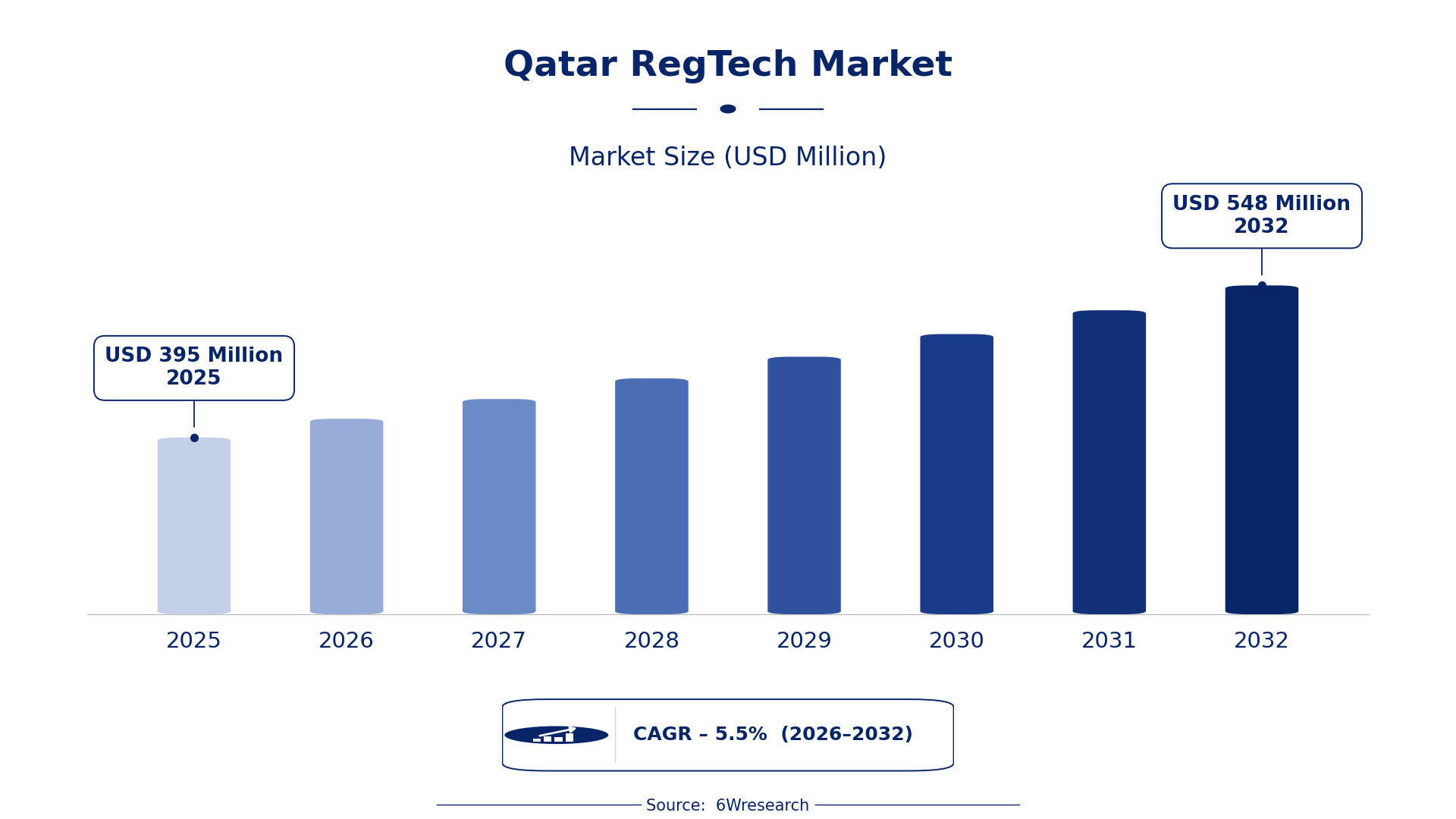
The Qatar RegTech Market was estimated at USD 395 Million in 2025 and is projected to reach USD 548 Million by 2032, growing at a CAGR of 5.5% from 2026 to 2032.
Qatar RegTech Market Synopsis
The regulatory technology (RegTech) sector in Qatar is rapidly expanding, driven by the increasing complexities of compliance across various industries. Businesses are now turning to RegTech solutions to streamline their regulatory processes, ensuring they remain compliant amid evolving laws and standards.
Financial institutions, in particular, are embracing automation and advanced technologies like artificial intelligence and blockchain to enhance their compliance capabilities. The ongoing pressures from both local and international regulatory bodies underscore the necessity for efficient compliance mechanisms in Qatar's dynamic economic environment.
Qatar RegTech Market Year-wise Growth Rate and Key Drivers
This graph illustrates the annual growth rates of the Qatar RegTech Market from 2021 to 2032, highlighting a steady upward trajectory and projected expansion over the forecast period.
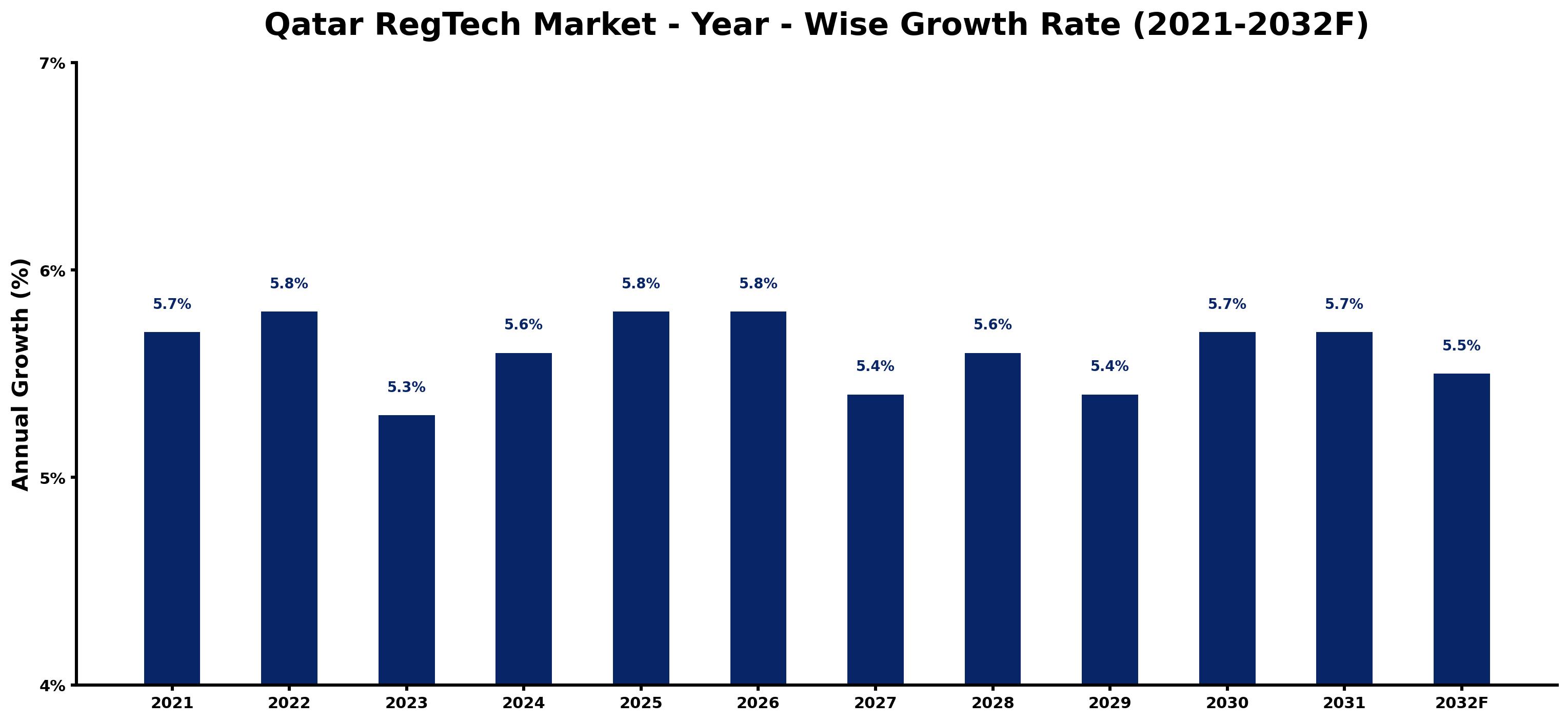
The table below presents the year‑wise growth rates along with the key drivers influencing the market
| Year | Growth Rate | Major Drivers |
| 2021 | 5.7% | Qatar Central Bank's fintech strategy drives RegTech adoption. |
| 2022 | 5.8% | Rising implementation of anti-money laundering regulations in finance. |
| 2023 | 5.3% | Growing focus on digital identity verification in banking sectors. |
| 2024 | 5.6% | New data protection laws enhance compliance software needs. |
| 2025 | 5.8% | Accelerating mobile payment initiatives increase compliance solutions demand. |
| 2026 | 5.8% | Regulatory sandbox supports innovative RegTech startups in Qatar. |
| 2027 | 5.4% | Partnerships with international firms boost local RegTech solutions. |
| 2028 | 5.6% | Emerging fintech hubs promote technology-driven regulatory compliance. |
| 2029 | 5.4% | Increased focus on cyber risk management among financial institutions. |
| 2030 | 5.7% | Government incentives stimulate investment in compliance technologies. |
| 2031 | 5.7% | Demand for efficient reporting tools grows among enterprises. |
| 2032 | 5.5% | Integration of AI enhances regulatory reporting processes in banks. |
Note: Market size estimations and growth projections presented in this report are based on 6Wresearch's proprietary forecasting methodology, utilizing the latest available industry data, government publications, and primary research inputs.
Qatar RegTech Market Key Takeaways
Below are some of the specific key takeaways from the market, including:
- The demand for RegTech solutions is being fueled by the increasing regulatory complexities across various sectors.
- Technological advancements, particularly in AI and blockchain, are transforming compliance processes for financial institutions.
- COVID-19 has accelerated the adoption of automated compliance solutions, highlighting the need for agility in regulatory responses.
- There is a significant push towards developing anti-money laundering (AML) capabilities within RegTech frameworks.
- Qatar’s evolving regulatory environment presents both challenges and opportunities for RegTech adoption.
Evaluation of Restraints in Qatar RegTech Market
The Qatar RegTech market faces notable constraints primarily due to the constantly changing regulatory framework. As the country updates its financial regulations, RegTech solutions must evolve accordingly to remain compliant. Data security and privacy concerns are also critical, as financial entities must adhere to stringent compliance standards. on top of that, the challenge of catering to both Islamic and conventional finance systems adds an additional layer of complexity that needs to be addressed in developing effective RegTech solutions.
Qatar RegTech Market Trends
Several trends are shaping the RegTech market in Qatar. The increasing sophistication of financial crimes has heightened the focus on anti-money laundering technologies. Companies are also prioritizing digital transformation initiatives, with RegTech solutions becoming integral to their strategies. on top of that, the integration of advanced analytics and machine learning is allowing organizations to better anticipate regulatory changes and respond proactively. This trend reflects a broader shift towards data-driven decision-making in compliance processes.
Qatar RegTech Market Opportunities
The market presents numerous growth opportunities, especially for innovative firms that can deliver tailored compliance solutions. The rising demand for real-time regulatory reporting and risk management tools provides a fertile ground for investment. Additionally, as businesses seek to enhance their operational efficiencies, partnerships between technology vendors and financial institutions are likely to expand, fostering a collaborative approach to compliance. The increasing regulatory scrutiny from international bodies also encourages local firms to adopt advanced RegTech solutions.
Government Initiatives in the Qatar RegTech Market
The Qatari government is actively shaping the RegTech market through various initiatives that emphasize regulatory compliance and innovation. With a strong focus on enhancing financial transparency and security, government policies are designed to support the development of effective RegTech solutions. The commitment to updating and refining regulatory frameworks makes public-sector involvement crucial for businesses seeking to navigate compliance challenges.
- A recently completed initiative focused on revising anti-money laundering regulations to align with international standards.
- Currently underway is a national digital infrastructure upgrade program aimed at improving data security and compliance tracking.
- A planned public-private partnership is set to launch in 2026, targeting the development of innovative RegTech solutions tailored for both Islamic and conventional financial systems.
- The establishment of a regulatory sandbox in 2025 allows startups to test their RegTech innovations within a controlled environment.
- An ongoing initiative to enhance cross-border regulatory cooperation has been initiated to facilitate compliance for international firms operating in Qatar.
Future Insights of the Qatar RegTech Market
Looking ahead to 2026-2032, the Qatar RegTech market is set to experience substantial growth. The push for enhanced compliance measures will continue, driven by increasing regulatory scrutiny and the need for efficient risk management solutions. Organizations that embrace digital transformation and invest in innovative technologies will be better positioned to meet the evolving demands of the regulatory landscape. As businesses adapt, we expect to see a greater integration of advanced analytics and machine learning in compliance processes, creating a more proactive approach to regulatory challenges.
Qatar RegTech Market Latest Developments
Recent developments in the Qatar RegTech market reflect a trend towards innovation and collaboration among stakeholders. Over the past year, there have been significant strides in enhancing compliance frameworks and technology deployments aimed at improving efficiency. These movements are indicative of a growing recognition of the importance of effective regulatory technology solutions.
- A leading regional operator launched a new compliance automation platform in Q1 2025, designed to streamline regulatory reporting for financial institutions.
- In mid-2025, a major technology vendor announced a partnership with local banks to develop AI-driven AML solutions tailored to the Qatari market.
- Currently ongoing is a pilot program initiated in late 2025, aimed at integrating blockchain technology into compliance processes for enhanced transparency.
- A rollout of a digital compliance training initiative for financial professionals is expected to begin in Q2 2026, enhancing skills in navigating regulatory changes.
- A new research project, planned for 2026, aims to explore the impact of RegTech on operational efficiencies in the financial sector.
Qatar RegTech Market - Key Attractiveness of the Report
- 10 Years of Market Numbers
- Historical Data Starting from 2022 to 2025
- Base Year: 2025
- Forecast Data until 2032
- Key Performance Indicators Impacting the Market
- Major Upcoming Developments and Projects
Key Highlights of the Report:
- Qatar RegTech Market Outlook
- Market Size of Qatar RegTech Market, 2025
- Forecast of Qatar RegTech Market, 2032
- Historical Data and Forecast of Qatar RegTech Revenues & Volume for the Period 2022-2032F
- Qatar RegTech Market Trend Evolution
- Qatar RegTech Market Drivers and Challenges
- Qatar RegTech Price Trends
- Qatar RegTech Porter's Five Forces
- Qatar RegTech Industry Life Cycle
- Historical Data and Forecast of Qatar RegTech Market Revenues & Volume By Component for the Period 2022-2032F
- Historical Data and Forecast of Qatar RegTech Market Revenues & Volume By Solutions for the Period 2022-2032F
- Historical Data and Forecast of Qatar RegTech Market Revenues & Volume By Services for the Period 2022-2032F
- Historical Data and Forecast of Qatar RegTech Market Revenues & Volume By Application for the Period 2022-2032F
- Historical Data and Forecast of Qatar RegTech Market Revenues & Volume By Risk & Compliance Management for the Period 2022-2032F
- Historical Data and Forecast of Qatar RegTech Market Revenues & Volume By Identity Management for the Period 2022-2032F
- Historical Data and Forecast of Qatar RegTech Market Revenues & Volume By Regulatory Reporting for the Period 2022-2032F
- Historical Data and Forecast of Qatar RegTech Market Revenues & Volume By AML and Fraud Management for the Period 2022-2032F
- Historical Data and Forecast of Qatar RegTech Market Revenues & Volume By Regulatory Intelligence for the Period 2022-2032F
- Historical Data and Forecast of Qatar RegTech Market Revenues & Volume By Organization Size for the Period 2022-2032F
- Historical Data and Forecast of Qatar RegTech Market Revenues & Volume By SMEs for the Period 2022-2032F
- Historical Data and Forecast of Qatar RegTech Market Revenues & Volume By Large Enterprises for the Period 2022-2032F
- Historical Data and Forecast of Qatar RegTech Market Revenues & Volume By Deployment Mode for the Period 2022-2032F
- Historical Data and Forecast of Qatar RegTech Market Revenues & Volume By On-Premises for the Period 2022-2032F
- Historical Data and Forecast of Qatar RegTech Market Revenues & Volume By Cloud for the Period 2022-2032F
- Historical Data and Forecast of Qatar RegTech Market Revenues & Volume By Vertical for the Period 2022-2032F
- Historical Data and Forecast of Qatar RegTech Market Revenues & Volume By Banking for the Period 2022-2032F
- Historical Data and Forecast of Qatar RegTech Market Revenues & Volume By Insurance for the Period 2022-2032F
- Historical Data and Forecast of Qatar RegTech Market Revenues & Volume By Non-Financial for the Period 2022-2032F
- Qatar RegTech Import Export Trade Statistics
- Market Opportunity Assessment By Component
- Market Opportunity Assessment By Application
- Market Opportunity Assessment By Organization Size
- Market Opportunity Assessment By Deployment Mode
- Market Opportunity Assessment By Vertical
- Qatar RegTech Top Companies Market Share
- Qatar RegTech Competitive Benchmarking By Technical and Operational Parameters
- Qatar RegTech Company Profiles
- Qatar RegTech Key Strategic Recommendations






































