Peru RegTech Market Size & Growth Rate (2026-2032)
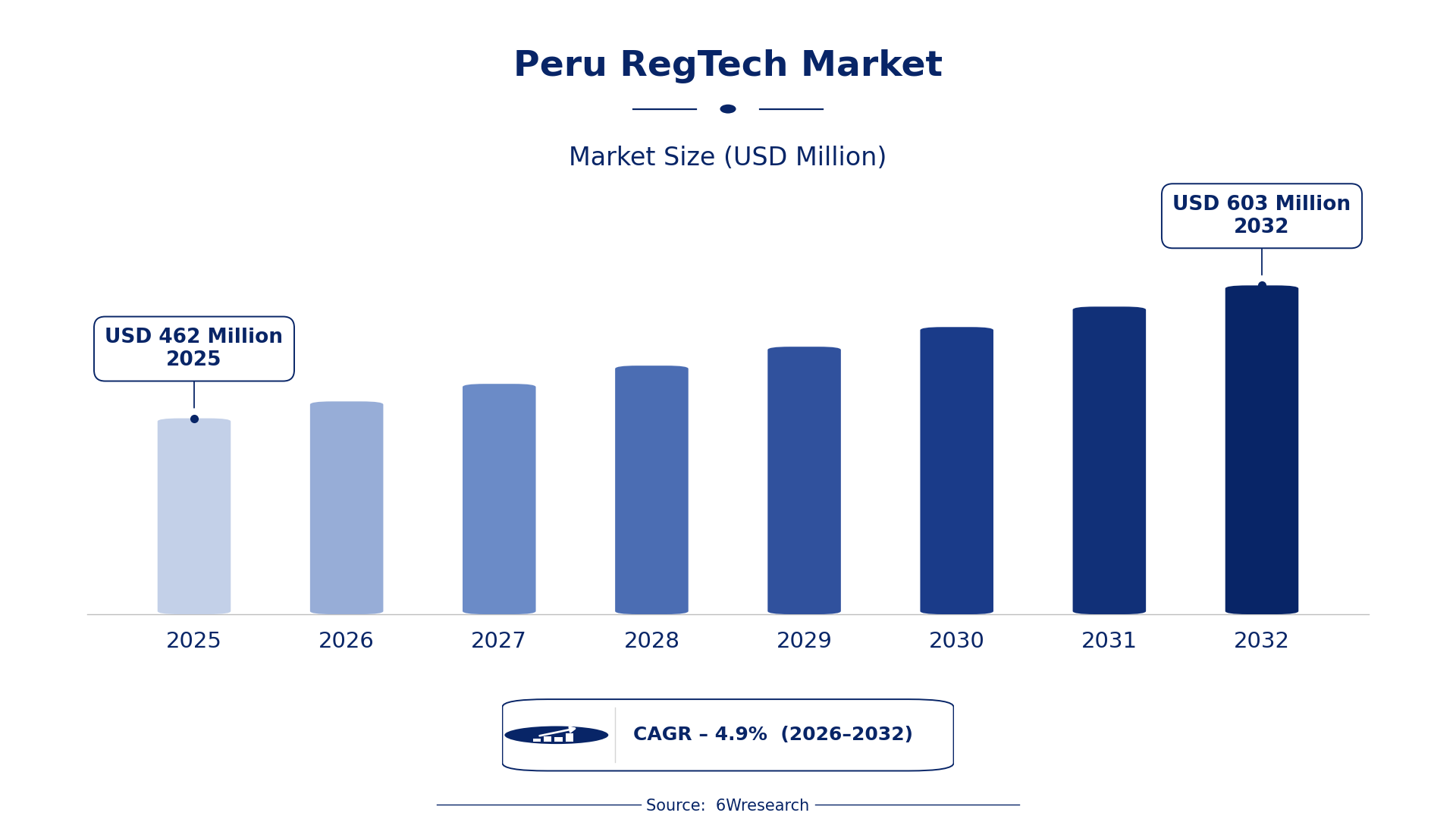
The Peru RegTech Market was estimated at USD 462 Million in 2025 and is projected to reach USD 603 Million by 2032, growing at a CAGR of 4.9% from 2026 to 2032.
Peru RegTech Market Synopsis
The increasing complexity of regulatory frameworks in Peru is pushing financial institutions to adopt RegTech solutions. These technologies not only streamline compliance but also enhance operational efficiency, making them essential for businesses navigating the regulatory environment.
As Peruvian financial institutions face mounting pressures to comply with evolving regulations, the demand for advanced technology solutions is skyrocketing. The integration of artificial intelligence and machine learning into RegTech is particularly noteworthy, as these technologies are transforming how organizations approach risk management and compliance.
Peru RegTech Market Year-wise Growth Rate and Key Drivers
This graph illustrates the annual growth rates of the Peru RegTech Market from 2021 to 2032, highlighting a steady upward trajectory and projected expansion over the forecast period.
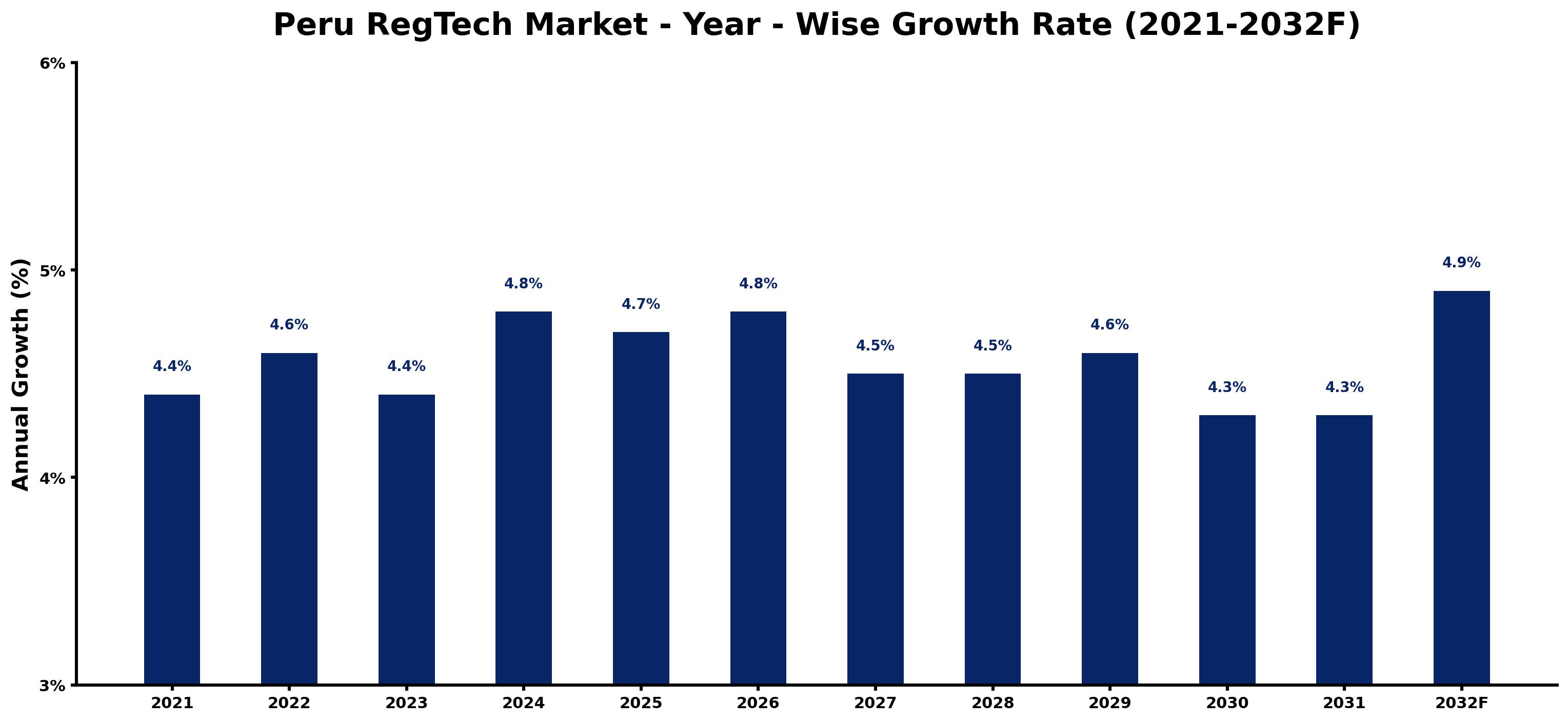
The table below presents the year‑wise growth rates along with the key drivers influencing the market
| Year | Growth Rate | Major Drivers |
| 2021 | 4.4% | Regulatory push for digital financial services adoption. |
| 2022 | 4.6% | Increased enforcement of AML compliance by ASBANC. |
| 2023 | 4.4% | Growth in fintech startups driving regulatory technology need. |
| 2024 | 4.8% | Implementation of new data protection regulations by INDECOPI. |
| 2025 | 4.7% | Demand for automated compliance solutions rises in banks. |
| 2026 | 4.8% | Collaboration between fintechs and regulatory bodies enhances innovation. |
| 2027 | 4.5% | Boost in digital identity verification requirements for businesses. |
| 2028 | 4.5% | Rising focus on consumer protection regulations in finance. |
| 2029 | 4.6% | Government incentives for digital transformation of banks. |
| 2030 | 4.3% | Strong emphasis on KYC process efficiencies in transactions. |
| 2031 | 4.3% | Surge in investment for cybersecurity measures mandates. |
| 2032 | 4.9% | Support for RegTech startups from PERU's tech incubators. |
Note: Market size estimations and growth projections presented in this report are based on 6Wresearch's proprietary forecasting methodology, utilizing the latest available industry data, government publications, and primary research inputs.
Peru RegTech Market Key Takeaways
Below are some of the specific key takeaways from the market, including:
- RegTech adoption is primarily driven by increasing regulatory requirements in the financial sector.
- AI and machine learning are becoming crucial for enhancing compliance and risk management processes.
- Data security and AML compliance are top priorities for financial institutions utilizing RegTech solutions.
- Collaboration between RegTech providers and financial institutions is on the rise, promoting innovation.
- Small and medium-sized enterprises (SMEs) show limited awareness of available RegTech solutions.
Evaluation of Restraints in Peru RegTech Market
The Peru RegTech market faces several restraints that hinder its potential growth. Regulatory complexity is a major challenge, as frequent changes in compliance requirements can overwhelm businesses, particularly smaller ones. Limited awareness among SMEs about the advantages of RegTech solutions poses another significant barrier. Additionally, concerns regarding data privacy and a general reluctance from traditional financial institutions to adopt new technologies further impede progress. These factors create a challenging environment that demands focused efforts to educate stakeholders and foster collaboration.
Peru RegTech Market Trends
The RegTech market in Peru is witnessing several trends that are shaping its trajectory. The adoption of AI and machine learning for regulatory reporting is gaining momentum, enabling real-time monitoring and analysis. Cybersecurity has become a focal point, with businesses prioritizing data privacy compliance as they implement technology solutions. on top of that, the rise of fintech companies is catalyzing innovation, leading to the development of specialized RegTech solutions that cater to unique regulatory challenges.
Peru RegTech Market Opportunities
Significant growth opportunities exist within the Peru RegTech market. As organizations seek to enhance compliance processes and risk management, there is a clear demand for tailored RegTech solutions that address the specific needs of the Peruvian regulatory environment. Addressing AML requirements and digital identity verification are two areas ripe for development. on top of that, the increasing collaboration between technology providers and financial institutions presents avenues for innovative partnerships that can drive market expansion.
Government Initiatives in the Peru RegTech Market
Government policy in Peru is increasingly supporting the RegTech market, emphasizing the importance of technological solutions for regulatory compliance. The Superintendencia del Mercado de Valores (SMV) is actively working on regulations that encourage financial institutions to utilize technology for monitoring and reporting suspicious activities. This proactive stance aims to foster collaboration between regulators and technology providers, creating a more secure and efficient financial system.
- A regulatory framework introduced in 2025 mandating technology-driven solutions for compliance reporting.
- Current initiatives focus on enhancing cooperation between financial institutions and RegTech providers to streamline compliance processes.
- Ongoing programs are aimed at raising awareness among SMEs about the benefits of adopting RegTech solutions.
- Planned public-private partnerships expected to bolster financial crime prevention efforts by 2026.
Future Insights of the Peru RegTech Market
The future of the Peru RegTech market looks promising, with an increasing emphasis on regulatory compliance driving demand for innovative solutions. As financial institutions continue to face stricter regulations, the necessity for efficient compliance processes will only grow. Digital transformation initiatives across various sectors will likely accelerate the adoption of advanced RegTech solutions, particularly those focused on data security and privacy. As key players invest in developing targeted solutions, the market will evolve to meet specific compliance challenges, paving the way for sustained growth through 2032.
Peru RegTech Market Latest Developments
Recent activity in the Peru RegTech market has been dynamic, reflecting the urgent need for compliance solutions amid evolving regulatory frameworks. Financial institutions are increasingly looking to technology providers to enhance their compliance capabilities, leading to a flurry of developments in the sector.
- A major technology vendor launched an AI-driven compliance monitoring tool in Q2 2025, designed to streamline reporting processes for financial institutions.
- An initiative that began in early 2025 focuses on integrating blockchain technology to enhance transparency in regulatory reporting.
- Current collaborations between RegTech firms and banks are underway, aimed at developing customized solutions for AML compliance.
- A rollout of a new cybersecurity framework is planned for the latter half of 2026, targeting improved data protection measures for financial entities.
Peru RegTech Market - Key Attractiveness of the Report
- 10 Years of Market Numbers
- Historical Data Starting from 2022 to 2025
- Base Year: 2025
- Forecast Data until 2032
- Key Performance Indicators Impacting the Market
- Major Upcoming Developments and Projects
Key Highlights of the Report:
- Peru RegTech Market Outlook
- Market Size of Peru RegTech Market, 2025
- Forecast of Peru RegTech Market, 2032
- Historical Data and Forecast of Peru RegTech Revenues & Volume for the Period 2022-2032F
- Peru RegTech Market Trend Evolution
- Peru RegTech Market Drivers and Challenges
- Peru RegTech Price Trends
- Peru RegTech Porter's Five Forces
- Peru RegTech Industry Life Cycle
- Historical Data and Forecast of Peru RegTech Market Revenues & Volume By Component for the Period 2022-2032F
- Historical Data and Forecast of Peru RegTech Market Revenues & Volume By Solutions for the Period 2022-2032F
- Historical Data and Forecast of Peru RegTech Market Revenues & Volume By Services for the Period 2022-2032F
- Historical Data and Forecast of Peru RegTech Market Revenues & Volume By Application for the Period 2022-2032F
- Historical Data and Forecast of Peru RegTech Market Revenues & Volume By Risk & Compliance Management for the Period 2022-2032F
- Historical Data and Forecast of Peru RegTech Market Revenues & Volume By Identity Management for the Period 2022-2032F
- Historical Data and Forecast of Peru RegTech Market Revenues & Volume By Regulatory Reporting for the Period 2022-2032F
- Historical Data and Forecast of Peru RegTech Market Revenues & Volume By AML and Fraud Management for the Period 2022-2032F
- Historical Data and Forecast of Peru RegTech Market Revenues & Volume By Regulatory Intelligence for the Period 2022-2032F
- Historical Data and Forecast of Peru RegTech Market Revenues & Volume By Organization Size for the Period 2022-2032F
- Historical Data and Forecast of Peru RegTech Market Revenues & Volume By SMEs for the Period 2022-2032F
- Historical Data and Forecast of Peru RegTech Market Revenues & Volume By Large Enterprises for the Period 2022-2032F
- Historical Data and Forecast of Peru RegTech Market Revenues & Volume By Deployment Mode for the Period 2022-2032F
- Historical Data and Forecast of Peru RegTech Market Revenues & Volume By On-Premises for the Period 2022-2032F
- Historical Data and Forecast of Peru RegTech Market Revenues & Volume By Cloud for the Period 2022-2032F
- Historical Data and Forecast of Peru RegTech Market Revenues & Volume By Vertical for the Period 2022-2032F
- Historical Data and Forecast of Peru RegTech Market Revenues & Volume By Banking for the Period 2022-2032F
- Historical Data and Forecast of Peru RegTech Market Revenues & Volume By Insurance for the Period 2022-2032F
- Historical Data and Forecast of Peru RegTech Market Revenues & Volume By Non-Financial for the Period 2022-2032F
- Peru RegTech Import Export Trade Statistics
- Market Opportunity Assessment By Component
- Market Opportunity Assessment By Application
- Market Opportunity Assessment By Organization Size
- Market Opportunity Assessment By Deployment Mode
- Market Opportunity Assessment By Vertical
- Peru RegTech Top Companies Market Share
- Peru RegTech Competitive Benchmarking By Technical and Operational Parameters
- Peru RegTech Company Profiles
- Peru RegTech Key Strategic Recommendations






































