Qatar Retail And Wholesale Market Size, Share & Growth Rate
The Qatar Retail And Wholesale Market was estimated at USD 620 Million in 2025 and is projected to reach USD 1147 Million by 2032, growing at a CAGR of 9.2% from 2026 to 2032. This robust growth is driven by a combination of high consumer spending, an increasing population, and ongoing strategic investments in retail infrastructure. The ongoing digital transformation and shifts towards e-commerce are also pivotal, reflecting a more tech-savvy consumer base keen on exploring diverse shopping channels.
Qatar Retail And Wholesale Market Year-wise Growth Rate and Key Drivers
This graph highlights how the Qatar Retail And Wholesale Market has steadily grown over the years, supported by major growth factors.
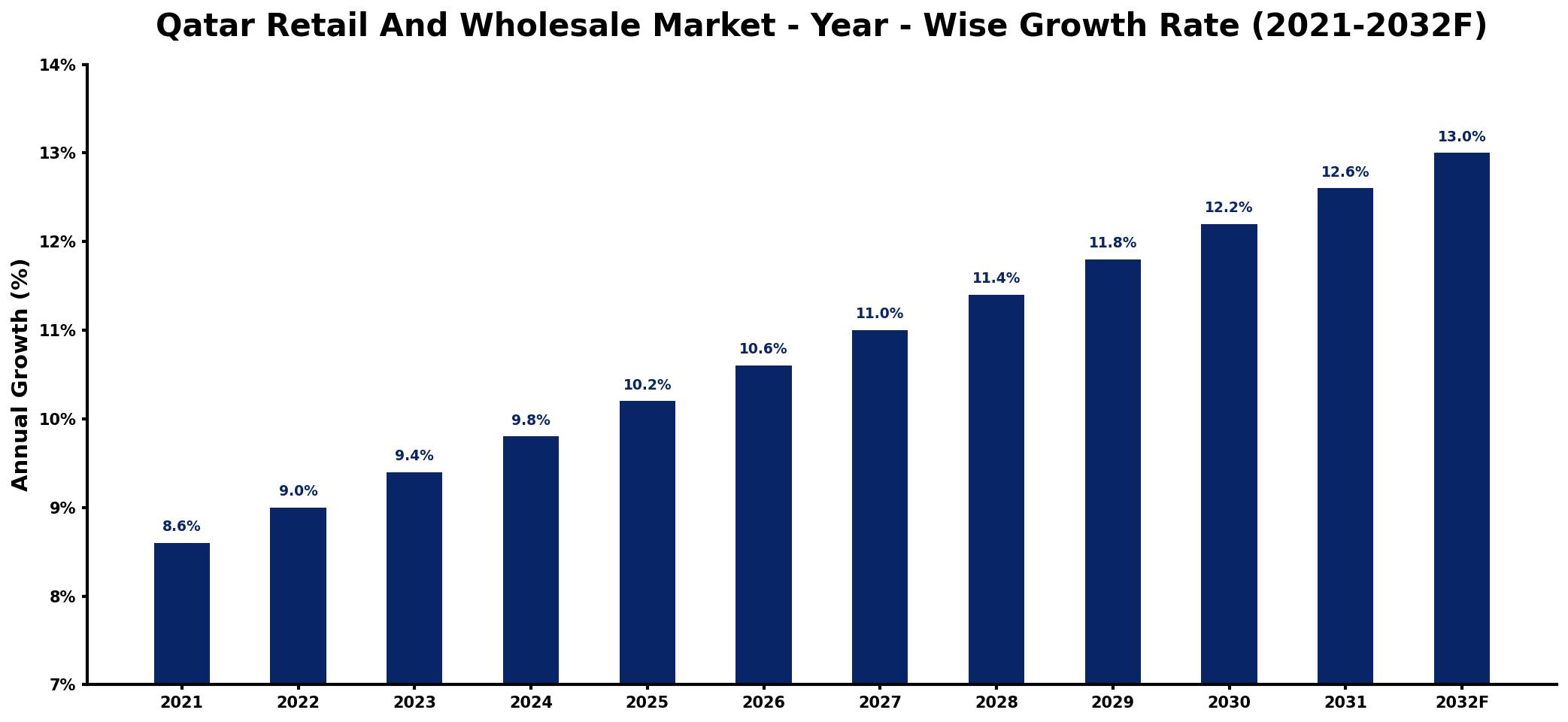
The table below presents the year‑wise growth rates along with the key drivers influencing the market
| Year | Growth Rate | Major Drivers |
| 2021 | 8.6% | E-commerce adoption accelerated growth |
| 2022 | 9.0% | Consumer spending increased significantly |
| 2023 | 9.4% | Tourism rebound drives sales |
| 2024 | 9.8% | New shopping centers opening nationwide |
| 2025 | 10.2% | Technological innovations enhancing experience |
| 2026 | 10.6% | Sustainable practices gaining popularity |
| 2027 | 11.0% | Expansion of local brands occurs |
| 2028 | 11.4% | Digital payment solutions expanding rapidly |
| 2029 | 11.8% | Increased foreign investment influx |
| 2030 | 12.2% | Growing population boosts demand |
| 2031 | 12.6% | Enhanced logistics networks improving supply |
| 2032 | 13.0% | Rising disposable income encourages spending |
Note: Market size estimations and growth projections presented in this report are based on 6Wresearch's proprietary forecasting methodology, utilizing the latest available industry data, government publications, and primary research inputs.
Qatar Retail And Wholesale Market Synopsis
The Qatar retail and wholesale market has displayed significant momentum, buoyed by strong consumer demand for both luxury and everyday goods. This dynamic landscape is evolving, with increasing emphasis on online shopping and sustainability, which are reshaping traditional retail paradigms.
As Qatar forges ahead, the market is set to benefit from ongoing diversification efforts, creating a vibrant entrepreneurial ecosystem. This evolving environment presents challenges but also opportunities for retailers and wholesalers willing to adapt to shifting consumer preferences.
Qatar Retail And Wholesale Market Key Takeaways
- The market is projected to grow significantly, reaching USD 1147 Million by 2032.
- High per capita income and a thriving consumer base drive demand for luxury and international brands.
- E-commerce is rapidly gaining ground, transforming the retail landscape in Qatar.
- Strategic investments in infrastructure are enhancing the shopping experience across the country.
- Entrepreneurial innovation is emerging as a key driver in the market's evolution.
Evaluation of Restraints in Qatar Retail And Wholesale Market
Despite the promising outlook, the Qatar retail and wholesale market faces certain restraints that could limit growth. Adaptation to rapidly changing consumer preferences, especially towards e-commerce, requires significant investments in technology and logistics. Intense competition from international retailers necessitates a constant need for differentiation and innovation in product offerings. Moreover, the challenge of maintaining profitability while balancing competitive pricing strategies continues to be a critical concern for local businesses.
Qatar Retail And Wholesale Market Trends
Several trends are currently shaping the Qatar retail and wholesale market. A notable shift towards digitalization has prompted businesses to enhance their online presence and integrate technology into the shopping experience. Sustainability is also becoming a key focus, with consumers increasingly favoring brands that prioritize eco-friendly practices. Furthermore, personalized shopping experiences are gaining traction, as retailers leverage data analytics to cater to individual preferences, enhancing customer satisfaction and loyalty.
Qatar Retail And Wholesale Market Opportunities
The Qatar retail and wholesale market presents numerous growth opportunities for both local and international players. Expanding e-commerce capabilities, particularly in logistics and delivery services, offers a pathway for reaching a broader consumer base. Additionally, the increasing inclination towards sustainable products opens avenues for brands to innovate and differentiate themselves. Enhanced marketing strategies that focus on personalized consumer engagement can also drive significant growth in this competitive environment.
Government Initiatives in the Qatar Retail And Wholesale Market
The Qatari government has been proactive in fostering a conducive environment for retail and wholesale growth. Initiatives aimed at boosting infrastructure development and enhancing the overall ease of doing business play a crucial role. Programs that support local entrepreneurship and investments in technology are also pivotal in promoting innovation within the retail sector. The governments commitment to diversifying the economy further supports the sustainability of the retail and wholesale market.
Future Insights of the Qatar Retail And Wholesale Market
Looking towards 2026-2032, the Qatar retail and wholesale market is poised for significant transformation. Continued investment in technology and infrastructure will likely propel growth, with digitalization set to redefine the consumer experience. As the economy diversifies beyond hydrocarbons, the market will attract new entrants and innovations. Enhanced consumer engagement through personalized experiences will become a cornerstone of competitive strategy, ensuring the market remains vibrant and responsive to evolving needs.
Qatar Retail And Wholesale Market Latest Developments (2025 - 2026)
In recent months, the retail landscape in Qatar has witnessed notable shifts, driven by increased digital adoption and evolving consumer preferences. Traditional retailers are increasingly integrating online platforms into their strategies, enhancing customer accessibility and engagement. Simultaneously, the growth of sustainable brands and initiatives has caught consumer attention, reflecting a shift towards responsible shopping practices. These developments signal an exciting phase of adaptation and growth for the retail and wholesale market.
Qatar Retail And Wholesale Market - Key Attractiveness of the Report
- 10 Years of Market Numbers
- Historical Data Starting from 2022 to 2025
- Base Year: 2025
- Forecast Data until 2032
- Key Performance Indicators Impacting the Market
- Major Upcoming Developments and Projects
Key Highlights of the Report:
- Qatar Retail And Wholesale Market Outlook
- Market Size of Qatar Retail And Wholesale Market, 2025
- Forecast of Qatar Retail And Wholesale Market, 2032
- Historical Data and Forecast of Qatar Retail And Wholesale Revenues & Volume for the Period 2022-2032F
- Qatar Retail And Wholesale Market Trend Evolution
- Qatar Retail And Wholesale Market Drivers and Challenges
- Qatar Retail And Wholesale Price Trends
- Qatar Retail And Wholesale Porter's Five Forces
- Qatar Retail And Wholesale Industry Life Cycle
- Historical Data and Forecast of Qatar Retail And Wholesale Market Revenues & Volume By Type for the Period 2022-2032F
- Historical Data and Forecast of Qatar Retail And Wholesale Market Revenues & Volume By Retail for the Period 2022-2032F
- Historical Data and Forecast of Qatar Retail And Wholesale Market Revenues & Volume By Wholesale for the Period 2022-2032F
- Historical Data and Forecast of Qatar Retail And Wholesale Market Revenues & Volume By Ownership for the Period 2022-2032F
- Historical Data and Forecast of Qatar Retail And Wholesale Market Revenues & Volume By Retail Chain/Wholesale Chain for the Period 2022-2032F
- Historical Data and Forecast of Qatar Retail And Wholesale Market Revenues & Volume By Independent Retailer/Independent Wholesalers for the Period 2022-2032F
- Historical Data and Forecast of Qatar Retail And Wholesale Market Revenues & Volume By Price Range for the Period 2022-2032F
- Historical Data and Forecast of Qatar Retail And Wholesale Market Revenues & Volume By Premium for the Period 2022-2032F
- Historical Data and Forecast of Qatar Retail And Wholesale Market Revenues & Volume By Mid-Range for the Period 2022-2032F
- Historical Data and Forecast of Qatar Retail And Wholesale Market Revenues & Volume By Economy for the Period 2022-2032F
- Historical Data and Forecast of Qatar Retail And Wholesale Market Revenues & Volume By Distribution Channel for the Period 2022-2032F
- Historical Data and Forecast of Qatar Retail And Wholesale Market Revenues & Volume By Supermarkets/Hypermarkets for the Period 2022-2032F
- Historical Data and Forecast of Qatar Retail And Wholesale Market Revenues & Volume By Convenience Stores for the Period 2022-2032F
- Historical Data and Forecast of Qatar Retail And Wholesale Market Revenues & Volume By Department Stores for the Period 2022-2032F
- Historical Data and Forecast of Qatar Retail And Wholesale Market Revenues & Volume By Specialty Stores for the Period 2022-2032F
- Qatar Retail And Wholesale Import Export Trade Statistics
- Market Opportunity Assessment By Type
- Market Opportunity Assessment By Ownership
- Market Opportunity Assessment By Price Range
- Market Opportunity Assessment By Distribution Channel
- Qatar Retail And Wholesale Top Companies Market Share
- Qatar Retail And Wholesale Competitive Benchmarking By Technical and Operational Parameters
- Qatar Retail And Wholesale Company Profiles
- Qatar Retail And Wholesale Key Strategic Recommendations






































