Qatar Retail Industry Market Size, Share & Growth Rate
The Qatar Retail Industry Market was estimated at USD 390 Million in 2025 and is projected to reach USD 496 Million by 2032, growing at a CAGR of 3.5% from 2026 to 2032. This robust growth trajectory is primarily driven by the rising disposable incomes and an influx of both tourists and expatriates, which is significantly reshaping consumer spending patterns. Furthermore, the burgeoning number of shopping malls and luxury retail offerings are expected to cater to the evolving tastes of the Qatari populace.
Qatar Retail Industry Market Year-wise Growth Rate and Key Drivers
This graph highlights how the Qatar Retail Industry Market has steadily grown over the years, supported by major growth factors.
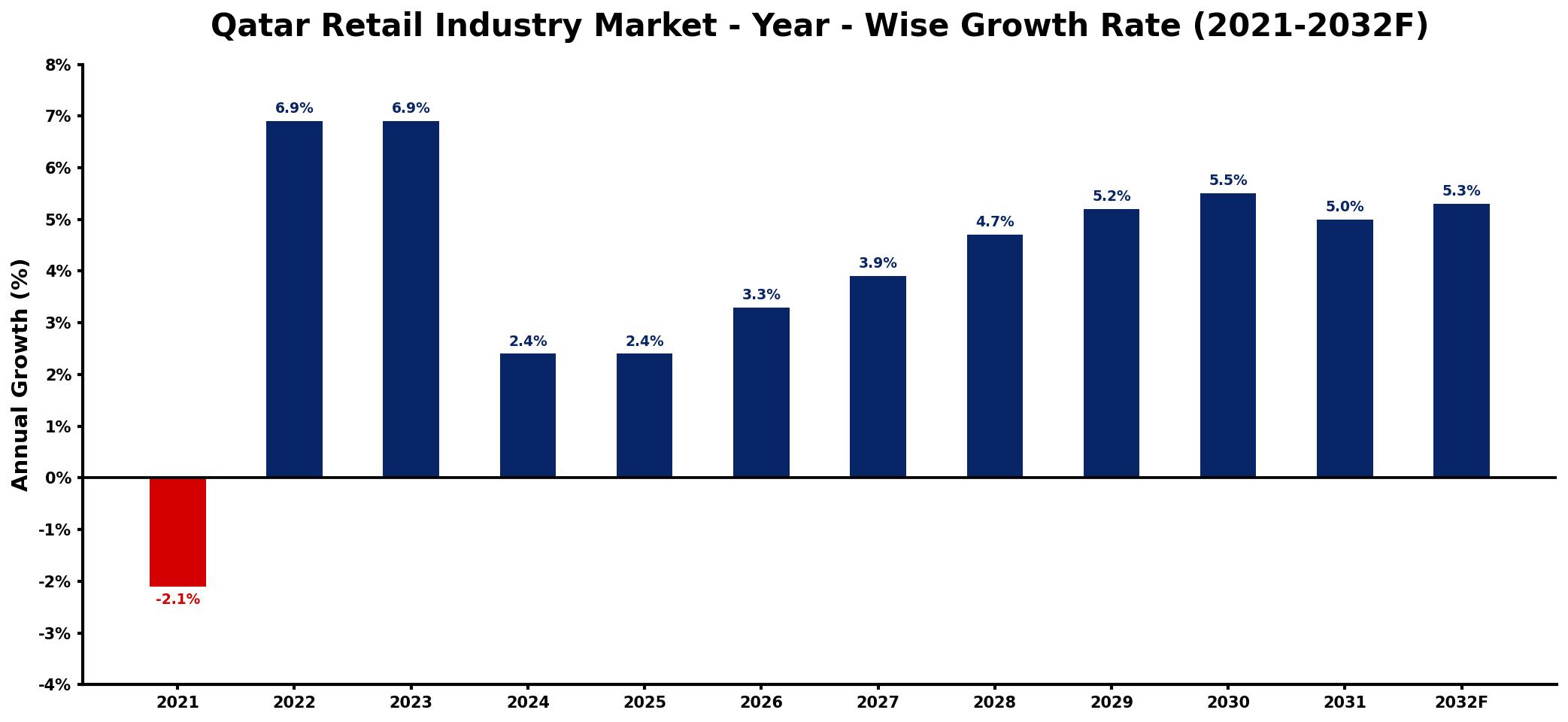
The table below presents the year‑wise growth rates along with the key drivers influencing the market
| Year | Growth Rate | Major Drivers |
| 2021 | -2.1% | decreased consumer spending patterns |
| 2022 | 6.9% | rising disposable income levels |
| 2023 | 6.9% | increased tourism and visitors |
| 2024 | 2.4% | expansion of shopping centers |
| 2025 | 2.4% | growth in online shopping platforms |
| 2026 | 3.3% | enhanced supply chain efficiencies |
| 2027 | 3.9% | increased production capacity utilization |
| 2028 | 4.7% | development of luxury offerings |
| 2029 | 5.2% | greater focus on sustainability |
| 2030 | 5.5% | technological advancements in logistics |
| 2031 | 5.0% | increased overall sector activity |
| 2032 | 5.3% | rising consumer confidence indices |
Note: Market size estimations and growth projections presented in this report are based on 6Wresearch's proprietary forecasting methodology, utilizing the latest available industry data, government publications, and primary research inputs.
Qatar Retail Industry Market Synopsis
Qatar's retail landscape is characterized by an increasing demand for luxury and high-end products, aligning with the nation's economic prosperity. The combination of a growing population and a cultural affinity for shopping has established the retail sector as a cornerstone of the local economy, attracting international brands seeking to capitalize on the expanding market.
Additionally, the rapid digitalization of retail is reshaping how businesses engage with consumers. The integration of online platforms with traditional retail practices allows companies to offer personalized shopping experiences, reflecting the modern preferences of Qatari consumers, who are increasingly inclined towards e-commerce solutions.
Qatar Retail Industry Market Key Takeaways
- Qatar's retail market is experiencing significant growth due to rising disposable incomes and an influx of expatriates.
- The luxury segment is particularly strong, with a growing demand for high-end retail experiences.
- Digital transformation is influencing consumer behavior, encouraging retailers to adapt to online platforms.
- Government initiatives to boost tourism directly benefit the retail sector, enhancing market dynamics.
- Supply chain challenges and evolving consumer preferences are pivotal factors shaping the future landscape.
Evaluation of Restraints in Qatar Retail Industry Market
Despite its vibrant growth, the Qatar retail industry faces certain restraints that could hinder its potential. Increasing competition among both traditional brick-and-mortar retailers and online platforms creates pricing pressures that may impact profit margins. Additionally, the after-effects of the COVID-19 pandemic have led to lasting changes in shopping habits, necessitating a swift adaptation by businesses. Supply chain disruptions and global economic uncertainties also present challenges in maintaining product availability, affecting demand dynamics in the market. Moreover, changing consumer preferences toward sustainability require retailers to reassess their product assortments and operational practices.
Qatar Retail Industry Market Trends
Several key trends are shaping the Qatar retail industry. The increasing reliance on e-commerce and digital platforms has become a defining characteristic, driven by consumer demand for convenience and diverse shopping experiences. Furthermore, sustainability is rising in importance, with consumers favoring brands that emphasize eco-friendly practices. The integration of technological advancements, such as augmented reality and mobile payment solutions, is also enhancing the shopping experience, fostering deeper connections between consumers and retailers. Lastly, as the retail landscape diversifies, there is a noticeable shift toward experiential shopping, focusing on creating memorable experiences for customers.
Qatar Retail Industry Market Opportunities
The opportunities within the Qatar retail market are abundant, especially for brands that adapt to local preferences. The growing population and increasing disposable income present avenues for investment in diverse retail formats, including luxury outlets and experiential shopping centers. Additionally, the ongoing development of tourist attractions and governmental support for the tourism sector creates a promising environment for retailers to cater to both locals and visitors. Companies that harness technological innovations to enhance customer engagement will find significant growth potential in this evolving market.
Government Initiatives in the Qatar Retail Industry Market
The Qatari government plays a crucial role in shaping the retail landscape through various initiatives aimed at boosting investment and tourism. Policies promoting foreign direct investment in the retail sector are designed to attract international brands, enhancing the diversity of offerings available to consumers. Furthermore, ongoing public spending on infrastructure development, including transport and logistics, aims to facilitate smoother operations for retailers. These efforts collectively contribute to a conducive business environment that supports sustained growth in the retail industry.
Future Insights of the Qatar Retail Industry Market
Looking ahead to 2026-2032, the Qatar retail industry is positioned for continued expansion. The anticipated increase in consumer spending, bolstered by a stable economy, will further amplify market growth. As digitalization continues to permeate the retail sector, businesses that invest in technology and innovation will likely gain a competitive edge. The trend toward sustainable practices is also expected to strengthen, with more retailers aligning their operations with eco-conscious consumer values. Overall, the outlook for Qatar's retail market is optimistic, with promising opportunities on the horizon.
Qatar Retail Industry Market Latest Developments (2025 - 2026)
Recent developments in the Qatar retail sector indicate a strong recovery post-COVID-19, with many retailers enhancing their online presence to meet changing consumer preferences. Major shopping malls are revitalizing their strategies to attract foot traffic through unique events and experiences. The introduction of new luxury brands and products continues to reshape the retail environment, indicating a robust response to the evolving market dynamics. Additionally, sustainability initiatives are gaining traction as retailers adopt eco-friendly practices in their operations.
Qatar Retail Industry Market - Key Attractiveness of the Report
- 10 Years of Market Numbers
- Historical Data Starting from 2022 to 2025
- Base Year: 2025
- Forecast Data until 2032
- Key Performance Indicators Impacting the Market
- Major Upcoming Developments and Projects
Key Highlights of the Report:
- Qatar Retail Industry Market Outlook
- Market Size of Qatar Retail Industry Market, 2025
- Forecast of Qatar Retail Industry Market, 2032
- Historical Data and Forecast of Qatar Retail Industry Revenues & Volume for the Period 2022-2032F
- Qatar Retail Industry Market Trend Evolution
- Qatar Retail Industry Market Drivers and Challenges
- Qatar Retail Industry Price Trends
- Qatar Retail Industry Porter's Five Forces
- Qatar Retail Industry Industry Life Cycle
- Historical Data and Forecast of Qatar Retail Industry Market Revenues & Volume By Product for the Period 2022-2032F
- Historical Data and Forecast of Qatar Retail Industry Market Revenues & Volume By Food and Beverages for the Period 2022-2032F
- Historical Data and Forecast of Qatar Retail Industry Market Revenues & Volume By Personal and Household Care for the Period 2022-2032F
- Historical Data and Forecast of Qatar Retail Industry Market Revenues & Volume By Apparel, Footwear, and Accessories for the Period 2022-2032F
- Historical Data and Forecast of Qatar Retail Industry Market Revenues & Volume By Furniture, Toys, and Hobby for the Period 2022-2032F
- Historical Data and Forecast of Qatar Retail Industry Market Revenues & Volume By Electronic and Household Appliances for the Period 2022-2032F
- Historical Data and Forecast of Qatar Retail Industry Market Revenues & Volume By Other Products for the Period 2022-2032F
- Historical Data and Forecast of Qatar Retail Industry Market Revenues & Volume By Distribution Channel for the Period 2022-2032F
- Historical Data and Forecast of Qatar Retail Industry Market Revenues & Volume By Supermarkets/Hypermarkets for the Period 2022-2032F
- Historical Data and Forecast of Qatar Retail Industry Market Revenues & Volume By Convenience Stores for the Period 2022-2032F
- Historical Data and Forecast of Qatar Retail Industry Market Revenues & Volume By Department Stores for the Period 2022-2032F
- Historical Data and Forecast of Qatar Retail Industry Market Revenues & Volume By Specialty Stores for the Period 2022-2032F
- Historical Data and Forecast of Qatar Retail Industry Market Revenues & Volume By Online for the Period 2022-2032F
- Historical Data and Forecast of Qatar Retail Industry Market Revenues & Volume By Other Distribution Channels for the Period 2022-2032F
- Qatar Retail Industry Import Export Trade Statistics
- Market Opportunity Assessment By Product
- Market Opportunity Assessment By Distribution Channel
- Qatar Retail Industry Top Companies Market Share
- Qatar Retail Industry Competitive Benchmarking By Technical and Operational Parameters
- Qatar Retail Industry Company Profiles
- Qatar Retail Industry Key Strategic Recommendations






































