United States (US) Retail Industry Market Size, Share & Growth Rate
The United States (US) Retail Industry Market was estimated at USD 199 Million in 2025 and is projected to reach USD 271 Million by 2032, growing at a CAGR of 4.5% from 2026 to 2032. This growth trajectory is largely driven by the increasing consumer inclination towards online shopping, alongside the evolution of omnichannel strategies that enhance customer engagement. Furthermore, the focus on sustainability and personalized shopping experiences is reshaping retail dynamics, ensuring that the market remains robust and adaptive.
United States (US) Retail Industry Market Year-wise Growth Rate and Key Drivers
This graph highlights how the United States (US) Retail Industry Market has steadily grown over the years, supported by major growth factors.
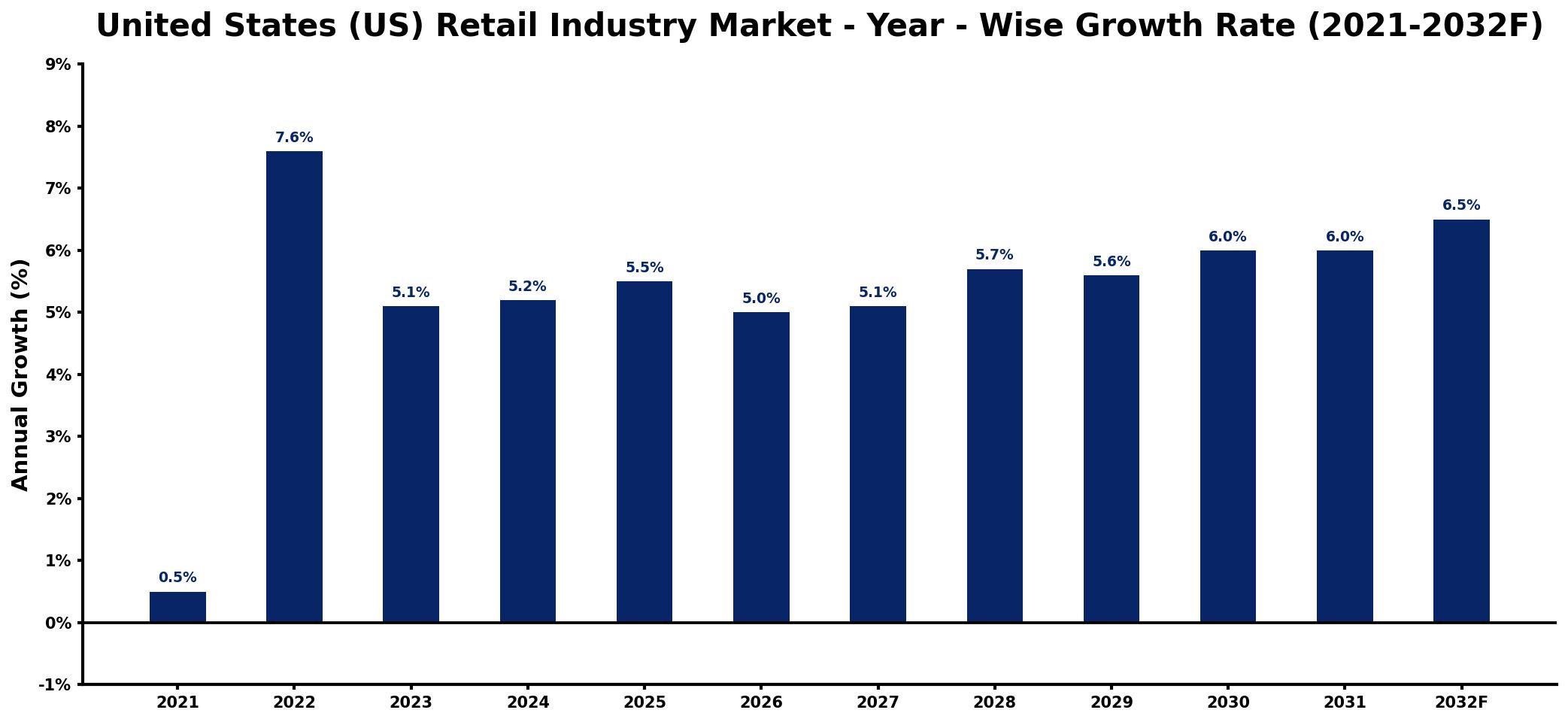
The table below presents the year‑wise growth rates along with the key drivers influencing the market
| Year | Growth Rate | Major Drivers |
| 2021 | 0.5% | E-commerce adoption accelerates significantly |
| 2022 | 7.6% | Consumer spending rebounds strongly |
| 2023 | 5.1% | Technology investments enhance efficiency |
| 2024 | 5.2% | Sustainability initiatives gain traction |
| 2025 | 5.5% | Personalized shopping experiences flourish |
| 2026 | 5.0% | Omnichannel strategies become essential |
| 2027 | 5.1% | Mobile commerce experiences rapid growth |
| 2028 | 5.7% | Supply chain optimization improves delivery |
| 2029 | 5.6% | Health and wellness trends expand |
| 2030 | 6.0% | Digital payment solutions advance rapidly |
| 2031 | 6.0% | Subscription services attract new customers |
| 2032 | 6.5% | Innovative marketing strategies engage consumers |
Note: Market size estimations and growth projections presented in this report are based on 6Wresearch's proprietary forecasting methodology, utilizing the latest available industry data, government publications, and primary research inputs.
United States (US) Retail Industry Market Synopsis
The strongest force currently shaping the United States Retail Industry Market is the significant shift towards e-commerce. As consumers increasingly seek convenience, retailers are investing heavily in digital platforms and improving their online shopping interfaces to cater to this demand. This transition is complemented by a growing emphasis on omnichannel retailing, merging the online and offline shopping experiences.
In addition to digital advancements, sustainability practices are becoming integral to retail strategies. Consumers are now demanding transparency regarding product sourcing and eco-friendliness. As a result, many retailers are reformulating their offerings and practices to align with these values, marking a notable shift in consumer-retailer dynamics within the market.
United States (US) Retail Industry Market Key Takeaways
- The retail landscape is being transformed by the rapid growth of e-commerce, compelling retailers to adopt omnichannel approaches.
- Sustainability and ethical sourcing are increasingly prioritized by consumers, driving demand for eco-friendly products.
- Personalized shopping experiences facilitated by AI and data analytics are enhancing customer loyalty and satisfaction.
- Investment opportunities are emerging in niche markets focused on sustainable consumer goods and experiential retail.
- Government policies are shaping competition, supply chains, and operational practices within the retail sector.
Evaluation of Restraints in United States (US) Retail Industry Market
Despite its dynamic nature, the United States Retail Industry faces several constraints that can impede growth. One significant challenge is the fierce competition from e-commerce giants, which places pressure on traditional retailers to innovate and reduce costs. Additionally, rising operational expenses, particularly related to labor and rent, are forcing retailers to reconsider their pricing strategies. Furthermore, the ongoing impacts of the COVID-19 pandemic have altered consumer behaviors and caused supply chain disruptions, complicating inventory management and product availability.
United States (US) Retail Industry Market Trends
Several key trends are shaping the current landscape of the United States Retail Industry. The ongoing shift to e-commerce is undeniable, as consumers gravitate towards online shopping for convenience. This has prompted retailers to develop seamless omnichannel strategies, integrating in-store and online experiences. Additionally, sustainability has emerged as a significant focus, with consumers increasingly favoring brands that demonstrate environmental responsibility. Personalization through data analytics is on the rise, allowing retailers to tailor offerings to individual customer preferences. Lastly, experiential retail is gaining traction, with stores crafting unique shopping experiences that engage consumers beyond mere transactions.
United States (US) Retail Industry Market Opportunities
The United States Retail Industry presents numerous investment opportunities for savvy investors. The burgeoning e-commerce sector continues to thrive, offering potential in online retail platforms, logistics solutions, and technology innovations. Additionally, niche markets focusing on sustainable and ethical products are poised for growth, driven by shifting consumer preferences. Retailers that successfully integrate omnichannel strategies stand to benefit significantly, while those providing personalized experiences through customization are well-positioned to capture emerging market segments. Overall, the landscape is ripe for innovation and adaptation, offering diverse avenues for growth.
Government Initiatives in the United States (US) Retail Industry Market
Government policies play a pivotal role in shaping the United States Retail Industry. Regulations regarding employment practices, including minimum wage laws and consumer protection measures, significantly influence operational frameworks for retailers. Additionally, antitrust laws are enforced to ensure competitive practices and prevent monopolies, fostering a fair marketplace. Trade policies and tariffs further affect the cost structures within the industry, particularly for imported goods. Moreover, government initiatives promoting sustainability and environmental regulations encourage retailers to adopt responsible sourcing and operational practices.
Future Insights of the United States (US) Retail Industry Market
Looking ahead to 2026-2032, the United States Retail Industry is expected to continue its trajectory towards e-commerce dominance and omnichannel retailing. Consumer preferences for convenience, seamless shopping experiences, and personalized service will drive innovation across the sector. Technological advancements, particularly in AI and data analytics, will enhance both customer engagement and operational efficiencies, allowing retailers to meet evolving demands. Furthermore, as sustainability becomes a cornerstone of consumer choice, retailers that embrace eco-friendly practices will likely gain a competitive edge, solidifying their position in a rapidly changing market.
United States (US) Retail Industry Market Latest Developments (2025 - 2026)
Recent developments in the United States Retail Industry highlight a focus on enhancing customer experiences through technology. Retailers are increasingly deploying advanced analytics to better understand consumer behavior, thereby tailoring their offerings to meet specific demands. There is also a growing trend towards partnerships and collaborations aimed at creating innovative retail solutions, especially in sustainability efforts. As brick-and-mortar stores adapt to the rise of digital shopping, many are reimagining their in-store experiences to draw customers back while integrating online convenience.
United States (US) Retail Industry Market - Key Attractiveness of the Report
- 10 Years of Market Numbers
- Historical Data Starting from 2022 to 2025
- Base Year: 2025
- Forecast Data until 2032
- Key Performance Indicators Impacting the Market
- Major Upcoming Developments and Projects
Key Highlights of the Report:
- United States (US) Retail Industry Market Outlook
- Market Size of United States (US) Retail Industry Market, 2025
- Forecast of United States (US) Retail Industry Market, 2032
- Historical Data and Forecast of United States (US) Retail Industry Revenues & Volume for the Period 2022-2032F
- United States (US) Retail Industry Market Trend Evolution
- United States (US) Retail Industry Market Drivers and Challenges
- United States (US) Retail Industry Price Trends
- United States (US) Retail Industry Porter's Five Forces
- United States (US) Retail Industry Industry Life Cycle
- Historical Data and Forecast of United States (US) Retail Industry Market Revenues & Volume By Product for the Period 2022-2032F
- Historical Data and Forecast of United States (US) Retail Industry Market Revenues & Volume By Food and Beverages for the Period 2022-2032F
- Historical Data and Forecast of United States (US) Retail Industry Market Revenues & Volume By Personal and Household Care for the Period 2022-2032F
- Historical Data and Forecast of United States (US) Retail Industry Market Revenues & Volume By Apparel, Footwear, and Accessories for the Period 2022-2032F
- Historical Data and Forecast of United States (US) Retail Industry Market Revenues & Volume By Furniture, Toys, and Hobby for the Period 2022-2032F
- Historical Data and Forecast of United States (US) Retail Industry Market Revenues & Volume By Electronic and Household Appliances for the Period 2022-2032F
- Historical Data and Forecast of United States (US) Retail Industry Market Revenues & Volume By Other Products for the Period 2022-2032F
- Historical Data and Forecast of United States (US) Retail Industry Market Revenues & Volume By Distribution Channel for the Period 2022-2032F
- Historical Data and Forecast of United States (US) Retail Industry Market Revenues & Volume By Supermarkets/Hypermarkets for the Period 2022-2032F
- Historical Data and Forecast of United States (US) Retail Industry Market Revenues & Volume By Convenience Stores for the Period 2022-2032F
- Historical Data and Forecast of United States (US) Retail Industry Market Revenues & Volume By Department Stores for the Period 2022-2032F
- Historical Data and Forecast of United States (US) Retail Industry Market Revenues & Volume By Specialty Stores for the Period 2022-2032F
- Historical Data and Forecast of United States (US) Retail Industry Market Revenues & Volume By Online for the Period 2022-2032F
- Historical Data and Forecast of United States (US) Retail Industry Market Revenues & Volume By Other Distribution Channels for the Period 2022-2032F
- United States (US) Retail Industry Import Export Trade Statistics
- Market Opportunity Assessment By Product
- Market Opportunity Assessment By Distribution Channel
- United States (US) Retail Industry Top Companies Market Share
- United States (US) Retail Industry Competitive Benchmarking By Technical and Operational Parameters
- United States (US) Retail Industry Company Profiles
- United States (US) Retail Industry Key Strategic Recommendations






































