Qatar Rolling Mill Components and Ancillary Equipment Market Size, Share & Growth Rate
The Qatar Rolling Mill Components and Ancillary Equipment Market was estimated at USD 471 Million in 2025 and is projected to reach USD 641 Million by 2032, growing at a CAGR of 4.5% from 2026 to 2032. This upward trajectory is driven by Qatars ongoing commitment to infrastructural enhancement and its expanding manufacturing sector, which increasingly relies on efficient metalworking processes. The rising demand for high-quality steel products across various industries further solidifies this market's positive outlook.
Qatar Rolling Mill Components and Ancillary Equipment Market Year-wise Growth Rate and Key Drivers
This graph highlights how the Qatar Rolling Mill Components and Ancillary Equipment Market has steadily grown over the years, supported by major growth factors.
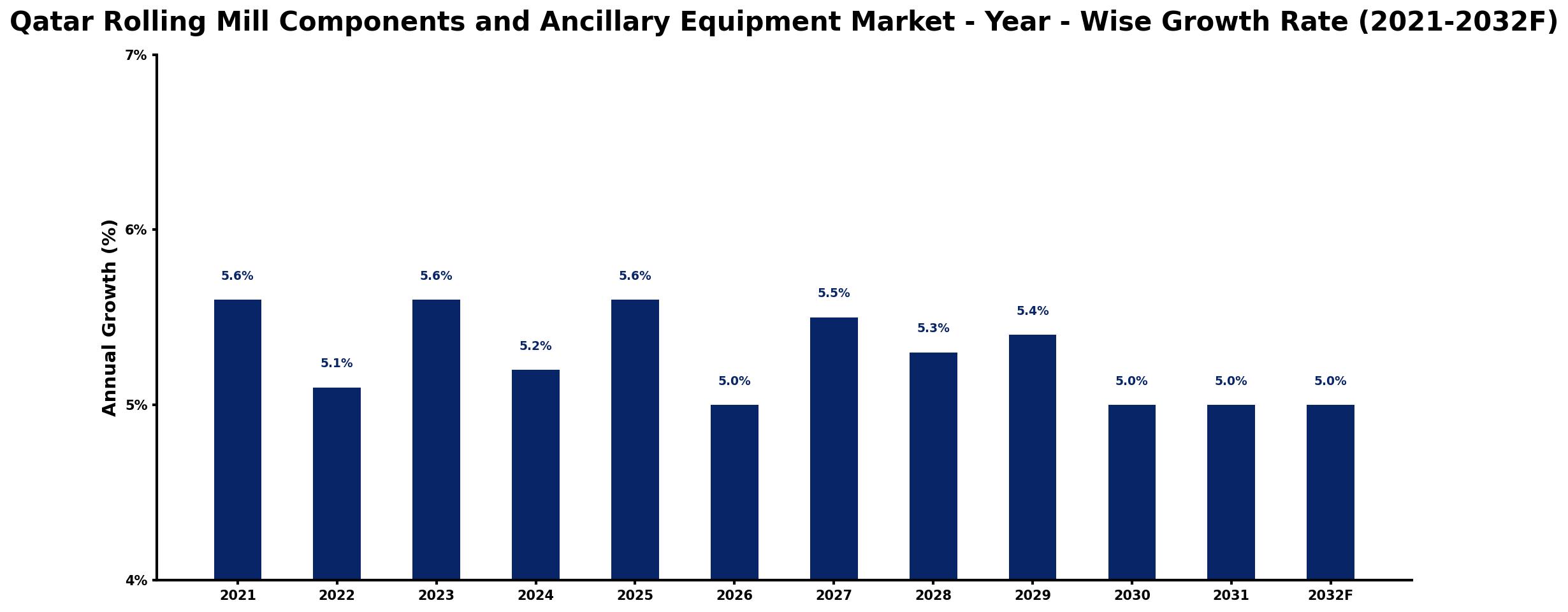
The table below presents the year‑wise growth rates along with the key drivers influencing the market
| Year | Growth Rate | Major Drivers |
| 2021 | 5.6% | Increased construction sector investments |
| 2022 | 5.1% | Rising demand for manufacturing capabilities |
| 2023 | 5.6% | Expansion of renewable energy projects |
| 2024 | 5.2% | Growth in automotive production facilities |
| 2025 | 5.6% | Surge in infrastructure development projects |
| 2026 | 5.0% | Higher adoption of automation technologies |
| 2027 | 5.5% | Increasing focus on sustainable practices |
| 2028 | 5.3% | Boost in regional trade activities |
| 2029 | 5.4% | rising procurement volume requirements |
| 2030 | 5.0% | Growing demand for export markets |
| 2031 | 5.0% | Investments in technological innovations |
| 2032 | 5.0% | Rising emphasis on efficiency improvements |
Note: Market size estimations and growth projections presented in this report are based on 6Wresearch's proprietary forecasting methodology, utilizing the latest available industry data, government publications, and primary research inputs.
Qatar Rolling Mill Components and Ancillary Equipment Market Synopsis
The demand for rolling mill components in Qatar is particularly influenced by the countrys rapid urbanization and extensive infrastructure projects, necessitating a consistent supply of high-performance machinery. As sectors such as construction and automotive thrive, the need for precision-engineered components, including automation systems and cooling solutions, has become paramount.
This market not only supports the production of steel but also plays a crucial role in boosting the operational efficiency of rolling mills. As manufacturers adapt to the latest advancements in technology and material science, the focus is increasingly on innovative solutions that enhance the productivity of ancillary equipment.
Qatar Rolling Mill Components and Ancillary Equipment Market Key Takeaways
- Robust growth anticipated due to increased investments in Qatars industrial sector.
- Technological advancements driving demand for high-efficiency components.
- Expanding construction and automotive industries fueling the need for reliable steel products.
- Focus on sustainability and adherence to safety regulations influencing component development.
- The market is set for recovery following the disruptions of the COVID-19 pandemic.
Evaluation of Restraints in Qatar Rolling Mill Components and Ancillary Equipment Market
Despite a promising outlook, the Qatar rolling mill components market faces notable restraints. The challenge of meeting high-quality standards while ensuring production efficiency remains significant. Additionally, evolving safety and environmental regulations require constant adaptation from manufacturers. The necessity for a skilled workforce adds another layer of complexity, as the demand for technical expertise in operating and maintaining these sophisticated systems continues to grow. Addressing these factors is vital for sustaining long-term market growth.
Qatar Rolling Mill Components and Ancillary Equipment Market Trends
Current trends in the Qatar rolling mill components market emphasize a shift towards automation and smart manufacturing solutions. The integration of IoT technologies allows for real-time monitoring and predictive maintenance, enhancing operational efficiency. Additionally, sustainable practices are gaining traction, with manufacturers seeking eco-friendly materials and processes. This trend is not only in response to regulatory pressures but also reflects a broader commitment to environmental responsibility within the sector.
Qatar Rolling Mill Components and Ancillary Equipment Market Opportunities
Significant growth and investment opportunities lie in the development of advanced automation solutions and high-performance materials tailored for specific applications. As Qatar continues to expand its industrial base, there is a pressing need for innovative components that can withstand the rigors of modern manufacturing processes. Collaborations with technology providers to enhance product offerings further present avenues for growth, positioning businesses strategically to meet future demands.
Government Initiatives in the Qatar Rolling Mill Components and Ancillary Equipment Market
The Qatari government is actively promoting industrial growth through various initiatives aimed at bolstering the manufacturing sector. Public investments in infrastructure development and support for local manufacturers play a crucial role in enhancing the overall market environment. Programs designed to encourage innovation and adoption of advanced technologies are also in place, fostering a conducive ecosystem for growth in the rolling mill components and ancillary equipment market.
Future Insights of the Qatar Rolling Mill Components and Ancillary Equipment Market
Looking ahead to 2026-2032, the Qatar rolling mill components market is expected to witness a transformation characterized by technological advancements and increased operational efficiencies. Demand for high-quality, customized equipment will continue to rise, driven by the expanding metalworking sector. The commitment to sustainability and innovation will shape future investments, as companies seek to establish themselves as leaders in an evolving landscape that prioritizes both performance and environmental responsibility.
Qatar Rolling Mill Components and Ancillary Equipment Market Latest Developments (2025 - 2026)
In recent months, the rolling mill components market in Qatar has seen a surge in collaborative efforts among manufacturers to develop innovative solutions tailored to the unique demands of the local industry. There is a growing emphasis on integrating automation technologies to enhance production capabilities. Additionally, companies are investing in research and development initiatives to improve component durability and efficiency, aligning with global trends towards sustainability and high-performance machinery.
Qatar Rolling Mill Components and Ancillary Equipment Market - Key Attractiveness of the Report
- 10 Years of Market Numbers
- Historical Data Starting from 2022 to 2025
- Base Year: 2025
- Forecast Data until 2032
- Key Performance Indicators Impacting the Market
- Major Upcoming Developments and Projects
Key Highlights of the Report:
- Qatar Rolling Mill Components and Ancillary Equipment Market Outlook
- Market Size of Qatar Rolling Mill Components and Ancillary Equipment Market, 2025
- Forecast of Qatar Rolling Mill Components and Ancillary Equipment Market, 2032
- Historical Data and Forecast of Qatar Rolling Mill Components and Ancillary Equipment Revenues & Volume for the Period 2022-2032F
- Qatar Rolling Mill Components and Ancillary Equipment Market Trend Evolution
- Qatar Rolling Mill Components and Ancillary Equipment Market Drivers and Challenges
- Qatar Rolling Mill Components and Ancillary Equipment Price Trends
- Qatar Rolling Mill Components and Ancillary Equipment Porter's Five Forces
- Qatar Rolling Mill Components and Ancillary Equipment Industry Life Cycle
- Historical Data and Forecast of Qatar Rolling Mill Components and Ancillary Equipment Market Revenues & Volume By Product for the Period 2022-2032F
- Historical Data and Forecast of Qatar Rolling Mill Components and Ancillary Equipment Market Revenues & Volume By Iron Rolls for the Period 2022-2032F
- Historical Data and Forecast of Qatar Rolling Mill Components and Ancillary Equipment Market Revenues & Volume By Steel Rolls for the Period 2022-2032F
- Historical Data and Forecast of Qatar Rolling Mill Components and Ancillary Equipment Market Revenues & Volume By Others for the Period 2022-2032F
- Historical Data and Forecast of Qatar Rolling Mill Components and Ancillary Equipment Market Revenues & Volume By End User for the Period 2022-2032F
- Historical Data and Forecast of Qatar Rolling Mill Components and Ancillary Equipment Market Revenues & Volume By Oil & Gas for the Period 2022-2032F
- Historical Data and Forecast of Qatar Rolling Mill Components and Ancillary Equipment Market Revenues & Volume By Industrial for the Period 2022-2032F
- Historical Data and Forecast of Qatar Rolling Mill Components and Ancillary Equipment Market Revenues & Volume By Automotive for the Period 2022-2032F
- Historical Data and Forecast of Qatar Rolling Mill Components and Ancillary Equipment Market Revenues & Volume By Mining for the Period 2022-2032F
- Historical Data and Forecast of Qatar Rolling Mill Components and Ancillary Equipment Market Revenues & Volume By Others for the Period 2022-2032F
- Qatar Rolling Mill Components and Ancillary Equipment Import Export Trade Statistics
- Market Opportunity Assessment By Product
- Market Opportunity Assessment By End User
- Qatar Rolling Mill Components and Ancillary Equipment Top Companies Market Share
- Qatar Rolling Mill Components and Ancillary Equipment Competitive Benchmarking By Technical and Operational Parameters
- Qatar Rolling Mill Components and Ancillary Equipment Company Profiles
- Qatar Rolling Mill Components and Ancillary Equipment Key Strategic Recommendations






































