Qatar Ropes and Cordages Market Summary
The qatar ropes and cordages market was estimated at USD 769 Million in 2025 and is projected to reach USD 1105 Million by 2032, growing at a CAGR of 6.6% from 2026 to 2032.
Qatar Ropes and Cordages Market Year-wise Growth Rate and Key Drivers
This graph highlights how the Qatar Ropes and Cordages Market has steadily grown over the past five years, supported by major growth factors.
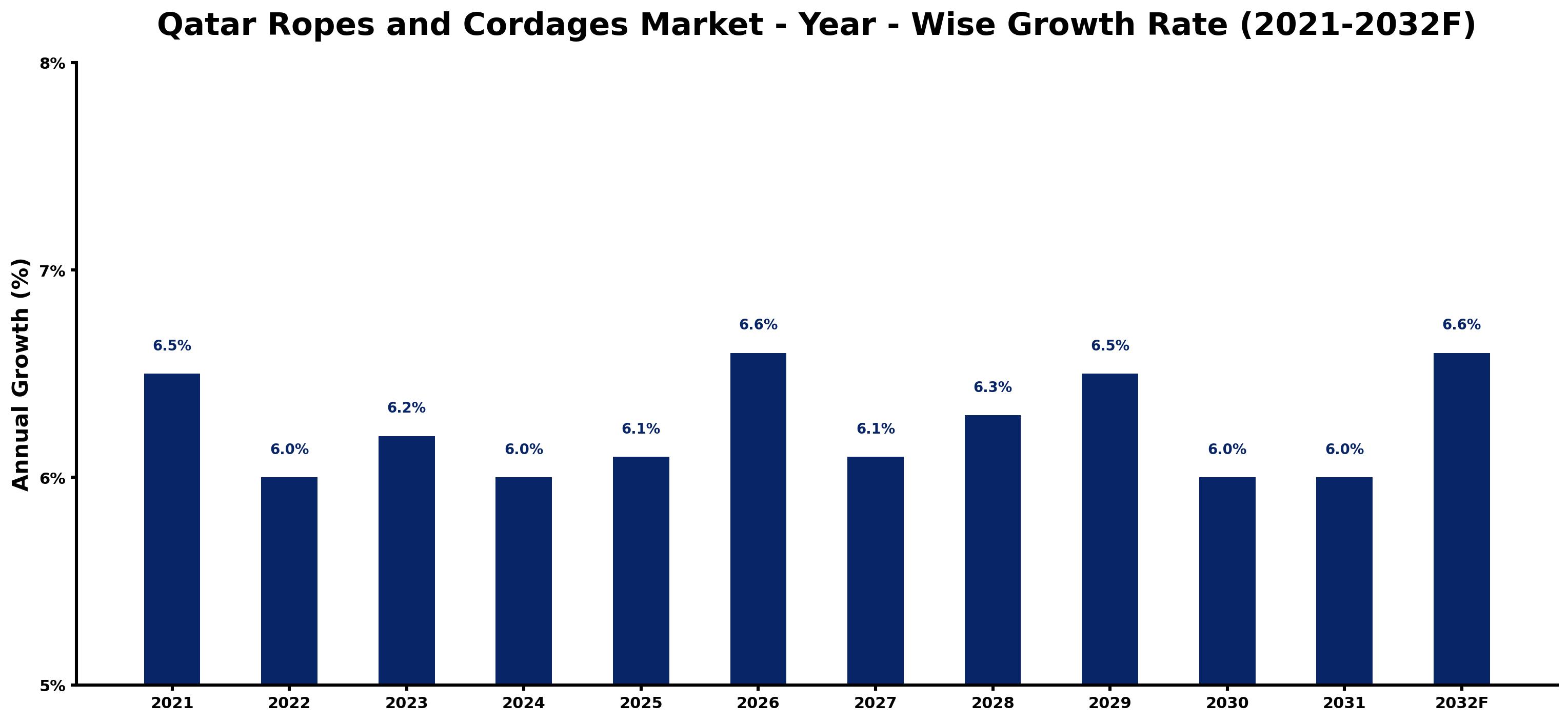
The table below presents the year wise growth rates along with the key drivers influencing the market
| Year | Growth Rate | Major Drivers |
| 2021 | 6.5% | Market presence significantly benefits from Qatar's expanding construction and infrastructure projects. |
| 2022 | 6.0% | New investments in sports and entertainment venues amplify demand for specialized cordages. |
| 2023 | 6.2% | Sustainable material adoption resonates with eco-conscious consumers and industry players alike. |
| 2024 | 6.0% | Integration of advanced materials enhances product performance amidst high-temperature conditions. |
| 2025 | 6.1% | Continued urbanization drives requirements for versatile, durable ropes in various applications. |
| 2026 | 6.6% | Logistical improvements across ports foster increased distribution of cordages in the GCC. |
| 2027 | 6.1% | Collaborations with regional manufacturers promote localized production of high-quality rope products. |
| 2028 | 6.3% | Technological innovations streamline manufacturing, enhancing efficiency in production processes. |
| 2029 | 6.5% | Growing recreational activities fuel demand for ropes in sports and outdoor equipment. |
| 2030 | 6.0% | Competitive pricing strategies emerge as local startups challenge established industry players. |
| 2031 | 6.0% | Emerging markets within Qatar highlight opportunities for specialized cordage applications. |
| 2032 | 6.6% | Rising awareness of safety standards influences procurement decisions across industries. |
Note - Market size estimations and growth projections presented in this report are based on 6Wresearch's advanced forecasting approach, validated with industry datasets as of June 2026.
Qatar Ropes and Cordages Market Synopsis
The Qatar Ropes and Cordages Market is projected to reach 6.6% and witness significant growth during the forecast period (2026-2032). This market has benefitted from a robust increase in demand across various industries, including shipping, construction, and recreational activities. Notably, the expansion of infrastructure projects and maritime trade has been instrumental in fueling this growth, leading to a diverse range of applications for ropes and cordages within Qatar.
Qatar Ropes and Cordages Market Growth Drivers
The drivers influencing the Qatar ropes and cordages market are multifaceted. A primary factor is the surge in infrastructure development initiated by the government, which has created a heightened requirement for durable and reliable rope solutions in construction projects. The construction industry increasingly relies on high-performance ropes for various applications, ranging from lifting to securing materials.
- The burgeoning maritime sector in Qatar has led to an amplified demand for robust ropes designed to withstand the rigors of marine environments.
- Adventure sports are experiencing a renaissance in popularity, with activities like rock climbing and sailing further driving the need for specialized cords and ropes.
- Technological advancements in rope manufacturing have resulted in the production of high-performance products that meet the stringent safety and durability standards required by various industries.
- Increased recreational and professional use of ropes in outdoor activities is contributing to a broader consumer base and heightened awareness of product quality.
- Environmental considerations are influencing the market, with the introduction of eco-friendly materials in rope production aligning with global sustainability trends.
Qatar Ropes and Cordages Market Trends and Opportunities
The Qatar ropes and cordages market is currently undergoing transformative trends that promise new opportunities for growth. The integration of digital technologies in manufacturing processes is creating efficiencies and opening doors for innovative product offerings tailored to specific industry needs. Moreover, cross-industry collaborations, particularly in the construction and maritime sectors, are fostering partnerships that can result in enhanced product development and market penetration.
- The trend towards lightweight yet strong materials is reshaping product designs, making them more appealing to end users who prioritize efficiency and usability.
- Customization in rope production is becoming increasingly popular, enabling manufacturers to cater to specialized applications across different sectors.
- The rise of e-commerce platforms is providing new channels for market access, facilitating the availability of ropes and cordages to a broader audience.
- Health and safety regulations are fueling demand for high-quality materials that ensure reliable performance in critical applications.
- Training and certification programs for cordage handling and safety are becoming more prevalent, promoting best practices and creating a knowledgeable consumer base.
Qatar Ropes and Cordages Market Challenges and Restraints
Despite the positive growth trajectory, the Qatar ropes and cordages market faces several challenges that could impede its expansion. Fluctuations in the prices of raw materials, commonly used in manufacturing ropes, have posed significant hurdles for manufacturers, impacting production costs and profit margins. Additionally, competition from alternative materials, such as synthetic fibers and chains, presents a challenge as these substitutes offer viable solutions for specific applications.
- Raw material price volatility has been a consistent challenge, necessitating more strategic sourcing and cost management for manufacturers.
- The presence of alternative technologies, such as synthetic ropes, has led to increased competition, influencing market pricing and growth strategies.
- Environmental regulations may impose additional compliance costs for manufacturers aiming to produce sustainable products.
- Consumer preferences shifting towards innovative materials may require traditional manufacturers to adapt quickly to remain competitive.
- Market saturation in specific segments could lead to increased price competition, potentially impacting overall profitability.
Qatar Ropes and Cordages Market Government Investment and Initiatives
The Qatari government plays a crucial role in supporting the ropes and cordages market through various initiatives and investment strategies. Public spending on infrastructure development has significantly increased, fostering demand for high-quality ropes and cordages. Additionally, the government's focus on diversifying the economy and promoting sustainable development aligns with the market's evolution towards environmentally-friendly products.
- Initiatives aimed at enhancing the shipping and logistics infrastructure are directly linked to increased demand for robust marine ropes.
- Government funding for adventure sports and recreational facilities is likely to provide new opportunities for cordage applications.
- Investment in technology and innovation is being encouraged to enhance manufacturing processes in the ropes and cordages sector.
- Policies favoring local manufacturing and sourcing are intended to reduce dependency on imported materials, promoting domestic industry growth.
- Collaborative efforts with industry stakeholders are underway to ensure that safety standards in rope usage are maintained and continuously improved.
Qatar Ropes and Cordages Market Latest Developments (May 2025 - June 2026)
Recent months have witnessed notable developments within the Qatar ropes and cordages market. Manufacturers are prioritizing product innovation, focusing on integrating advanced materials to meet the evolving demands of various industries. Moreover, various industry forums have emerged, facilitating the exchange of knowledge and best practices related to the utilization of ropes and cordages. As the market responds to the pandemic's aftermath, there is an increasing emphasis on safety and quality, prompting companies to enhance their offerings in line with contemporary standards.
- Discussions around sustainability have intensified, with companies exploring the use of biodegradable materials in rope production.
- Increased attention on the safety of ropes in construction and maritime applications has led to stricter compliance requirements.
- Marketing strategies are evolving to incorporate digital platforms, expanding reach and accessibility.
- The industry is witnessing a focus on consumer education regarding the performance characteristics of different rope materials.
- Collaborations among stakeholders to optimize supply chains are emerging, aiming to mitigate challenges previously faced due to the pandemic.
Qatar Ropes and Cordages Market - Key Attractiveness of the Report
- 10 Years of Market Numbers
- Historical Data Starting from 2022 to 2025
- Base Year: 2025
- Forecast Data until 2032
- Key Performance Indicators Impacting the Market
- Major Upcoming Developments and Projects
Key Highlights of the Report:
- Qatar Ropes and Cordages Market Outlook
- Market Size of Qatar Ropes and Cordages Market, 2025
- Forecast of Qatar Ropes and Cordages Market, 2032
- Historical Data and Forecast of Qatar Ropes and Cordages Revenues & Volume for the Period 2022-2032F
- Qatar Ropes and Cordages Market Trend Evolution
- Qatar Ropes and Cordages Market Drivers and Challenges
- Qatar Ropes and Cordages Price Trends
- Qatar Ropes and Cordages Porter's Five Forces
- Qatar Ropes and Cordages Industry Life Cycle
- Historical Data and Forecast of Qatar Ropes and Cordages Market Revenues & Volume By Raw Material for the Period 2022-2032F
- Historical Data and Forecast of Qatar Ropes and Cordages Market Revenues & Volume By Natural for the Period 2022-2032F
- Historical Data and Forecast of Qatar Ropes and Cordages Market Revenues & Volume By Synthetic for the Period 2022-2032F
- Historical Data and Forecast of Qatar Ropes and Cordages Market Revenues & Volume By Twist Type for the Period 2022-2032F
- Historical Data and Forecast of Qatar Ropes and Cordages Market Revenues & Volume By Strand Braided Rope for the Period 2022-2032F
- Historical Data and Forecast of Qatar Ropes and Cordages Market Revenues & Volume By Double Braided Rope for the Period 2022-2032F
- Historical Data and Forecast of Qatar Ropes and Cordages Market Revenues & Volume By Turbo Braided Rope for the Period 2022-2032F
- Historical Data and Forecast of Qatar Ropes and Cordages Market Revenues & Volume By End-User Industry for the Period 2022-2032F
- Historical Data and Forecast of Qatar Ropes and Cordages Market Revenues & Volume By Marine & Fishing for the Period 2022-2032F
- Historical Data and Forecast of Qatar Ropes and Cordages Market Revenues & Volume By Packaging for the Period 2022-2032F
- Historical Data and Forecast of Qatar Ropes and Cordages Market Revenues & Volume By Sports & Leisure for the Period 2022-2032F
- Historical Data and Forecast of Qatar Ropes and Cordages Market Revenues & Volume By Oil & Gas for the Period 2022-2032F
- Historical Data and Forecast of Qatar Ropes and Cordages Market Revenues & Volume By Construction for the Period 2022-2032F
- Historical Data and Forecast of Qatar Ropes and Cordages Market Revenues & Volume By Others for the Period 2022-2032F
- Qatar Ropes and Cordages Import Export Trade Statistics
- Market Opportunity Assessment By Raw Material
- Market Opportunity Assessment By Twist Type
- Market Opportunity Assessment By End-User Industry
- Qatar Ropes and Cordages Top Companies Market Share
- Qatar Ropes and Cordages Competitive Benchmarking By Technical and Operational Parameters
- Qatar Ropes and Cordages Company Profiles
- Qatar Ropes and Cordages Key Strategic Recommendations






































