Qatar Seals and gaskets Market Summary
The qatar seals and gaskets market was estimated at USD 451 Million in 2025 and is projected to reach USD 647 Million by 2032, growing at a CAGR of 6.4% from 2026 to 2032.
Qatar Seals and gaskets Market Year-wise Growth Rate and Key Drivers
This graph highlights how the Qatar Seals and gaskets Market has steadily grown over the past five years, supported by major growth factors.
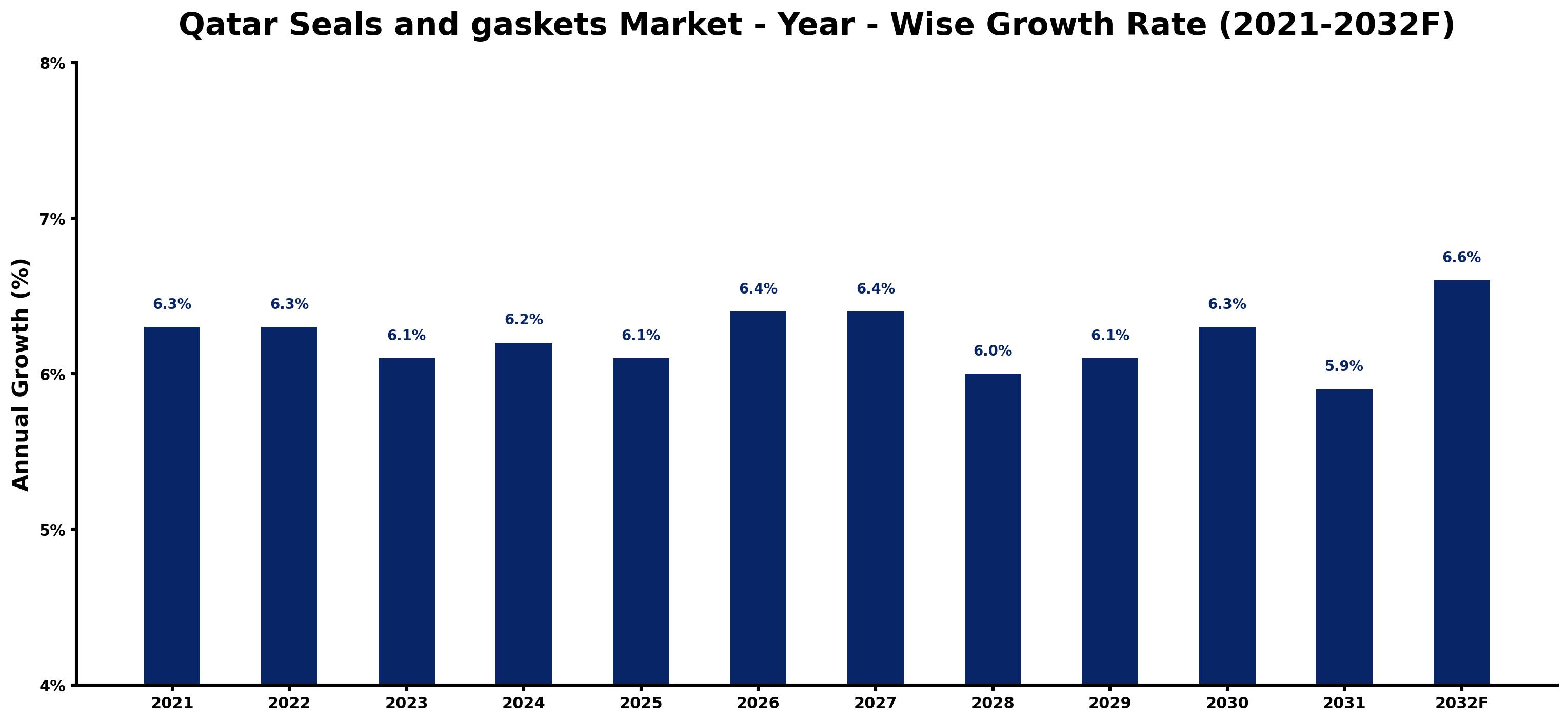
The table below presents the year wise growth rates along with the key drivers influencing the market
| Year | Growth Rate | Major Drivers |
| 2021 | 6.3% | Post-lockdown retail projects initiated more infrastructure investments across various sectors. |
| 2022 | 6.3% | Rising construction activities fueled the need for high-quality sealing solutions in Qatar. |
| 2023 | 6.1% | Increased industrial operations prioritized reliability, enhancing the demand for durable gaskets. |
| 2024 | 6.2% | Regional initiatives for local production are reshaping the supply landscape in Qatar. |
| 2025 | 6.1% | Expansion of oil and gas sectors requires specialized seal technology for demanding environments. |
| 2026 | 6.4% | Technological enhancements in seal manufacturing improve performance and sustainability in various applications. |
| 2027 | 6.4% | Supply chain realignments are influencing sourcing strategies within the sealing products market. |
| 2028 | 6.0% | Growing renewable energy projects demand innovative sealing solutions for harsh conditions. |
| 2029 | 6.1% | Infrastructure advancements in transportation networks elevate sealing requirements for diverse projects. |
| 2030 | 6.3% | Emerging industries necessitate customized gaskets to meet specific operational challenges. |
| 2031 | 5.9% | International partnerships enhance knowledge transfer, improving local manufacturing capabilities in Qatar. |
| 2032 | 6.6% | Market consolidation efforts aim to boost efficiency and streamline distribution channels. |
Note - Market size estimations and growth projections presented in this report are based on 6Wresearch's advanced forecasting approach, validated with industry datasets as of June 2026.
Qatar Seals and gaskets Market Synopsis
The Qatar Seals and gaskets Market is projected to reach 6.4% and witness significant growth during the forecast period (2026-2032). Gaskets and seals play a crucial role across various industries, including automotive, industrial, oil gas, petrochemicals, mining, and power generation. Their primary function is to provide an effective seal between surfaces, preventing leaks and ensuring optimal operation. The selection of materials for these components—such as rubber, metal, foam, or paper—depends on the application and required durability.
Qatar Seals and gaskets Market Growth Drivers
The expansion of the Qatar Seals and gaskets Market can be attributed to several key factors:
- Increasing industrialization is a significant driver, as sectors like oil & gas and petrochemicals ramp up production and require high-quality sealing solutions.
- Government initiatives aimed at diversifying the economy beyond oil have resulted in increased investments in infrastructure, further boosting demand for sealing solutions.
- The rise in energy efficiency awareness among consumers and businesses is leading to a growing emphasis on sealing solutions that minimize leaks and reduce operational costs.
- Technological advancements in seal manufacturing, resulting in precision seals that cater to specialized applications, create new opportunities for vendors.
- The growing mining and power generation sectors in Qatar necessitate reliable seals and gaskets, which contributes to market growth.
Qatar Seals and gaskets Market Challenges and Restraints
Despite its promising outlook, the Qatar Seals and gaskets Market faces several challenges:
- High initial costs associated with acquiring quality seals and gaskets can deter smaller companies and new entrants, limiting market penetration.
- Economic fluctuations and global supply chain disruptions, often affecting availability and pricing, can pose challenges for local manufacturers and suppliers.
- The maintenance and replacement of seals can be an overlooked aspect by operators, affecting the efficiency and reliability of equipment, which may hinder growth.
- Stringent regulatory standards regarding product quality and environmental safety may pose difficulties for manufacturers needing to comply with evolving requirements.
- The competition from lower-cost alternatives in the market may lead to pressure on pricing, affecting profit margins for local manufacturers.
Qatar Seals and gaskets Market Government Investment and Initiatives
The government of Qatar has been proactive in fostering the local industry, which significantly impacts the Qatar Seals and gaskets Market. Various initiatives are in place to promote non-oil sectors through public spending and investment.
Public sector projects, such as infrastructural developments and the establishment of industrial zones, create steady demand for sealing solutions. Additionally, the government supports technology adoption, encouraging manufacturers to innovate and produce advanced sealing products.
Financial incentives for local manufacturers and regulatory frameworks that promote domestic production further bolster the market. The emphasis on sustainability and energy efficiency aligns with global trends, influencing investments in high-quality sealing solutions, which are pivotal for achieving operational excellence.
Qatar Seals and gaskets Market Latest Developments (May 2025 - June 2026)
The Qatar Seals and gaskets Market, during the period from May 2025 to June 2026, has witnessed notable developments that highlight its dynamic nature. An increasing number of infrastructure projects have commenced, leading to heightened demand for reliable sealing solutions. Moreover, collaborations between local firms and international technology providers have improved manufacturing processes, resulting in the introduction of advanced sealing materials.
The focus on sustainability has driven businesses to adopt sealing solutions that enhance energy efficiency, contributing to lower operational costs. Furthermore, challenges stemming from the COVID-19 pandemic are gradually being addressed, with supply chains adapting and recovering to meet the renewed demand.
Qatar Seals and gaskets Market - Key Attractiveness of the Report
- 10 Years of Market Numbers
- Historical Data Starting from 2022 to 2025
- Base Year: 2025
- Forecast Data until 2032
- Key Performance Indicators Impacting the Market
- Major Upcoming Developments and Projects
The oil & gas, petrochemicals, mining, and power generation sectors are the primary industries driving growth in the Qatar Seals and gaskets Market.
Key Highlights of the Report:
- Qatar Seals and gaskets Market Outlook
- Market Size of Qatar Seals and gaskets Market, 2025
- Forecast of Qatar Seals and gaskets Market, 2032
- Historical Data and Forecast of Qatar Seals and gaskets Revenues & Volume for the Period 2022-2032F
- Qatar Seals and gaskets Market Trend Evolution
- Qatar Seals and gaskets Market Drivers and Challenges
- Qatar Seals and gaskets Price Trends
- Qatar Seals and gaskets Porter's Five Forces
- Qatar Seals and gaskets Industry Life Cycle
- Historical Data and Forecast of Qatar Seals and gaskets Market Revenues & Volume By Types for the Period 2022-2032F
- Historical Data and Forecast of Qatar Seals and gaskets Market Revenues & Volume By Gasket for the Period 2022-2032F
- Historical Data and Forecast of Qatar Seals and gaskets Market Revenues & Volume By Seal for the Period 2022-2032F
- Historical Data and Forecast of Qatar Seals and gaskets Market Revenues & Volume By End-users for the Period 2022-2032F
- Historical Data and Forecast of Qatar Seals and gaskets Market Revenues & Volume By Power and Energy for the Period 2022-2032F
- Historical Data and Forecast of Qatar Seals and gaskets Market Revenues & Volume By Industrial and Manufacturing for the Period 2022-2032F
- Historical Data and Forecast of Qatar Seals and gaskets Market Revenues & Volume By Oil and Gas for the Period 2022-2032F
- Historical Data and Forecast of Qatar Seals and gaskets Market Revenues & Volume By Automotive for the Period 2022-2032F
- Historical Data and Forecast of Qatar Seals and gaskets Market Revenues & Volume By Chemical and Petrochemicals for the Period 2022-2032F
- Historical Data and Forecast of Qatar Seals and gaskets Market Revenues & Volume By Others for the Period 2022-2032F
- Qatar Seals and gaskets Import Export Trade Statistics
- Market Opportunity Assessment By Types
- Market Opportunity Assessment By End-users
- Qatar Seals and gaskets Top Companies Market Share
- Qatar Seals and gaskets Competitive Benchmarking By Technical and Operational Parameters
- Qatar Seals and gaskets Company Profiles
- Qatar Seals and gaskets Key Strategic Recommendations






































