Qatar Self-Driving Truck Market Size, Share & Growth Rate
The Qatar Self-Driving Truck Market was estimated at USD 394 Million in 2025 and is projected to reach USD 546 Million by 2032, growing at a CAGR of 4.8% from 2026 to 2032. This growth trajectory is influenced by Qatars strategic push towards modernizing its logistics infrastructure and adopting innovative technologies. The integration of self-driving trucks is seen as pivotal to overcoming regional labor shortages while enhancing operational efficiency and safety within the sector.
Qatar Self-Driving Truck Market Year-wise Growth Rate and Key Drivers
This graph highlights how the Qatar Self-Driving Truck Market has steadily grown over the years, supported by major growth factors.
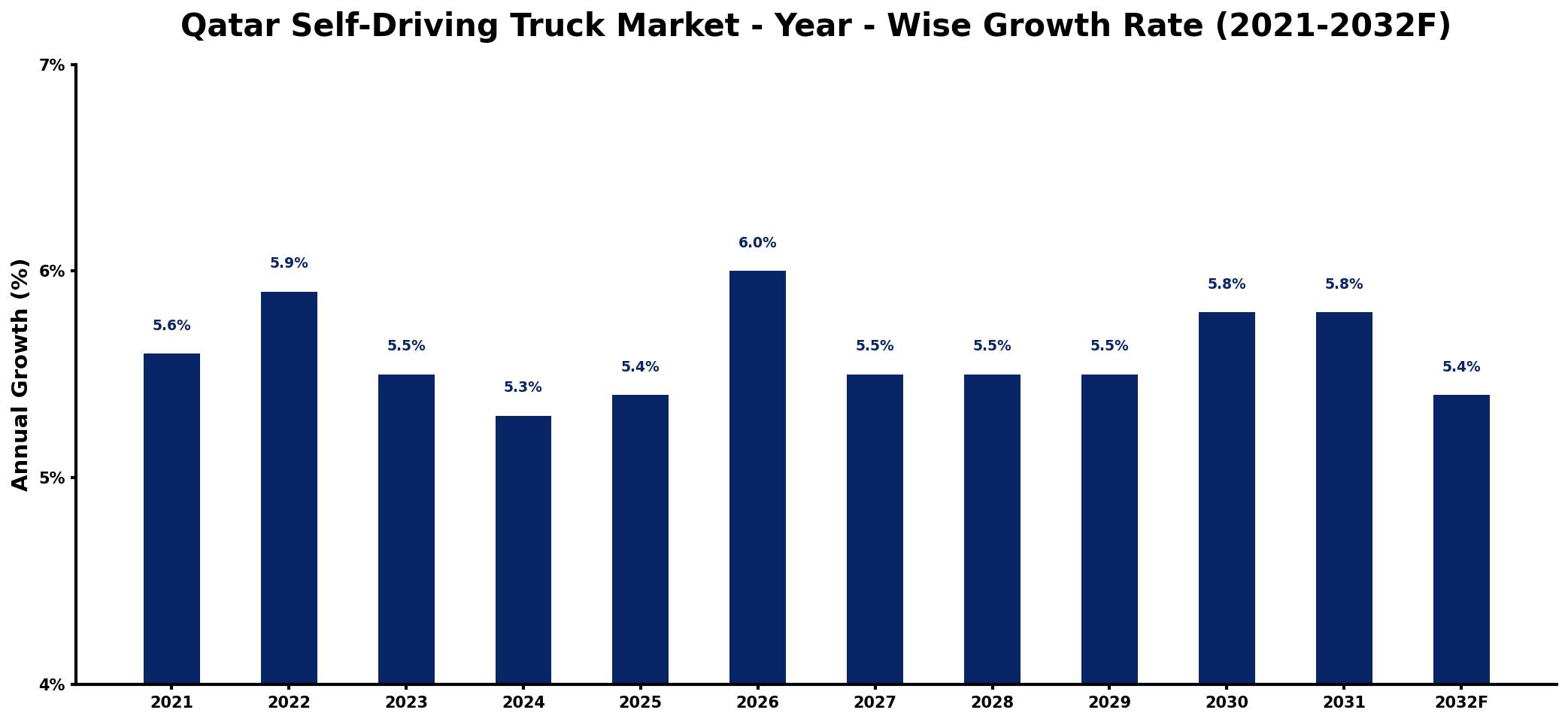
The table below presents the year‑wise growth rates along with the key drivers influencing the market
| Year | Growth Rate | Major Drivers |
| 2021 | 5.6% | Rising demand for logistics automation |
| 2022 | 5.9% | Increased investments in technology integration |
| 2023 | 5.5% | Expansion of smart infrastructure projects |
| 2024 | 5.3% | Growing focus on sustainability initiatives |
| 2025 | 5.4% | Advancements in artificial intelligence applications |
| 2026 | 6.0% | Regulatory support for autonomous vehicles |
| 2027 | 5.5% | Enhanced safety standards in transportation |
| 2028 | 5.5% | Boost in e-commerce delivery services |
| 2029 | 5.5% | improved raw material availability |
| 2030 | 5.8% | Increased public acceptance of automation |
| 2031 | 5.8% | Growth in regional trade partnerships |
| 2032 | 5.4% | Emergence of new logistics startups |
Note: Market size estimations and growth projections presented in this report are based on 6Wresearch's proprietary forecasting methodology, utilizing the latest available industry data, government publications, and primary research inputs.
Qatar Self-Driving Truck Market Synopsis
The demand for self-driving trucks in Qatar is underscored by the logistics sector's rapid expansion, driven by population growth and increased commercial activity. As the country invests heavily in state-of-the-art transportation systems, the adoption of autonomous vehicles is expected to significantly optimize freight operations.
Moreover, the logistical challenges experienced during the COVID-19 pandemic have spurred interest in contactless and efficient transportation solutions. As the sector rebounds, the deployment of autonomous trucks is positioned as a strategic avenue to bolster resilience and adaptability in Qatar's supply chain.
Qatar Self-Driving Truck Market Key Takeaways
- The market is witnessing robust growth due to government support for innovative transportation technologies.
- Self-driving trucks are set to play a crucial role in addressing labor shortages in Qatar's logistics sector.
- Technological advancements are making autonomous trucks increasingly viable for regional logistics.
- Partnerships between tech firms and logistics companies are crucial for accelerating market adoption.
- Regulatory frameworks are evolving to facilitate the safe integration of self-driving vehicles.
Evaluation of Restraints in Qatar Self-Driving Truck Market
Despite the promising outlook, several restraints persist in the Qatar Self-Driving Truck Market. Regulatory hurdles remain a significant concern; existing laws may not adequately address the unique challenges posed by autonomous vehicles. Additionally, safety concerns regarding the reliability of self-driving technology can hinder widespread acceptance. The integration of these vehicles into the established transportation infrastructure also presents a logistical challenge. Until these issues are thoroughly resolved, market expansion may be impeded.
Qatar Self-Driving Truck Market Trends
Several key trends are shaping the self-driving truck market in Qatar. The increasing focus on sustainability is driving interest in autonomous vehicles, as they promise to lower fuel consumption and emissions. Furthermore, advancements in artificial intelligence and machine learning are enhancing the capabilities of self-driving technology, making it more efficient and reliable. Partnerships between technology providers and logistics firms are also becoming more common, facilitating the adoption of self-driving solutions.
Qatar Self-Driving Truck Market Opportunities
There are ample growth and investment opportunities within the Qatar Self-Driving Truck Market. The governments commitment to infrastructure development, particularly in logistics hubs, creates a fertile environment for autonomous trucking solutions. As companies seek to automate operations and reduce costs, investments in self-driving technologies are likely to increase. Additionally, the post-pandemic emphasis on resilient supply chains presents an ideal context for expanding the use of autonomous vehicles.
Government Initiatives in the Qatar Self-Driving Truck Market
The Qatari government is actively promoting the adoption of autonomous vehicles through various initiatives and policies. Public spending on modern transportation infrastructure is increasing, reflecting a commitment to enhancing logistics capabilities. Furthermore, regulatory bodies are working on frameworks that facilitate the testing and deployment of self-driving technologies, ensuring that safety and operational standards are met. These government-led initiatives underscore the strategic importance placed on innovation in the logistics sector.
Future Insights of the Qatar Self-Driving Truck Market
Looking ahead to 2026-2032, the Qatar Self-Driving Truck Market is set to evolve significantly. As technological advancements continue, the capabilities of autonomous vehicles will enhance, leading to broader applications across various logistics functions. The governments ongoing infrastructure projects will further support market growth, while the increasing focus on efficiency and sustainability will catalyze demand for self-driving solutions. The interplay between regulatory developments and technological progress will determine the pace and extent of market adoption.
Qatar Self-Driving Truck Market Latest Developments (2025 - 2026)
Recent developments in the Qatar Self-Driving Truck Market indicate a strong move towards pilot projects involving autonomous vehicles. Companies are increasingly engaging in collaborations with local logistics providers to explore practical applications of this technology. Additionally, there has been a noticeable shift in public sentiment, as awareness campaigns promote the benefits of self-driving trucks, paving the way for a smoother regulatory process. Overall, the landscape is becoming increasingly conducive to the broader implementation of autonomous trucking solutions.
Qatar Self-Driving Truck Market - Key Attractiveness of the Report
- 10 Years of Market Numbers
- Historical Data Starting from 2022 to 2025
- Base Year: 2025
- Forecast Data until 2032
- Key Performance Indicators Impacting the Market
- Major Upcoming Developments and Projects
Key Highlights of the Report:
- Qatar Self-Driving Truck Market Outlook
- Market Size of Qatar Self-Driving Truck Market, 2025
- Forecast of Qatar Self-Driving Truck Market, 2032
- Historical Data and Forecast of Qatar Self-Driving Truck Revenues & Volume for the Period 2022-2032F
- Qatar Self-Driving Truck Market Trend Evolution
- Qatar Self-Driving Truck Market Drivers and Challenges
- Qatar Self-Driving Truck Price Trends
- Qatar Self-Driving Truck Porter's Five Forces
- Qatar Self-Driving Truck Industry Life Cycle
- Historical Data and Forecast of Qatar Self-Driving Truck Market Revenues & Volume By Level Of Autonomy for the Period 2022-2032F
- Historical Data and Forecast of Qatar Self-Driving Truck Market Revenues & Volume By Level One for the Period 2022-2032F
- Historical Data and Forecast of Qatar Self-Driving Truck Market Revenues & Volume By Level Two for the Period 2022-2032F
- Historical Data and Forecast of Qatar Self-Driving Truck Market Revenues & Volume By Level Three for the Period 2022-2032F
- Historical Data and Forecast of Qatar Self-Driving Truck Market Revenues & Volume By Level Four for the Period 2022-2032F
- Historical Data and Forecast of Qatar Self-Driving Truck Market Revenues & Volume By Industry Verticals for the Period 2022-2032F
- Historical Data and Forecast of Qatar Self-Driving Truck Market Revenues & Volume By Logistics for the Period 2022-2032F
- Historical Data and Forecast of Qatar Self-Driving Truck Market Revenues & Volume By Construction & Manufacturing for the Period 2022-2032F
- Historical Data and Forecast of Qatar Self-Driving Truck Market Revenues & Volume By Mining for the Period 2022-2032F
- Historical Data and Forecast of Qatar Self-Driving Truck Market Revenues & Volume By Port for the Period 2022-2032F
- Qatar Self-Driving Truck Import Export Trade Statistics
- Market Opportunity Assessment By Level Of Autonomy
- Market Opportunity Assessment By Industry Verticals
- Qatar Self-Driving Truck Top Companies Market Share
- Qatar Self-Driving Truck Competitive Benchmarking By Technical and Operational Parameters
- Qatar Self-Driving Truck Company Profiles
- Qatar Self-Driving Truck Key Strategic Recommendations






































