Qatar Ship Building and Repairing Market Summary
The qatar ship building and repairing market was estimated at USD 438 Million in 2025 and is projected to reach USD 814 Million by 2032, growing at a CAGR of 10.7% from 2026 to 2032.
Qatar Ship Building and Repairing Market Year-wise Growth Rate and Key Drivers
This graph highlights how the Qatar Ship Building and Repairing Market has steadily grown over the past five years, supported by major growth factors.
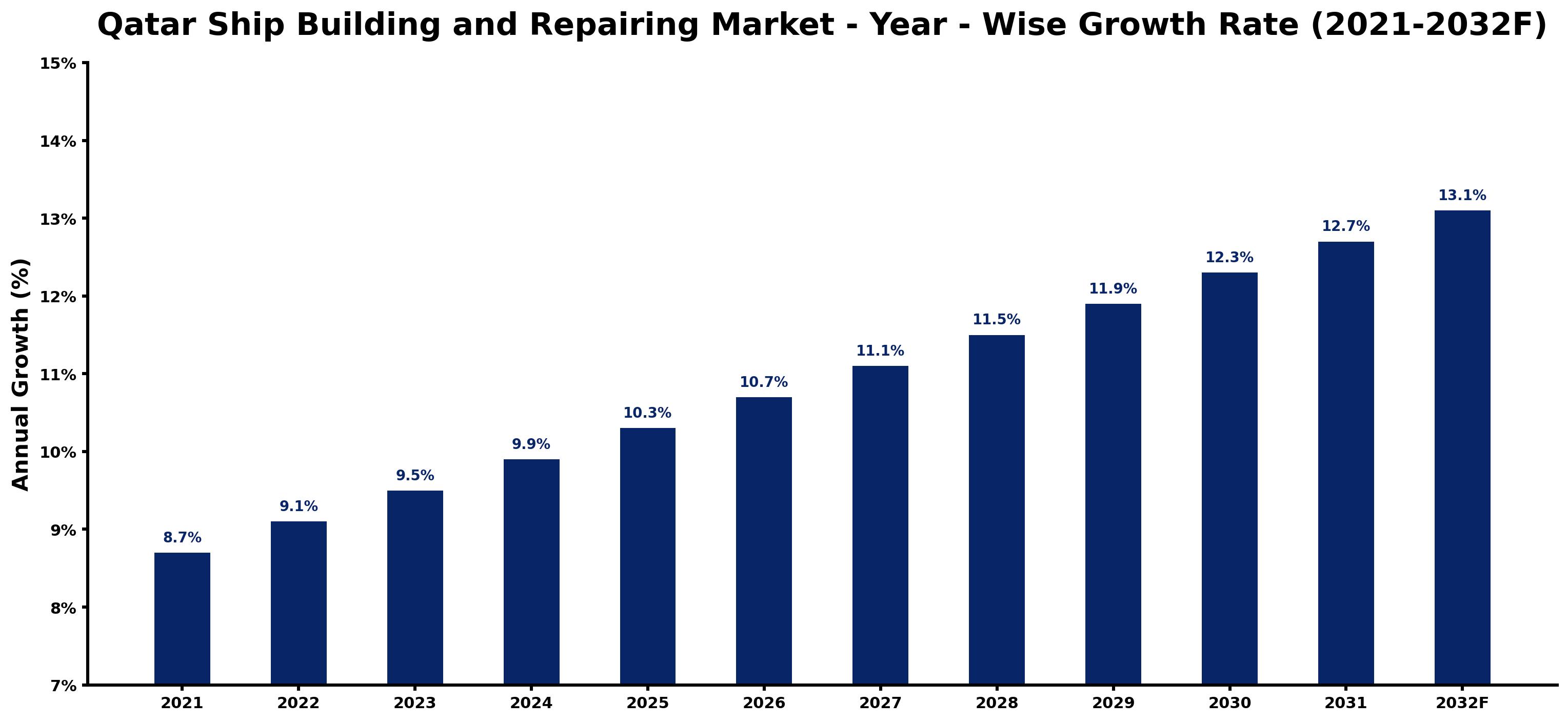
The table below presents the year wise growth rates along with the key drivers influencing the market
| Year | Growth Rate | Major Drivers |
| 2021 | 8.7% | The port expansion projects initiated by Qatari authorities are enhancing infrastructural capabilities. |
| 2022 | 9.1% | Evolving maritime regulations drive a need for modernized shipbuilding practices and technologies. |
| 2023 | 9.5% | High-profile events like the World Cup stimulate short-term demand for marine logistics services. |
| 2024 | 9.9% | Local shipyards increasingly cater to the offshore oil and gas sector's unique requirements. |
| 2025 | 10.3% | Emerging trends in eco-friendly ship designs align with global sustainability discussions. |
| 2026 | 10.7% | Technological partnerships with international firms introduce innovative repair methodologies in shipbuilding. |
| 2027 | 11.1% | Increasing shipping traffic through Qatar necessitates enhanced repair facilities and services. |
| 2028 | 11.5% | The demand for specialized vessels to support regional construction projects gains momentum. |
| 2029 | 11.9% | Investment in maritime education programs leads to a skilled workforce benefiting the industry. |
| 2030 | 12.3% | Local businesses leverage Qatar's strategic location to serve as a regional maritime hub. |
| 2031 | 12.7% | Collaboration between shipbuilders and tech companies fosters advanced automation in operations. |
| 2032 | 13.1% | Shifts in global trade patterns create new opportunities for ship repair and maintenance services. |
Note - Market size estimations and growth projections presented in this report are based on 6Wresearch's advanced forecasting approach, validated with industry datasets as of June 2026.
Qatar Ship Building and Repairing Market Synopsis
The Qatar Ship Building and Repairing Market is projected to reach 10.7% and witness significant growth during the forecast period (2026-2032). This growth can be attributed to several key factors including rising demand for new vessels, advancements in technology within the shipbuilding sector, and increased government initiatives and investments. The resurgence of oil and gas activities in the region further stimulates demand for ships utilized in transportation. Additionally, there is a growing emphasis on refurbishing old vessels to mitigate air pollution caused by emissions from marine fuels, further propelling the market forward.
Qatar Ship Building and Repairing Market Growth Drivers
Several critical drivers are underpinning the growth of the Qatar Ship Building and Repairing Market. Firstly, the global shipping industry is experiencing an upward trajectory, largely due to enhanced delivery capabilities that facilitate international trade.
- The increased velocity of goods delivery has led to a heightened demand for new vessels, creating lucrative opportunities for local players in Qatar.
- Technological advancements have significantly improved the shipbuilding processes, resulting in faster production cycles and enhanced product quality.
- Cost-efficiency in production, driven by modern techniques, is expected to attract further investment in the sector.
- A growing awareness of environmental issues is prompting companies to invest in greener technologies, thereby expanding market opportunities.
- International clients and local operators are increasingly seeking long-term contracts, further demonstrating the market's robust potential.
Qatar Ship Building and Repairing Market Challenges and Restraints
Despite the positive growth outlook, the Qatar Ship Building and Repairing Market faces several challenges that could hinder its expansion. One of the most pressing issues is the shortage of qualified professionals in the sector.
- The lack of skilled labor in design, engineering, manufacturing, and installation could limit the capacity expansion of the industry.
- Inadequate technical knowledge may lead to safety issues, resulting in potential legal complications and substantial fines.
- The growing competition from international markets, especially from cost-effective solutions offered by nations like China, poses a significant challenge to profit margins.
- Fluctuations in the global economy, particularly in trade activities, can significantly impact local demand for shipbuilding and repairing services.
- Market players must also navigate complex regulatory environments which can affect operational efficiency.
Qatar Ship Building and Repairing Market Government Investment and Initiatives
The Qatari government has been proactive in supporting the shipbuilding and repair sector through various investments and initiatives. The government's strategic focus on enhancing maritime infrastructure aims to boost the national economy and create job opportunities.
- Significant investments are being funneled into upgrading current port facilities and constructing new maritime infrastructure to accommodate increased ship traffic.
- Government policies are designed to foster public-private partnerships, encouraging collaboration between local and foreign firms in shipbuilding initiatives.
- Incentives for technological innovations in the maritime sector are being offered to promote environmentally-friendly shipbuilding practices.
- The Qatari government is enhancing regulatory frameworks to ensure safety and environmental standards, which will also support market stability.
- Public spending on research and development in maritime technologies is expected to yield long-term benefits for the industry.
Qatar Ship Building and Repairing Market Latest Developments (May 2025 - June 2026)
The period from May 2025 to June 2026 has seen notable developments in the Qatar Ship Building and Repairing Market. Industry participants have been adapting to the evolving demands of global shipping trends, focusing on technological integration and environmental sustainability.
- Manufacturers are increasingly investing in digital technologies to streamline operations and enhance efficiencies in the shipbuilding process.
- Collaborative ventures with international firms have become more prevalent, allowing for knowledge transfer and access to advanced technologies.
- Regulatory reforms aimed at enhancing safety and environmental compliance have been enacted, establishing a more robust operational framework.
- Some companies are exploring alternative energy sources for ship propulsion, in line with global sustainable practices.
- Market players are also enhancing customer service through digital platforms, providing better communication and service delivery.
Qatar Ship Building and Repairing Market - Key Attractiveness of the Report
- 10 Years of Market Numbers
- Historical Data Starting from 2022 to 2025
- Base Year: 2025
- Forecast Data until 2032
- Key Performance Indicators Impacting the Market
- Major Upcoming Developments and Projects
Key Highlights of the Report:
- Qatar Ship Building and Repairing Market Outlook
- Market Size of Qatar Ship Building and Repairing Market, 2025
- Forecast of Qatar Ship Building and Repairing Market, 2032
- Historical Data and Forecast of Qatar Ship Building and Repairing Revenues & Volume for the Period 2022-2032F
- Qatar Ship Building and Repairing Market Trend Evolution
- Qatar Ship Building and Repairing Market Drivers and Challenges
- Qatar Ship Building and Repairing Price Trends
- Qatar Ship Building and Repairing Porter's Five Forces
- Qatar Ship Building and Repairing Industry Life Cycle
- Historical Data and Forecast of Qatar Ship Building and Repairing Market Revenues & Volume By Type for the Period 2022-2032F
- Historical Data and Forecast of Qatar Ship Building and Repairing Market Revenues & Volume By Ship Building for the Period 2022-2032F
- Historical Data and Forecast of Qatar Ship Building and Repairing Market Revenues & Volume By Ship Repairing for the Period 2022-2032F
- Historical Data and Forecast of Qatar Ship Building and Repairing Market Revenues & Volume By Vessel Types for the Period 2022-2032F
- Historical Data and Forecast of Qatar Ship Building and Repairing Market Revenues & Volume By Oil And Chemical Tankers for the Period 2022-2032F
- Historical Data and Forecast of Qatar Ship Building and Repairing Market Revenues & Volume By Container Ships for the Period 2022-2032F
- Historical Data and Forecast of Qatar Ship Building and Repairing Market Revenues & Volume By Gas Carriers for the Period 2022-2032F
- Historical Data and Forecast of Qatar Ship Building and Repairing Market Revenues & Volume By Offshore Vessels for the Period 2022-2032F
- Historical Data and Forecast of Qatar Ship Building and Repairing Market Revenues & Volume By Passenger Ships And Ferries for the Period 2022-2032F
- Historical Data and Forecast of Qatar Ship Building and Repairing Market Revenues & Volume By Applications for the Period 2022-2032F
- Historical Data and Forecast of Qatar Ship Building and Repairing Market Revenues & Volume By General Services for the Period 2022-2032F
- Historical Data and Forecast of Qatar Ship Building and Repairing Market Revenues & Volume By Dockage for the Period 2022-2032F
- Historical Data and Forecast of Qatar Ship Building and Repairing Market Revenues & Volume By Hull Part for the Period 2022-2032F
- Historical Data and Forecast of Qatar Ship Building and Repairing Market Revenues & Volume By Engine Parts for the Period 2022-2032F
- Historical Data and Forecast of Qatar Ship Building and Repairing Market Revenues & Volume By Electric Works for the Period 2022-2032F
- Historical Data and Forecast of Qatar Ship Building and Repairing Market Revenues & Volume By Auxiliary Services for the Period 2022-2032F
- Qatar Ship Building and Repairing Import Export Trade Statistics
- Market Opportunity Assessment By Type
- Market Opportunity Assessment By Vessel Types
- Market Opportunity Assessment By Applications
- Qatar Ship Building and Repairing Top Companies Market Share
- Qatar Ship Building and Repairing Competitive Benchmarking By Technical and Operational Parameters
- Qatar Ship Building and Repairing Company Profiles
- Qatar Ship Building and Repairing Key Strategic Recommendations






































