Qatar Special Occasions Clothes Market Summary
The qatar special occasions clothes market was estimated at USD 314 Million in 2025 and is projected to reach USD 446 Million by 2032, growing at a CAGR of 6.3% from 2026 to 2032.
Qatar Special Occasions Clothes Market Year-wise Growth Rate and Key Drivers
This graph highlights how the Qatar Special Occasions Clothes Market has steadily grown over the past five years, supported by major growth factors.
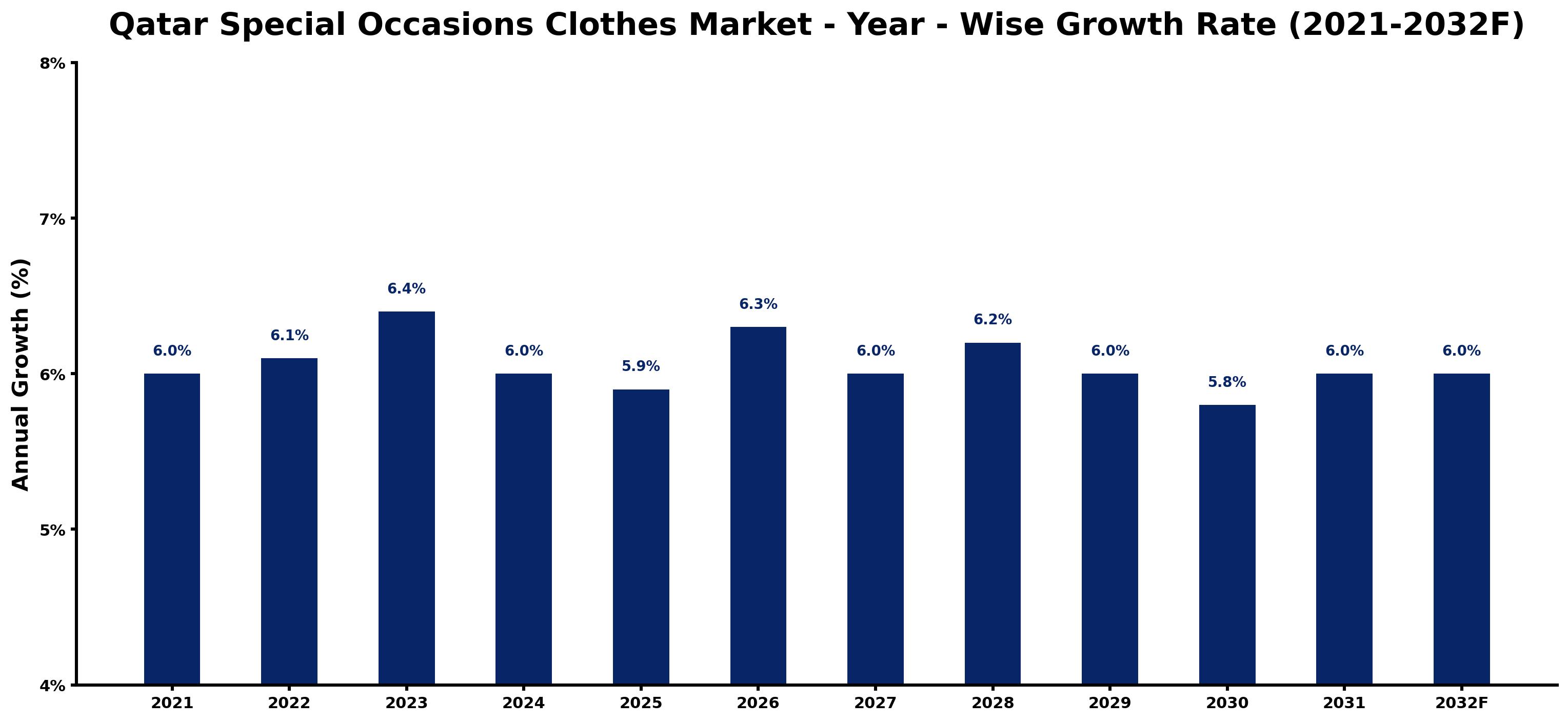
The table below presents the year wise growth rates along with the key drivers influencing the market
| Year | Growth Rate | Major Drivers |
| 2021 | 6.0% | Post-lockdown retail projects showcased unique designs for special occasions in Qatar. |
| 2022 | 6.1% | Increased cultural celebrations promoted demand for traditional and modern attire choices. |
| 2023 | 6.4% | Luxury brands entered the market, targeting affluent consumers seeking exclusive options. |
| 2024 | 6.0% | Expanding expatriate populations influenced customization trends in special occasion clothing. |
| 2025 | 5.9% | E-commerce platforms flourished, enabling wider accessibility to specialized garment choices. |
| 2026 | 6.3% | Festival cycles expanded, creating recurrent spikes in demand for formal wear. |
| 2027 | 6.0% | Sustainability trends prompted brands to innovate eco-friendly materials for garments. |
| 2028 | 6.2% | Regional fashion events gained prominence, showcasing local talent and craftsmanship. |
| 2029 | 6.0% | Consumer preferences shifted towards blending traditional and contemporary fashion styles. |
| 2030 | 5.8% | Collaborations between local designers and international brands enhanced market offerings. |
| 2031 | 6.0% | Technological integration streamlined manufacturing, improving efficiency and reducing costs. |
| 2032 | 6.0% | Personalized shopping experiences became the norm, driven by consumer data insights. |
Note - Market size estimations and growth projections presented in this report are based on 6Wresearch's advanced forecasting approach, validated with industry datasets as of June 2026.
Qatar Special Occasions Clothes Market Synopsis
The Qatar Special Occasions Clothes Market is projected to reach 6.3% and witness significant growth during the forecast period (2026-2032). Qatar's unique cultural significance placed on special occasion clothing reflects its opulent lifestyle and social practices, which further influences market dynamics. The sector is positioned for steady advancement, supported by several prominent factors including rising disposable incomes, population growth, changing social behaviors, and evolving fashion trends. Additionally, enhancements to digital infrastructure are expected to bolster growth opportunities in the coming years.
Qatar Special Occasions Clothes Market Growth Drivers
The growth of the Qatar Special Occasions Clothes Market can be attributed to several critical drivers, each contributing to an environment ripe for expansion:
- Increasing disposable incomes are facilitating a greater willingness among consumers to invest in high-end apparel. The affluent population increasingly seeks intricate designs and luxury fabrics, making high-quality special occasion clothing more accessible.
- Population growth plays a vital role in the demand for special occasion garments. As the demographic landscape of Qatar evolves, a larger customer base will necessitate an increase in clothing options tailored for various celebrations and events.
- Social norms are shifting, with greater acceptance and emphasis on dressing luxuriously for festive occasions such as weddings and national celebrations. This cultural evolution enhances the demand for exclusive garments that reflect individual style and status.
- Fashion trends continue to evolve, blending traditional styles with modern influences. The ability of consumers to express personal identity through their clothing choices drives market vitality.
- Improvements in digital infrastructure enable enhanced retail channels. The rise of e-commerce platforms allows consumers to shop for special occasion clothing conveniently, catering to a tech-savvy demographic increasingly integrated into the digital marketplace.
Qatar Special Occasions Clothes Market Challenges and Restraints
Despite the favorable growth prospects, the Qatar Special Occasions Clothes Market faces several significant challenges that could hinder potential development:
- Intense competition from international fashion brands poses a challenge for local designers and retailers. This influx of global players may overshadow smaller businesses that lack the resources to compete effectively.
- High production and marketing costs are notable barriers to entry. Local businesses may struggle to manage expenses while aiming to provide high-quality apparel at competitive prices.
- The availability of quality fabrics is often limited, requiring local businesses to source materials from abroad. This dependence on external suppliers can lead to inconsistent supply chains and inflated costs.
- Cultural norms around modesty can restrict creative expression within the market. Designers must navigate these cultural sensitivities while striving to innovate and attract diverse clientele.
- The impact of unforeseen events, such as the COVID-19 pandemic, can cause significant disruptions in consumer behavior and spending patterns, necessitating adaptability within the market.
Qatar Special Occasions Clothes Market Government Investment and Initiatives
The Qatari government has actively fostered a conducive environment for the Special Occasions Clothes Market through various initiatives and investments. The focus on cultural heritage and local craftsmanship is evident in public spending, which aims to promote traditional attire and support local artisans. Government policies are geared towards enhancing infrastructure and digital connectivity, thus facilitating a smoother retail experience for consumers and businesses alike. Additionally, incentives for local entrepreneurs encourage innovation in design and the use of sustainable practices, aligning with global sustainability trends. Overall, these initiatives are designed to enhance the market's attractiveness while preserving Qatar's rich cultural identity.
Qatar Special Occasions Clothes Market Latest Developments (May 2025 - June 2026)
Recent developments in the Qatar Special Occasions Clothes Market reflect a dynamic shift toward modernization while maintaining cultural authenticity. The period has seen an increase in collaborations between local designers and international brands, leading to the creation of hybrid styles that appeal to younger consumers. Additionally, digital retail channels have expanded significantly, with many players investing in robust online platforms to enhance customer engagement. Emerging trends in sustainability and ethical fashion have gained traction, prompting several designers to source materials locally and adopt eco-friendly practices. Moreover, there is a growing emphasis on unique, customized offerings tailored to individual preferences, further driving the market forward.
Qatar Special Occasions Clothes Market - Key Attractiveness of the Report
- 10 Years of Market Numbers
- Historical Data Starting from 2022 to 2025
- Base Year: 2025
- Forecast Data until 2032
- Key Performance Indicators Impacting the Market
- Major Upcoming Developments and Projects
Key Highlights of the Report:
- Qatar Special Occasions Clothes Market Outlook
- Market Size of Qatar Special Occasions Clothes Market, 2025
- Forecast of Qatar Special Occasions Clothes Market, 2032
- Historical Data and Forecast of Qatar Special Occasions Clothes Revenues & Volume for the Period 2022-2032F
- Qatar Special Occasions Clothes Market Trend Evolution
- Qatar Special Occasions Clothes Market Drivers and Challenges
- Qatar Special Occasions Clothes Price Trends
- Qatar Special Occasions Clothes Porter's Five Forces
- Qatar Special Occasions Clothes Industry Life Cycle
- Historical Data and Forecast of Qatar Special Occasions Clothes Market Revenues & Volume By Product Type for the Period 2022-2032F
- Historical Data and Forecast of Qatar Special Occasions Clothes Market Revenues & Volume By Gown for the Period 2022-2032F
- Historical Data and Forecast of Qatar Special Occasions Clothes Market Revenues & Volume By Suit/Tuxedo for the Period 2022-2032F
- Historical Data and Forecast of Qatar Special Occasions Clothes Market Revenues & Volume By Traditional Wear for the Period 2022-2032F
- Historical Data and Forecast of Qatar Special Occasions Clothes Market Revenues & Volume By Gender for the Period 2022-2032F
- Historical Data and Forecast of Qatar Special Occasions Clothes Market Revenues & Volume By Male for the Period 2022-2032F
- Historical Data and Forecast of Qatar Special Occasions Clothes Market Revenues & Volume By Female for the Period 2022-2032F
- Historical Data and Forecast of Qatar Special Occasions Clothes Market Revenues & Volume By Distribution Channel for the Period 2022-2032F
- Historical Data and Forecast of Qatar Special Occasions Clothes Market Revenues & Volume By Online for the Period 2022-2032F
- Historical Data and Forecast of Qatar Special Occasions Clothes Market Revenues & Volume By Offline for the Period 2022-2032F
- Qatar Special Occasions Clothes Import Export Trade Statistics
- Market Opportunity Assessment By Product Type
- Market Opportunity Assessment By Gender
- Market Opportunity Assessment By Distribution Channel
- Qatar Special Occasions Clothes Top Companies Market Share
- Qatar Special Occasions Clothes Competitive Benchmarking By Technical and Operational Parameters
- Qatar Special Occasions Clothes Company Profiles
- Qatar Special Occasions Clothes Key Strategic Recommendations






































