Qatar Sports Equipment Market Size, Share & Growth Rate
The Qatar Sports Equipment Market was estimated at USD 369 Million in 2025 and is projected to reach USD 519 Million by 2032, growing at a CAGR of 5.0% from 2026 to 2032. This growth trajectory is fueled by Qatar's robust investments in sports infrastructure, coinciding with the increasing health consciousness among its population. Additionally, the surge in sports tourism, spurred by the country's commitment to hosting international sporting events, significantly elevates demand across all sectors of the market.
Qatar Sports Equipment Market Year-wise Growth Rate and Key Drivers
This graph highlights how the Qatar Sports Equipment Market has steadily grown over the years, supported by major growth factors.
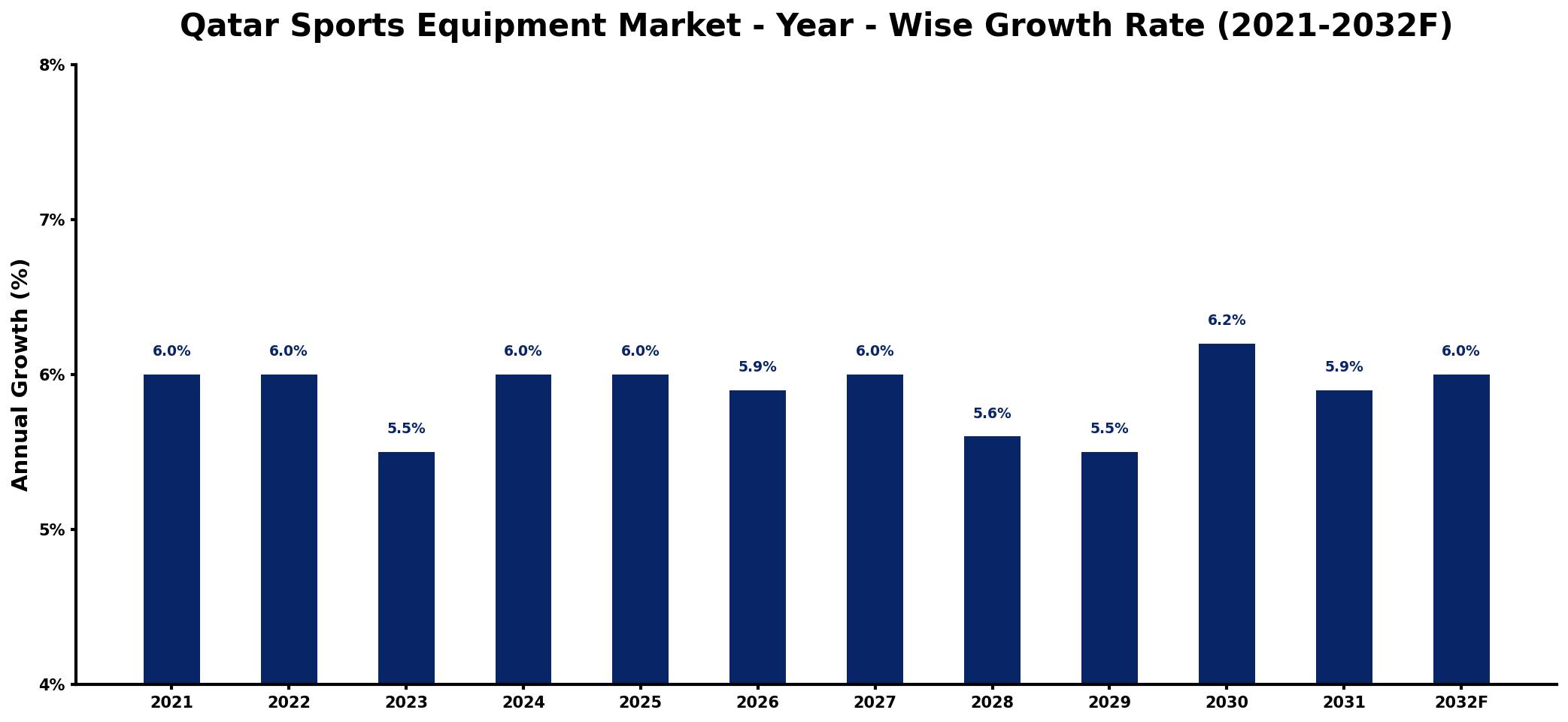
The table below presents the year‑wise growth rates along with the key drivers influencing the market
| Year | Growth Rate | Major Drivers |
| 2021 | 6.0% | increased consumer health awareness |
| 2022 | 6.0% | growing youth participation trends |
| 2023 | 5.5% | rise in fitness lifestyle adoption |
| 2024 | 6.0% | expansion of recreational facilities |
| 2025 | 6.0% | increased sponsorships and endorsements |
| 2026 | 5.9% | growing digital fitness platforms |
| 2027 | 6.0% | expanding manufacturing base activity |
| 2028 | 5.6% | increased government funding initiatives |
| 2029 | 5.5% | rising popularity of fitness events |
| 2030 | 6.2% | growth in wellness tourism sector |
| 2031 | 5.9% | emergence of innovative technologies |
| 2032 | 6.0% | increased focus on sustainability practices |
Note: Market size estimations and growth projections presented in this report are based on 6Wresearch's proprietary forecasting methodology, utilizing the latest available industry data, government publications, and primary research inputs.
Qatar Sports Equipment Market Synopsis
The burgeoning sports culture in Qatar is the strongest force shaping the sports equipment market today. With the country increasingly embracing various sports, there is an expanding demand for equipment across diverse athletic disciplines, from soccer and basketball to swimming and tennis.
Quality, safety, and performance remain paramount in this evolving landscape. As athletes, ranging from novices to professionals, seek high-performance gear, the market responds by diversifying product offerings to cater to the varied interests of Qatari sports enthusiasts.
Qatar Sports Equipment Market Key Takeaways
- The market is on a growth trajectory driven by infrastructure investments and health awareness.
- There is a notable shift towards home fitness equipment post-COVID-19.
- Diversity of sports preferences necessitates a wide-ranging inventory of equipment.
- Government initiatives promote grassroots sports participation, boosting overall market growth.
- COVID-19 has transformed buying habits, with a lasting interest in home fitness solutions.
Evaluation of Restraints in Qatar Sports Equipment Market
The Qatar Sports Equipment Market faces specific restraints linked to its diverse expatriate population, which has varying sports preferences. This diversity complicates inventory management and supply chain logistics, as companies must navigate the demand for a broad spectrum of sports equipment. Additionally, cultural and economic disparities among the population can impact the affordability and accessibility of certain sports, requiring businesses to tailor their strategies to meet the needs of different consumer segments. Adapting to these complexities through targeted market research is vital for sustained success in this dynamic market.
Qatar Sports Equipment Market Trends
Current trends indicate an increased demand for digital solutions in fitness, reflecting a shift towards virtual workouts and online training programs. Furthermore, sustainable products are gaining traction, as consumers become more eco-conscious. The rise of organized sports activities and community-centric fitness events also emphasizes the importance of accessible and high-quality sports equipment.
Qatar Sports Equipment Market Opportunities
As the market evolves, several growth opportunities are emerging. Companies that embrace technological advancements, particularly in digital fitness solutions and e-commerce platforms, will likely thrive. Moreover, targeting grassroots sports initiatives can facilitate community engagement and enhance brand loyalty. The ongoing development of sports tourism in Qatar presents additional avenues for investment, as international events drive demand for premium sports equipment.
Government Initiatives in the Qatar Sports Equipment Market
The Qatari government is actively promoting sports through various initiatives aimed at enhancing participation and fostering a culture of health and fitness. These include funding for sports infrastructure, support for local sports programs, and hosting prestigious international sporting events. Such policies not only stimulate interest in sports but also encourage investment in equipment and facilities, creating a supportive environment for the growth of the sports equipment market.
Future Insights of the Qatar Sports Equipment Market
Looking ahead to 2026-2032, the Qatar Sports Equipment Market is poised for continued expansion. With a focus on community health and increased participation in sports activities, demand for high-quality and diverse sports equipment will persist. The integration of technology in fitness, along with a rising interest in sustainable products, will also shape the future landscape of the market, as consumers increasingly seek innovative solutions that align with their values.
Qatar Sports Equipment Market Latest Developments (2025 - 2026)
Recent developments in the Qatar Sports Equipment Market reflect a significant pivot towards digital engagement, with companies enhancing their online platforms to reach consumers effectively. The ongoing post-pandemic recovery has reignited interest in traditional sports equipment while maintaining a robust demand for home fitness solutions. Additionally, community-based sports programs are gaining momentum, reinforcing the importance of accessibility and inclusivity in sports.
Qatar Sports Equipment Market - Key Attractiveness of the Report
- 10 Years of Market Numbers
- Historical Data Starting from 2022 to 2025
- Base Year: 2025
- Forecast Data until 2032
- Key Performance Indicators Impacting the Market
- Major Upcoming Developments and Projects
Key Highlights of the Report:
- Qatar Sports Equipment Market Outlook
- Market Size of Qatar Sports Equipment Market, 2025
- Forecast of Qatar Sports Equipment Market, 2032
- Historical Data and Forecast of Qatar Sports Equipment Revenues & Volume for the Period 2022-2032F
- Qatar Sports Equipment Market Trend Evolution
- Qatar Sports Equipment Market Drivers and Challenges
- Qatar Sports Equipment Price Trends
- Qatar Sports Equipment Porter's Five Forces
- Qatar Sports Equipment Industry Life Cycle
- Historical Data and Forecast of Qatar Sports Equipment Market Revenues & Volume By Product for the Period 2022-2032F
- Historical Data and Forecast of Qatar Sports Equipment Market Revenues & Volume By Ball over net games for the Period 2022-2032F
- Historical Data and Forecast of Qatar Sports Equipment Market Revenues & Volume By Ball games for the Period 2022-2032F
- Historical Data and Forecast of Qatar Sports Equipment Market Revenues & Volume By Fitness/Strength equipment for the Period 2022-2032F
- Historical Data and Forecast of Qatar Sports Equipment Market Revenues & Volume By Athletic training equipment for the Period 2022-2032F
- Historical Data and Forecast of Qatar Sports Equipment Market Revenues & Volume By Others for the Period 2022-2032F
- Historical Data and Forecast of Qatar Sports Equipment Market Revenues & Volume By Distribution Channel for the Period 2022-2032F
- Historical Data and Forecast of Qatar Sports Equipment Market Revenues & Volume By Online retail for the Period 2022-2032F
- Historical Data and Forecast of Qatar Sports Equipment Market Revenues & Volume By Specialty & sports shops for the Period 2022-2032F
- Historical Data and Forecast of Qatar Sports Equipment Market Revenues & Volume By Department & discount stores for the Period 2022-2032F
- Qatar Sports Equipment Import Export Trade Statistics
- Market Opportunity Assessment By Product
- Market Opportunity Assessment By Distribution Channel
- Qatar Sports Equipment Top Companies Market Share
- Qatar Sports Equipment Competitive Benchmarking By Technical and Operational Parameters
- Qatar Sports Equipment Company Profiles
- Qatar Sports Equipment Key Strategic Recommendations






































