Qatar Stainless Steel Market Size Growth Rate
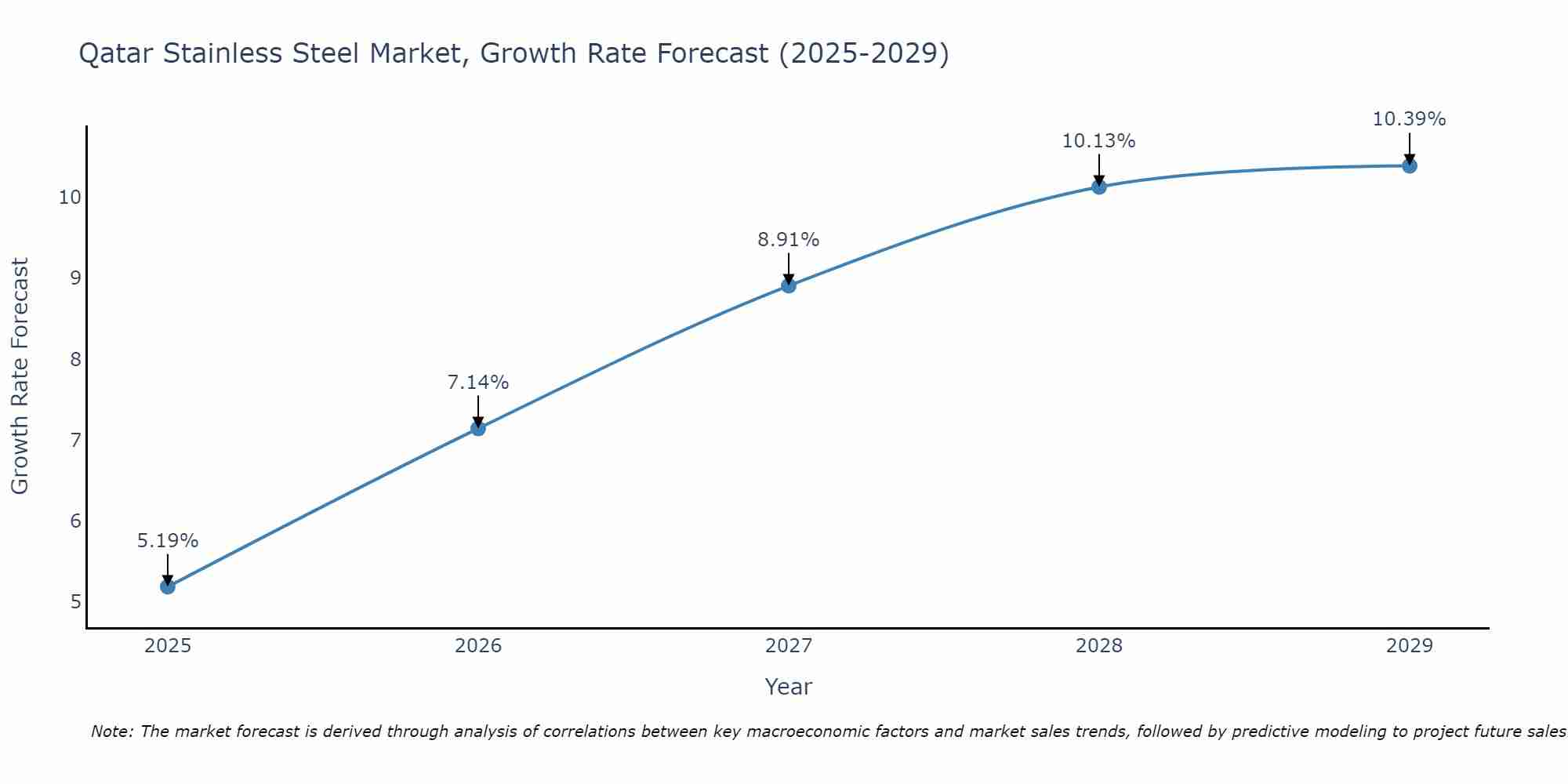
The Qatar Stainless Steel Market is likely to experience consistent growth rate gains over the period 2025 to 2029. From 5.19% in 2025, the growth rate steadily ascends to 10.39% in 2029.
Qatar Stainless Steel Market Synopsis
The stainless steel market in Qatar has witnessed a notable surge in demand owing to its superior corrosion resistance, making it a preferred choice in various critical applications. Industries such as petrochemicals, food processing, and construction have been pivotal in driving the growth of this market. Qatar`s focus on diversification and downstream industries has further propelled the demand for stainless steel. The market is expected to benefit from the continuous expansion of industrial facilities and the growing trend towards sustainable materials. With a favorable economic outlook, the stainless steel market is poised for sustained growth.
Drivers of the Market
The stainless steel market in Qatar is poised for robust growth, underpinned by several compelling factors. Foremost among these is the increasing demand from industries such as construction, automotive, and food processing. Stainless steel`s corrosion resistance, durability, and aesthetic appeal make it a preferred choice in various applications. Qatar`s dynamic construction sector, coupled with the growing automotive market, drives the demand for stainless steel. Additionally, the food processing industry`s strict hygiene standards further bolster the market. Furthermore, advancements in stainless steel manufacturing processes and the development of specialized alloys are expected to expand the range of applications, solidifying stainless steel`s position in the market.
Challenges of the Market
In the Qatar Stainless Steel market, there are several challenges that players must address to maintain sustainable growth. High production costs, primarily due to energy-intensive processes, present a significant challenge for manufacturers. Additionally, the market contends with fluctuations in global nickel and chrome prices, which are critical raw materials for stainless steel production. Moreover, ensuring consistent product quality and meeting stringent international standards demand continuous investment in technology and quality control measures.
COVID-19 Impact on the Market
Stainless steel is a versatile material used in various industries, including construction, manufacturing, and food processing. The COVID-19 pandemic disrupted supply chains and temporarily slowed down the demand for stainless steel in Qatar. The construction sector, which accounts for a significant portion of stainless steel consumption, experienced delays due to the pandemic`s impact on labor and logistics. However, as the nation`s economy recovers and construction projects gain momentum, the stainless steel market is expected to rebound, with sustained demand from various industries.
Key Players in the Market
The stainless steel market in Qatar is witnessing growth driven by the growing demand in the food processing, chemical, and oil and gas industries. Qatar`s stainless steel market is characterized by players such as Qatar Steel Co., Qatar Galvanizing Company, and Qatar Metal Industries.
Key Highlights of the Report:
- Qatar Stainless Steel Market Outlook
- Market Size of Qatar Stainless Steel Market, 2024
- Forecast of Qatar Stainless Steel Market, 2031
- Historical Data and Forecast of Qatar Stainless Steel Revenues & Volume for the Period 2021-2031
- Qatar Stainless Steel Market Trend Evolution
- Qatar Stainless Steel Market Drivers and Challenges
- Qatar Stainless Steel Price Trends
- Qatar Stainless Steel Porter's Five Forces
- Qatar Stainless Steel Industry Life Cycle
- Historical Data and Forecast of Qatar Stainless Steel Market Revenues & Volume By Product for the Period 2021-2031
- Historical Data and Forecast of Qatar Stainless Steel Market Revenues & Volume By Long for the Period 2021-2031
- Historical Data and Forecast of Qatar Stainless Steel Market Revenues & Volume By Flat for the Period 2021-2031
- Historical Data and Forecast of Qatar Stainless Steel Market Revenues & Volume By Application for the Period 2021-2031
- Historical Data and Forecast of Qatar Stainless Steel Market Revenues & Volume By Polish finishing for the Period 2021-2031
- Historical Data and Forecast of Qatar Stainless Steel Market Revenues & Volume By Exhaust system for the Period 2021-2031
- Historical Data and Forecast of Qatar Stainless Steel Market Revenues & Volume By Surgical instrument for the Period 2021-2031
- Historical Data and Forecast of Qatar Stainless Steel Market Revenues & Volume By Others for the Period 2021-2031
- Historical Data and Forecast of Qatar Stainless Steel Market Revenues & Volume By End User for the Period 2021-2031
- Historical Data and Forecast of Qatar Stainless Steel Market Revenues & Volume By Consumer goods for the Period 2021-2031
- Historical Data and Forecast of Qatar Stainless Steel Market Revenues & Volume By Automotive for the Period 2021-2031
- Historical Data and Forecast of Qatar Stainless Steel Market Revenues & Volume By Food & beverage for the Period 2021-2031
- Historical Data and Forecast of Qatar Stainless Steel Market Revenues & Volume By Oil & gas for the Period 2021-2031
- Historical Data and Forecast of Qatar Stainless Steel Market Revenues & Volume By Others for the Period 2021-2031
- Qatar Stainless Steel Import Export Trade Statistics
- Market Opportunity Assessment By Product
- Market Opportunity Assessment By Application
- Market Opportunity Assessment By End User
- Qatar Stainless Steel Top Companies Market Share
- Qatar Stainless Steel Competitive Benchmarking By Technical and Operational Parameters
- Qatar Stainless Steel Company Profiles
- Qatar Stainless Steel Key Strategic Recommendations






































