Qatar Stainless Steel Wire Rods Market Size, Share & Growth Rate
The Qatar Stainless Steel Wire Rods Market was estimated at USD 669 Million in 2025 and is projected to reach USD 1264 Million by 2032, growing at a CAGR of 9.5% from 2026 to 2032. This significant growth is primarily fueled by the expanding industrial sector and a vibrant construction industry, both of which increasingly rely on stainless steel wire rods for their durability and corrosion resistance. As Qatar continues to diversify its economy, the demand for high-quality materials in various applications will remain strong, offering promising opportunities for the market.
Qatar Stainless Steel Wire Rods Market Year-wise Growth Rate and Key Drivers
This graph highlights how the Qatar Stainless Steel Wire Rods Market has steadily grown over the years, supported by major growth factors.
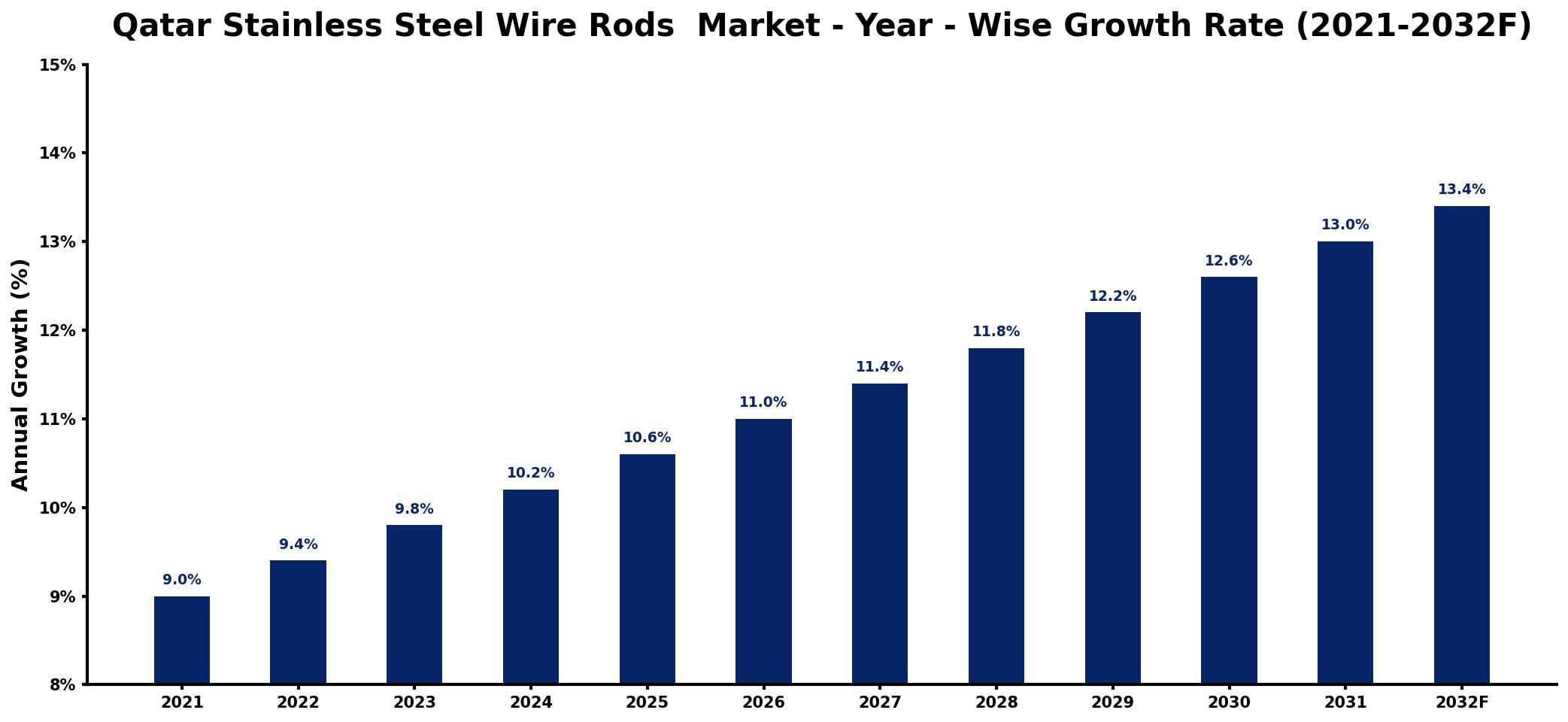
The table below presents the year‑wise growth rates along with the key drivers influencing the market
| Year | Growth Rate | Major Drivers |
| 2021 | 9.0% | Construction sector expansion initiatives |
| 2022 | 9.4% | Increased infrastructure development projects |
| 2023 | 9.8% | Rising demand from manufacturing sector |
| 2024 | 10.2% | Growing energy sector investments |
| 2025 | 10.6% | Boost in automotive industry production |
| 2026 | 11.0% | Surge in construction material needs |
| 2027 | 11.4% | Enhanced urbanization and development plans |
| 2028 | 11.8% | Growing demand from renewable energy |
| 2029 | 12.2% | Increased exports to regional markets |
| 2030 | 12.6% | Expansion of industrial facilities |
| 2031 | 13.0% | Rising consumer goods manufacturing requirements |
| 2032 | 13.4% | Increased government infrastructure spending |
Note: Market size estimations and growth projections presented in this report are based on 6Wresearch's proprietary forecasting methodology, utilizing the latest available industry data, government publications, and primary research inputs.
Qatar Stainless Steel Wire Rods Market Synopsis
The strongest force shaping the Qatar stainless steel wire rods market is the booming construction sector, which is undergoing a remarkable transformation. With numerous high-profile projects underway, including residential and commercial developments, the need for robust and reliable materials is at an all-time high.
Moreover, the industrial landscape is evolving, with advancements in manufacturing techniques leading to greater efficiency and production capacity. This evolution is propelling the demand for stainless steel wire rods across multiple sectors, particularly automotive and aerospace, where high tensile strength and reliability are paramount.
Qatar Stainless Steel Wire Rods Market Key Takeaways
- The market is projected to grow significantly, reaching USD 1264 Million by 2032.
- Key drivers include a strong construction sector and advancements in manufacturing technologies.
- Corrosion resistance and durability of stainless steel wire rods make them indispensable in various industries.
- Qatar's strategic geographic location enhances trade and export opportunities.
- Investments in advanced production techniques are essential to meet stringent quality standards.
Evaluation of Restraints in Qatar Stainless Steel Wire Rods Market
Despite the optimistic growth prospects, the Qatar stainless steel wire rods market faces notable restraints. A significant concern is the reliance on imported scrap metal, which exposes local producers to fluctuating global prices and potential supply chain disruptions. Additionally, stringent quality control measures and compliance with industry standards necessitate continuous investments in testing and certification. This reliance on cutting-edge technology and skilled labor presents further challenges, as maintaining high production quality is essential for sustained market competitiveness.
Qatar Stainless Steel Wire Rods Market Trends
The Qatar stainless steel wire rods market is witnessing several trends that shape its demand dynamics. Increasing adoption of advanced manufacturing technologies is on the rise, which enhances production capabilities and efficiency. Furthermore, the growing emphasis on sustainability is steering industries towards recyclable materials, reinforcing the appeal of stainless steel. Additionally, innovative applications in the automotive and electronics sectors are driving the demand for specialized wire rod products.
Qatar Stainless Steel Wire Rods Market Opportunities
There are substantial opportunities for growth in the Qatar stainless steel wire rods market, particularly within the construction and manufacturing sectors. As infrastructure projects expand, there is an increasing demand for high-quality wire rods. Furthermore, the potential for export markets is significant due to Qatar's favorable geographic location. Investment in advanced production methods could also open avenues for enhanced product offerings, catering to niche markets.
Government Initiatives in the Qatar Stainless Steel Wire Rods Market
The Qatari government is actively promoting initiatives aimed at bolstering the manufacturing sector, including policies that encourage diversification and support for local industries. Public spending on infrastructure projects continues to rise, creating a conducive environment for the stainless steel wire rods market. Various programs and incentives are being introduced to foster innovation and enhance production capabilities within the country.
Future Insights of the Qatar Stainless Steel Wire Rods Market
Looking ahead to 2026-2032, the Qatar stainless steel wire rods market is poised for significant expansion driven by ongoing industrial diversification and rising infrastructure investments. The demand for high-performance wire rods is expected to rise as sectors such as construction and automotive continue to thrive. Additionally, adopting advanced technologies in manufacturing will likely play a critical role in enhancing efficiency and product quality, further solidifying the market's growth trajectory.
Qatar Stainless Steel Wire Rods Market Latest Developments (2025 - 2026)
Recent developments within the Qatar stainless steel wire rods market indicate a strong focus on enhancing production capabilities through technology upgrades and innovation. Several local manufacturers are exploring strategic partnerships to enhance their supply chain resilience. Additionally, there is a growing interest in sustainable practices, prompting industries to explore eco-friendly production methods that align with global standards.
Qatar Stainless Steel Wire Rods Market - Key Attractiveness of the Report
- 10 Years of Market Numbers
- Historical Data Starting from 2022 to 2025
- Base Year: 2025
- Forecast Data until 2032
- Key Performance Indicators Impacting the Market
- Major Upcoming Developments and Projects
Key Highlights of the Report:
- Qatar Stainless Steel Wire Rods Market Outlook
- Market Size of Qatar Stainless Steel Wire Rods Market, 2025
- Forecast of Qatar Stainless Steel Wire Rods Market, 2032
- Historical Data and Forecast of Qatar Stainless Steel Wire Rods Revenues & Volume for the Period 2022-2032F
- Qatar Stainless Steel Wire Rods Market Trend Evolution
- Qatar Stainless Steel Wire Rods Market Drivers and Challenges
- Qatar Stainless Steel Wire Rods Price Trends
- Qatar Stainless Steel Wire Rods Porter's Five Forces
- Qatar Stainless Steel Wire Rods Industry Life Cycle
- Historical Data and Forecast of Qatar Stainless Steel Wire Rods Market Revenues & Volume By Types for the Period 2022-2032F
- Historical Data and Forecast of Qatar Stainless Steel Wire Rods Market Revenues & Volume By 12mm for the Period 2022-2032F
- Historical Data and Forecast of Qatar Stainless Steel Wire Rods Market Revenues & Volume By 10mm for the Period 2022-2032F
- Historical Data and Forecast of Qatar Stainless Steel Wire Rods Market Revenues & Volume By 8mm for the Period 2022-2032F
- Historical Data and Forecast of Qatar Stainless Steel Wire Rods Market Revenues & Volume By 6mm for the Period 2022-2032F
- Historical Data and Forecast of Qatar Stainless Steel Wire Rods Market Revenues & Volume By Others for the Period 2022-2032F
- Historical Data and Forecast of Qatar Stainless Steel Wire Rods Market Revenues & Volume By Applications for the Period 2022-2032F
- Historical Data and Forecast of Qatar Stainless Steel Wire Rods Market Revenues & Volume By Steel Fasteners for the Period 2022-2032F
- Historical Data and Forecast of Qatar Stainless Steel Wire Rods Market Revenues & Volume By Steel Wire for the Period 2022-2032F
- Historical Data and Forecast of Qatar Stainless Steel Wire Rods Market Revenues & Volume By Steel Bright Bars for the Period 2022-2032F
- Historical Data and Forecast of Qatar Stainless Steel Wire Rods Market Revenues & Volume By Others for the Period 2022-2032F
- Qatar Stainless Steel Wire Rods Import Export Trade Statistics
- Market Opportunity Assessment By Types
- Market Opportunity Assessment By Applications
- Qatar Stainless Steel Wire Rods Top Companies Market Share
- Qatar Stainless Steel Wire Rods Competitive Benchmarking By Technical and Operational Parameters
- Qatar Stainless Steel Wire Rods Company Profiles
- Qatar Stainless Steel Wire Rods Key Strategic Recommendations






































